
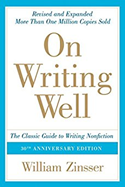
If you trace the life of greatest thinkers you’d find a common thread among them. Almost all of them were great writers too. William Zinsser gives useful and blunt advice about writing better non-fiction.
What differentiates a mediocre investor from a good investor? Knowledge? Knowledge is necessary but not sufficient. The key is having the ability to apply the knowledge wisely. And that ability is a product of how one thinks. If you trace the life of greatest thinkers you’d find a common thread among them. Almost all of them were great writers too.
Writing isn’t merely a tool for expressing one’s thoughts. It’s also a tool to discover new thoughts, structure them, and refine them. All the great thinkers, inventors, scientists, philosophers, communicators I know have vouched that writing and thinking are connected to each other like Siamese twins. Isaac Asimov, the most prolific sci-fi writer of 20th century, wrote more than 400 books. He used to say, “Writing, to me, is simply thinking through my fingers.”
[show_to accesslevel=’almanack-all’] Better writing drives superior thought and vice-versa. Clear thinking becomes clear writing; one can’t exist without the other, writes William Zinsser, in his book On Writing Well. Which means learning to write well is a skill every investor needs in his toolkit. That’s one argument in favour of writing well. In this book, William Zinsser gives useful and blunt advice about writing better non-fiction. Here are few lessons from the book.
Write Regularly
To write well one must first write a lot. Establish a daily schedule for writing and then stick to it. Our minds need to get disciplined in thinking and writing. Enforcing that discipline conditions the mind to focus its energy in one direction. Stephen King, one of the greatest novelist of our time, starts his day by putting down 2000 words on paper every single morning. That’s the minimum that he does to train his mind.
The only way to learn to write is to force yourself to produce a certain number of words on a regular basis. You can become an effective reader by reading more, a great speaker by speaking more, and a good writer by writing more. Regular brushing helps you maintain the oral hygiene and regular writing does it for the mental hygiene.
Quantity leads to quality. To generate great insights, you must spend time thinking and sifting through a lot of mediocre ideas. It’s true for writing too. To produce good writing, you must produce a lot of bad writing. So, write when you feel like writing and write when you don’t feel like writing. Write when you have something to write and write when you don’t have anything to write. Write every day.
Rewrite
The essence of writing is rewriting. This has been the most important revelation for me in last 2 years of writing for Safal Niveshak. If you don’t rewrite then it’s as good as dumping your verbal diarrhoea on to the reader. One aspect that makes writing superior to talk is that you don’t have to worry about holding back. You can’t take back the words that you speak but you can always edit what you write.
One of my favourite authors, Scott Adams, creator of popular comic strip Dilbert, once revealed in an interview that he rewrites the opening sentence in his blog posts at least a dozen times. When you aim to strip every sentence to its cleanest components it helps you dive deeper into the thought behind that sentence. It’s a great way to crystallize thinking.
Writing is hard work. A clear sentence is no accident. Very few sentences come out right the first time, or even the third time…With each rewrite I try to make what I have written tighter, stronger and more precise, eliminating every element that’s not doing useful work. Then I go over it once more, reading it aloud, and am always amazed at how much clutter can still be cut
Professional writers rewrite their sentences over and over and then rewrite what they have rewritten, writes Zinsser. The key to rewriting is to examine every single word. Just like a majority of thoughts in your mind are repetitive and useless, a surprising number of words in your first draft don’t serve any purpose. Modern technology has made writing and editing extremely easy. Gone are the days when you had to struggle with a bunch of pens, a stash of paper and a waste-bin overflowing with crumpled pages.
Constantly Ask: What am I Trying to Say?
While writing, the most important question that one needs to keep asking is – what am I trying to say? And the second important question that a writer should ask once he’s done writing – have I said it?
Every successful piece of nonfiction should leave the reader with one provocative thought that he or she didn’t have before. Not two thoughts, or five – just one.
There’s a common behavioural bias called The Curse of Knowledge. It says that once you know something it’s very difficult to imagine the state of mind when you didn’t know it. Which makes it hard for you to impart that knowledge to someone who doesn’t know it. A similar thing happens when you’re writing. Since the music of what you know is already playing in your head, it’s easy for you to make sense of what you’ve written. But for someone who doesn’t know what you know, you may be leaving out important details. Your assumptions about what the reader knows may not be right.
To overcome Curse of Knowledge, it’s a great idea to ask your friends to read your words. Another trick is to read everything aloud before letting it go out into the world. What your eyes miss, your ears tend to catch it.
Simplify
The secret of good writing is to use simple language. Zinsser quotes an interesting anecdote about US President Franklin Roosevelt when he looked at his own government’s memo for a blackout order in 1942. The memo read – Such preparations shall be made as will completely obscure all Federal buildings and non-Federal buildings occupied by the Federal government during an air raid for any period of time from visibility by reason of internal or external illumination.
“Tell them,” Roosevelt said, “that in buildings where they have to keep the work going to put something across the windows.”
A cluttered writing is a product of a cluttered mind.
Clear thinking becomes clear writing; one can’t exist without the other. It’s impossible for a muddy thinker to write good English. He may get away with it for a paragraph or two, but soon the reader will be lost, and there’s no sin so grave, for the reader will not easily be lured back.
The easiest way to practice simplicity is to write in the first person, writes Zinsser, “Writing is an intimate transaction between two people, conducted on paper, and it will go well to the extent that it retains its humanity. Therefore, I urge people to write in the first person: to use “I” and “me” and “we” and “us.”
Read a Lot
Good writers read a lot. That’s the only way to improve. Read your favourite authors and imitate their style. Mimicking precedes originality. Find the best writers and read their work aloud. Don’t just absorb from eyes, use your ears. Writers who write interestingly keep themselves interested, writes Zinsser. Follow your curiosity. When you follow the trail your curiosity leaves, you find refreshing insights.
Read fiction even if you don’t intend to write fiction. Writing fiction is hard because the writer has to paint a picture for the reader’s imagination. Creating a 3D canvas in someone’s thought screen using only words requires supreme skill. Learn that skill. Build vocabulary, not by memorizing words from the dictionary but by reading more. To master the writing craft, Benjamin Franklin created a copy work-like exercise for himself when he was a teenager. He wrote in his autobiography –
About this time I met with an odd volume of The Spectator – I thought the writing excellent, and wished, if possible, to imitate it. With this view I took some of the papers, and, making short hints of the sentiment in each sentence laid them by a few days, and then, without looking at the book, tried to complete the papers again, by expressing each hinted sentiment at length, and as fully as it had been expressed before, in any suitable words that should come to hand. Then I compared my Spectator with the original, discovered some of my faults, and corrected them.
Surf the Reader’s Attention
There are only two types of writing that people want to read. It should either be useful or it should be entertaining. If you can manage both, you’ve nailed it.
How to write something that’s entertaining? Please yourself, and you will also entertain the readers. Use unexpected but refreshing words. Engage the reader with novelty, or paradox, or humour, or surprise, or probing questions. Human beings find other human being more interesting than inanimate objects. A sentence is a dead sentence if the reader can’t visualize anybody performing some activity. So keep that in mind. Another trick is to leverage the reader’s imagination. Leave out some details for the reader to fill up with his/her own imagination. That’s how you increase the durability of your message.
The following piece of writing brilliantly illustrates how a great writer works with the reader’s attention –
This sentence has five words. Here are five more words. Five-word sentences are fine. But several together become monotonous. Listen to what is happening. The writing is getting boring. The sound of it drones. It’s like a stuck record. The ear demands some variety.
Now listen. I vary the sentence length, and I create music. Music. The writing sings. It has a pleasant rhythm, a lilt, a harmony. I use short sentence. And I use sentences of medium length. And sometimes when I am certain the reader is rested, I will engage him with a sentence of considerable length, a sentence that burns with energy and builds with all the impetus of a crescendo, the roll of drums, the crash of cymbals – sounds that say listen to this, it is important.
So write with a combination of short, medium and long sentences. Create a sound that pleases the reader’s ear. Don’t just write words. Write music.
Conclusion
I started this post with the argument that every investor should learn to write well. However, it’s not just investors who need this skill. I would argue that everyone needs to learn the art of writing well. The modern technology has created a hyperconnected world. More connections result in more communication. Which means, the more we communicate the higher the chances of miscommunication.
Of course, we have the option of talking to anyone anytime but written word remains the predominant way of sharing our ideas with the world. Thus, writing is the fundamental skill that’s becoming increasingly important in the modern world. To communicate effectively through writing isn’t a good to have skill anymore. It’s a must.
To invest well, write well. And to live well, write well.
[/show_to] [hide_from accesslevel=’almanack-all’]- Spotlight: Big ideas from Value Investing and why applying them in your investment decision making will be a great deal
- InvestorInsights: Interviews with experienced value investors, learners, and deep thinkers
- StockTalk: Thorough analysis of business models of companies (without any recommendations)
- Behaviouronomics: Deep analysis of human behaviour and how it impacts investment decision making
- BookWorm: Reviews of the best books on Value Investing and related subjects
- Free Course – Financial Statement Analysis for Smart People (otherwise priced at Rs 5,900)
- Archives: Instant access to our huge archive from the past three years