
In the value investing world, Michael Mauboussin is the foremost authority on business strategy and decision making. Anything he writes is worth reading twice. Although, the book we’re reviewing was written by him a decade ago but it has insights that are timeless for investors.
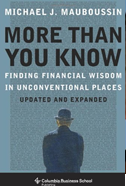
Michael Mauboussin has spent his life studying investment strategies and intricacies of human decision making. He’s a world known expert in one of the most debatable topics in the field of business strategy, i.e., role of luck in defining the success of an individual as well as an organization.
[show_to accesslevel=’almanack-all’]
Apart from being a successful investor, Michael Mauboussin also teaches at Columbia Graduate School of Business. In the previous issues of Value Investing Almanack, we had covered Michael’s another book, i.e., The Success Equation. Our bookworm series would be incomplete without talking about his other books, i.e., More Than You Know and Think Twice. Let’s pick up More Than You Know and reserve Think Twice for another day.
More Than You Know is especially for those who love learning about multidisciplinary ideas and using them for making better investing decisions. As the subtitle suggests – finding financial wisdom in unconventional places – it’s a book packed with insights from various fields of human knowledge.
Here are few ideas from the book.
Bulls, Bears, and Odds
Every investor would agree that one needs to be proven right to make money in the stock market. However, most people don’t intuitively understand that for an investor to be profitable, he doesn’t need to be right all the time. In fact, to be successful, an investor doesn’t even need to be right most of the times. So an investor could lose money in 5 or 6 stocks out of his 10-stock portfolio and still come out ahead. How’s that possible?
Mauboussin:
The frequency of correctness doesn’t matter; it is the magnitude of correctness that matters. Say you own four stocks, and that three of the stocks go down a bit but the fourth rises substantially. The portfolio will perform well even as the majority of the stocks decline.
In other words, what matters more is how much money you made when you were right and how much you lost when you were proven wrong. But most investors equate stock market success with how often they are right.
The most important insight from Daniel Kahneman’s Nobel Prize winning “Prospect Theory” is the idea of human aversion to losses. People exhibit significant aversion to losses when making choices between risky outcomes, writes Mauboussin, “no matter how small the stakes. This behavioural fact means that people are a lot happier when they are right frequently.”
Mauboussin:
What’s interesting is that being right frequently is not necessarily consistent with an investment portfolio that outperforms its benchmark. The percentage of stocks that go up in a portfolio doesn’t determine its performance; it is the dollar change in the portfolio. A few stocks going up or down dramatically will often have a much greater impact on portfolio performance than the batting average.
I can validate this based on my own investing experience. In last seven years, I must have transacted in about 25 different stocks and more than 50 percent of my absolute returns have come from a single stock.
Beware of Tupperware
Tupperware is a direct sales company with an annual revenue of more than $2 billion. It sells kitchen and home products, like containers for storing food items. Historically most of Tupperware’s sales have come through home parties. Talking about Tupperware’s business model, Charlie Munger once said –
[Tupperware] developed what I believe to be a corrupt system of psychological manipulation. But the practice worked and had legs. Tupperware parties sold billions of dollars of merchandise for decades.
Robert Cialdini, in his seminal book Influence, wrote about six powerful human biases which are exploited by persuasion experts. These six tendencies are – Reciprocation, Consistency, Social Validation, Liking, Authority, and Scarcity. These tendencies are singularly powerful, argues Mauboussin, “But when they are invoked in combinations, they are even more potent and create what Charlie Munger calls lollapalooza effects.”
Mauboussin describes how a Tupperware party is the perfect setup to trigger multiple psychological biases and gently nudge people into buying the products.
First is reciprocity. Early in the party, there is a quiz game that allows participants to win play money that they can “spend” on giveaway items. Each participant is also encouraged to share with the group the uses of products she has already purchased – evidence of commitment. Once the buying starts, each transaction demonstrates that others want the product, providing social validation. But perhaps the single most important facet of the Tupperware formula is the tendency to say yes to people you like. The purchase request comes not from a stranger, but rather a friend. Combine these effects, and it’s not hard to see why many people try to avoid going to Tupperware parties in the first place: they know that once they are there, they will buy something.
And it’s not just Tupperware but several other network marketing (or multilevel marketing as they are popularly known) companies like Amway who thrive on these psychological manipulation practices.
The stock market is one large Tupperware party. Unfortunately, unlike a Tupperware party, an investor can’t avoid the stock market. But knowing that you’re in a Tupperware party can surely mitigate the risk to some extent.
Lessons from Ants
Have you ever wondered how a supposedly dumb creature like an ant finds food so efficiently? Ants intuitively employ a strategy called diversity of information. Mauboussin writes –
Foraging ants depart the nest with one job in mind, to find and retrieve food. They also have the ability to leave and follow chemical trails. At first, they disperse randomly. When the ants that find food come back to the nest, they leave a chemical trail that their sisters can follow. Studies show that this process allows ants to consistently find the shortest path to the food.
Now, this is not new information. Most of us already know this trivia about ants. I learned this when I was in 7th grade and even experimented with my domestic (while interfering with their foraging) ants to validate above hypothesis. However, researchers have more resources than a 7th grader, so they set up controlled conditions to fool the ants.
The scientists placed two food sources at identical path lengths from the nest. As it turned out, the ants ended up using just one of the paths, although they chose at random. Why? Because they follow chemical trails, a couple more ants going down one path will attract other ants, triggering a positive feedback loop. So instead of finding an optimal solution, the ants have one crowded path and an equally long empty path.
Just when the scientists were about to pop the Champagne to celebrate their victory over ants, this dumb creature did something unexpected. Mother Nature (which designed this tiny foraging insect over millions of years of trial and error called natural selection) had already anticipated this problem.
As it turns out, ants periodically break from the main path and begin a random search process again. The ants are “programmed” to strike a balance between exploiting a known food source and exploring for the next food source. The ants are hard-wired to seek diversity.
Ants don’t rely on a single source of food. While they are exploiting the one food-source that they have, they don’t stop exploring. But how’s this ant-strategy connected to investment intelligence?
In well-defined systems, experts are useful because they can provide rules-based solutions. But when a system becomes complex, a collection of individuals often solves a problem better than an individual – even an expert. This means that the stock market is likely to be smarter than most people most of the time, a point the empirical facts bear out.
When the diversity of the stock market breaks down, i.e., when herd behaviour becomes more pronounced which usually happens during bull and bear phase, the wisdom of collective can’t be trusted. The key then is diversity of participants.
Just like an ant colony optimizes its foraging capabilities based on ant diversity, a decision-making process becomes more robust when it’s based on diverse information sources.
Investors that have investment approaches, or information sources, that are too narrow risk missing out on the power of diversity. The downside, of course, is that entertaining diverse ideas means sorting through lots of potentially useless input. But on balance diversity seems to enrich the investment performance and the lives of thoughtful investors.
Conclusion
Famous American Biologist, Edward Wilson, once wrote –
A balanced perspective cannot be acquired by studying disciplines in pieces but through pursuit of the consilience among them. To the extent that the gaps between the great branches of learning can be narrowed, diversity and depth of knowledge will increase.
True to Wilson’s ethos, Michael’s book is an invaluable compendium of diverse ideas and it will force you to reflect on your decision-making process.
Let me remind you that a book review – like this one – should not be a replacement for the book itself. My intention here is to merely expose you to few key ideas from the book and arouse sufficient curiosity in your mind. I hope you get your own copy of the book and read it cover to cover.
I usually go by Nassim Taleb’s filter – A book worth reading is worth reading twice. Mauboussin’s book passes this test. Which means you’ll have to read this book more than once to completely grasp the ideas presented.
Keep reading, keep learning!
[/show_to] [hide_from accesslevel=’almanack-all’]- Spotlight: Big ideas from Value Investing and why applying them in your investment decision making will be a great deal
- InvestorInsights: Interviews with experienced value investors, learners, and deep thinkers
- StockTalk: Thorough analysis of business models of companies (without any recommendations)
- Behaviouronomics: Deep analysis of human behaviour and how it impacts investment decision making
- BookWorm: Reviews of the best books on Value Investing and related subjects
- Free Course – Financial Statement Analysis for Smart People (otherwise priced at Rs 5,900)
- Archives: Instant access to our huge archive from the past three years