
Whether you hate numbers or love them, there’s no denying that being in the business of investing you can’t afford being numbers shy. Of course, successful investing doesn’t require you to be a mathematician but having an intuitive feel for numbers goes a long way in making the process of finding great businesses fun and intellectually stimulating.
If you’re reading this I won’t hesitate to make the assumption that you’re a knowledge worker, i.e., someone who gets paid not for the physical labour but for their knowledge and cognitive abilities to turn that know-how into something valuable and useful. And one skill that knowledge workers need the most is the ability to learn quickly and efficiently.
This means you should always be on the lookout to find the best strategies about meta-learning — learning how to learn.
Barbara Oakley teaches an online course Learning How to Learn and it wouldn’t be an overstatement if I say that this course has been the most popular online course in the world for many years.
[show_to accesslevel=’almanack-all’]
And there’s quite a bit of overlap between the online course and the book A Mind for Numbers which is chock-full of tricks and methods to bring structure to how you should approach learning and problem-solving.
So let’s dive into the book.
Focused Mode Vs. Diffuse Mode
We’ve all heard of the anecdote about ancient Greek polymath Archimedes who hit upon a solution to an important problem while he was in the bathtub. The story goes that the young Greek math whiz leapt out of the bath and ran naked on the streets crying “Eureka! Eureka!” (Translation: “I’ve found it! I’ve found it!”)
We’ve all experienced our own Eureka! moments — in the shower, while strolling or doing something completely unrelated to the original problem. Haven’t you?
Well, there’s a scientific explanation for this phenomenon and it can be developed as a conscious and deliberate method to generate fresh insights and unique solutions.
Neuroscientists have discovered that when our brain is engaged in any cognitive task, it usually switches between two states — highly attentive states and more relaxed resting state. Oakley calls them focused mode and diffuse mode.
Focused-mode thinking involves a direct approach to solving problems using rational, sequential, analytical approaches. The focused mode is associated with the concentrating abilities of the brain’s prefrontal cortex, located right behind your forehead. Turn your attention to something and bam – the focused mode is on, like the tight, penetrating beam of light.
Diffuse-mode thinking is also essential for learning math and science. It allows us to suddenly gain a new insight on a problem we’ve been struggling with and is associated with “big-picture” perspectives. Diffuse-mode thinking is what happens when you relax your attention and just let your mind wander. This relaxation can allow different areas of the brain to hook up and return valuable insights. Unlike the focused mode, the diffuse mode seems less affiliated with any one area of the brain—you can think of it as being “diffused” throughout the brain.5 Diffuse-mode insights often flow from preliminary thinking that’s been done in the focused mode.
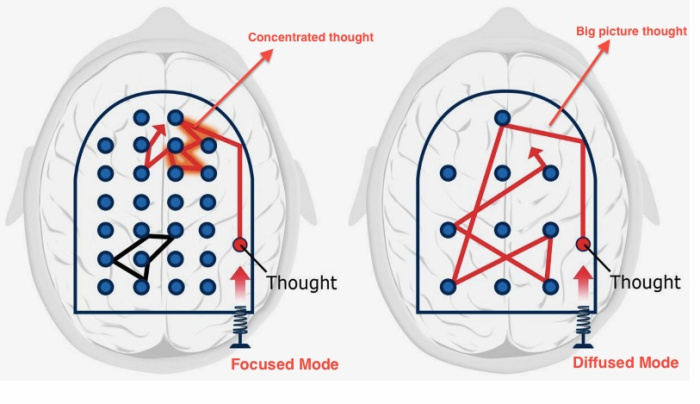 So the trick is to allow your brain to engage in both Focused-mode and Diffuse-mode. Legendary inventor Thomas Edison used this method routinely.
When faced with a difficult problem, instead of focusing intently on it, Edison, according to legend, took a nap. But he did so while sitting in a lounge chair, holding a ball bearing in his hand above a plate on the floor. As he relaxed, his thoughts moved toward free and open diffuse-mode thinking. When Edison fell asleep, the ball bearing fell from his hands. The clatter woke him so he could grasp the fragments of his diffuse-mode thinking to create new approaches.
The Pomodoro Technique
When the brain is challenged to learn something new, it goes through an initial phase of high mental discomfort. Being out of its comfort zone leads to procrastination. We all know that once we get started onto a seemingly difficult task, it gets easier but getting started is often not easy. We find ourselves drifting off to distractions and other less important (but cognitively easy) activities.
Pomodoro is a handy hack to break the procrastination. The idea is to break your work into bite-sized pieces and then work intently, but briefly.
The “Pomodoro” is a technique that’s been developed to help you focus your attention over a short period of time. Pomodoro is Italian for “tomato”—Francesco Cirillo, who originally developed this time-management system in the 1980s, used a tomato-shaped timer. In the Pomodoro technique, you set a timer for twenty-five minutes. Once the timer starts ticking, you’re on the clock. No sneaking off to web surf, chat on the phone, or instant-message your buddies. What’s nice about doing a Pomodoro is that if you’re working around friends or family, you can tell them about the technique. Then, if they happen to interrupt you, all you need to do is mention that you’re “doing a Pomodoro” or “on the clock,” and it gives a friendly reason for them to leave you alone.

You can use your smartphone timer. You can even change the 25-minute to other time duration which works best for you. It has to be long enough for you to make some progress in your work and short enough for your brain to not get overwhelmed. For me, 30-40 minutes works best.
When your timer goes off, you can reward your brain by indulging in non-work related activities for 5-10 minutes — like checking your phone or surfing the web or watching a short entertaining video on youtube. This is important because we want to train our brain — like Pavlov’s dog — to associate the Pomodoro technique with reward centers in your brain. This way, the brain doesn’t revolt while you’re engaged in focused work during the 25-min period.
Spaced Repetition
Memory plays a vital role in learning. To learn something new, you need to commit the fundamentals into your memory. Our brain broadly works with two kinds of memory networks — working memory and long-term memory.
Working memory is the part of memory that has to do with what you are immediately and consciously processing in your mind. You can think of working memory as the mental equivalent of a juggler. Your working memory is important in learning math and science because it’s like your own private mental blackboard where you can jot down a few ideas that you are considering or trying to understand. How do you keep things in working memory? Often it’s through rehearsal; for example, you can repeat a phone number to yourself until you have a chance to write it down.
In contrast, long-term memory might be thought of as a storage warehouse. Once items are in there, they generally stay put. The warehouse is large, with room for billions of items, and it can be easy for stored parcels to get buried so deeply that it’s difficult to retrieve them. Research has shown that when your brain first puts an item of information in long-term memory, you need to revisit it a few times to increase the chances you’ll later be able to find it when you need it. (Techie types sometimes equate short-term memory to random-access memory [RAM], and long-term memory to hard drive space.)
The most popular method to register something to long term memory is to repeat it endlessly. I remember, when I was trying to work on my English vocabulary (preparing for CAT exam), I had a notebook full of new words and I would go through the whole notebook every day. In spite of all the efforts, today I hardly remember 10% of all those words.
New research in this field has discovered that the most efficient and reliable way to commit something to the long term memory is practicing spaced repetition.
…this technique involves repeating what you are trying to retain, like a new vocabulary word or a new problem-solving technique, but spacing this repetition out over a number of days. Research has shown that if you try to glue things into your memory by repeating something twenty times in one evening, for example, it won’t stick nearly as well as it will if you practice it the same number of times over several days or weeks.
One tool that I have found very useful for practicing spaced repetition is Anki. Do check it out.
A Mind for Numbers is not as much about maths as it is about practical advice on how to think better. And for investors, outthinking Mr.Market is a pretty crucial skill to learn if you want to generate alpha over the long term.[/show_to] [hide_from accesslevel=’almanack-all’]
- Spotlight: Big ideas from Value Investing and why applying them in your investment decision making will be a great deal
- InvestorInsights: Interviews with experienced value investors, learners, and deep thinkers
- StockTalk: Thorough analysis of business models of companies (without any recommendations)
- Behaviouronomics: Deep analysis of human behaviour and how it impacts investment decision making
- BookWorm: Reviews of the best books on Value Investing and related subjects
- Free Course – Financial Statement Analysis for Smart People (otherwise priced at Rs 5,900)
- Archives: Instant access to our huge archive from the past three years