
The story of the undisputed merchant king of the late twentieth century. Sam Walton rolled up his sleeves in 1946 and didn’t stop until 1992. What he ended up creating was world’s largest private employer and the biggest company by revenue. In his autobiography, he pours his heart out, chronicling his strategies, successes, and mistakes.
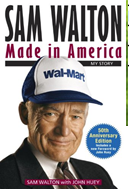
In January 2017, I decided to read more biographies. The year started with Phil Knight’s Shoe Dog and Tony Hsieh’s Delivering Happiness. We covered both in Bookworm section of the earlier issues of Almanack. However, the most remarkable one which I read this year was Sam Walton’s autobiography – Made in America. For those who don’t know, Sam Walton was the founder of multinational discount retail chain — Wal-Mart.
[show_to accesslevel=’almanack-all’]
Walton founded Wal-Mart in 1962. Today it has more than 11,000 stores in 28 countries. Not only that, Wal-Mart is world’s largest company by revenue — approximately US$480 billion according to the Fortune Global 500 list in 2016 — as well as the largest private employer in the world with 2.3 million employees. Wal-Mart’s success has eclipsed almost every other business in the 20th century.
It was a jaw-dropping experience when I first entered a Wal-Mart store in 2005 in U.S. The biggest I had seen before that was Big-Bazaar in India. Today, India is on the verge of massive retail boom and lot of players are trying to ride this rising tide. It’s difficult to predict which player will eventually come out a winner. However, reading the story of Wal-Mart will surely give important clues about what it takes for a business to stay ahead in an industry where cut-throat competition is the norm, i.e., retail sector.
It’s clear that Wal-Mart’s success wasn’t just luck. It was Walton’s energy, integrity and intelligence that transformed his small retail store into the behemoth it is today. He was, as Charlie Munger likes to call, a true intelligent fanatic.
One pattern that sticks out prominently in the Wal-Mart story is that Sam Walton wasn’t afraid to be wrong. The moment he would realize that he had made a mistake, he’d shake off the dust and head in another direction. Agility and quick course correction were his modes of operation.
If I could distil out one thing as the secret sauce of Walton’s success, it would be this: Experimenting. He was always experimenting and quickly discarding ideas that didn’t work and scale the ones that worked.
In the early years of Wal-Mart when it was expanding the operations and opening new stores, Sam Walton used to fly a two-seater plane alone all over the united states scouting for locations. A thousand-foot view from the top can reveal things that aren’t visible when you’re on the ground. Mind you, the google maps and satellite view wasn’t available then. At least not for the commercial purpose. A businessman flying solo was very unusual, but it gave Walton a bigger picture — a tremendous edge — in identifying the right location for the new stores.
There’s no question whatsoever that we could not have done what we did back then if I hadn’t had my airplanes. I bought that first plane for business, to travel between the stores and keep in touch with what was going on. But once we started really rolling out the stores, the airplane turned into a great tool for scouting real estate. We were probably ten years ahead of most other retailers in scouting locations from the air, and we got a lot of great ones that way. From up in the air we could check out traffic flows, see which way cities and towns were growing, and evaluate the location of the competition—if there was any. Then we would develop our real estate strategy for that market.
Here are some of the insights that I picked up from the book.
An Intelligent Fanatic
As a value investor, one of the qualities that you look in the person who’s managing the business is how he thinks about his company’s stock performance. Is he worried about pleasing the investment community or is he focused on running the business? Walton somewhere had the genes of a value investor too.
I guess what’s annoying to executives—to anybody who tries to spend their time managing a company as big as this — is these money managers who’re always churning their investors’ accounts. You know, the stock will get to $40 or $42, and they’ll rush in there and say, “Hey, let’s sell this thing because it’s just too high. It’s an overvalued stock.” Well, to my mind, that doesn’t make much sense. As long as we’re managing our company well, as long as we take care of our people and our customers, keep our eye on those fundamentals, we are going to be successful. Of course, it takes an observing, discerning person to judge those fundamentals for himself. If I were a stockholder of Wal-Mart, or considering becoming one, I’d go into ten Wal-Mart stores and ask the folks working there, “How do you feel? How’s the company treating you?” Their answers would tell me much of what I need to know.
These words are like music to ears for any value investor —
If we fail to live up to somebody’s hypothetical projection for what we should be doing, I don’t care. It may knock our stock back a little, but we’re in it for the long run. We couldn’t care less about what is forecast or what the market says we ought to do. If we listened very seriously to that sort of stuff, we never would have gone into small-town discounting in the first place.
Being Curious
There’s story about how Sam Walton was arrested in Brazil. The cops thought he was a danger to society because they’d found him on his hands and knees measuring the amount of space a store had left in-between the aisles. He wasn’t embarrassed to pounce on any opportunity to learn things which could be implemented in Wal-Mart stores.
In his words – “Most of everything I’ve done I’ve copied from somebody else.”
It was a real blessing for me to be so green and ignorant, because it was from that experience that I learned a lesson which has stuck with me all through the years: you can learn from everybody. I didn’t just learn from reading every retail publication I could get my hands on, I probably learned the most from studying what John Dunham was doing across the street.
Constraints are Good
In one of the interviews, Jack Ma, the founder of Alibaba, said that not having a lot of money, in the beginning, is a good thing. It makes you do things which you would never do if you had all the resources and size. It’s these constraints that give birth to resourcefulness that creates a moat in the long run and helps you scale in a unique way which dumbfounds the competitors.
Walton too agrees —
I can tell you this, though: after a lifetime of swimming upstream, I am convinced that one of the real secrets to Wal-Mart’s phenomenal success has been that very tendency. Many of our best opportunities were created out of necessity. The things that we were forced to learn and do, because we started out underfinanced and undercapitalized in these remote, small communities, contributed mightily to the way we’ve grown as a company. Had we been capitalized, or had we been the offshoot of a large corporation the way I wanted to be, we might not ever have tried the Harrisons or the Rogers or the Springdales and all those other little towns we went into in the early days. It turned out that the first big lesson we learned was that there was much, much more business out there in small-town America than anybody, including me, had ever dreamed of.
In fact, it’s an excellent trick to self-impose artificial constraints. It forces us to spend sufficient time thinking about the problem. Every expense and investment should be questioned and thought through. It’s true for business as well as investing.
We as company have been ahead of most other retailers in investing in sophisticated equipment and technology. The funny thing is, everybody at Wal-Mart knows that I’ve fought all these technology expenditures as hard as I could. All these guys love to talk about how I never wanted any of this technology, and how they had to lay down their life to get it. The truth is, I did want it, I knew we needed it, but I just couldn’t bring myself to say, “Okay, sure, spend what you need.” I always questioned everything. It was important to me to make them think that maybe the technology wasn’t as good as they thought it was, or that maybe it really wasn’t the end-all they promised it would be. It seems to me they try just a little harder and check into things a little bit closer if they think they might have a chance to prove me wrong. If I really hadn’t wanted the technology, I wouldn’t have sprung the money loose to pay for it.
The Myth of Overnight Success
Most overnight success stories are like Chinese bamboo trees. When you sow the seed of Chinese bamboo tree, nothing happens for first five years. But in the sixth year, a tiny sapling breaks out from the earth. And within few weeks the puny plant vaults to a height of ninety feet. What’s not visible is the work that happens underground for the first five years — the bamboo tree grows its roots wide and deep to support its eventual spurt above the ground.
Somehow over the years, folks have gotten the impression that Wal-Mart was something I dreamed up out of the blue as a middle-aged man, and that it was just this great idea that turned into an overnight success. It’s true that I was forty-four when we opened our first Wal-Mart in 1962, but the store was totally an outgrowth of everything we’d been doing since Newport – another case of me being unable to leave well enough alone, another experiment. And like most other overnight success, it was about twenty years in the making
Of course, I needed somebody to run my new store, and I didn’t have much money, so I did something I would do for the rest of my run in the retail business without any shame or embarrassment whatsoever: nose around other people’s stores searching for good talent. That’s when I made my first real hire.
You’d find something similar in the biography of McDonald’s founder Ray Krock. He started McDonalds at the age of fifty-one and scaled his restaurant chain very fast. What people don’t know is a string of business failures that Krock experienced before laying his hands-on McDonalds. McDonalds is world’s best-known brand and rubs shoulder with Wal-Mart.
Insights on Retail Industry
Some industry-specific insights straight from the horse’s mouth —
In retail, you are either operations driven—where your main thrust is toward reducing expenses and improving efficiency — or you are merchandise driven. The ones that are truly merchandise driven can always work on improving operations. But the ones that are operations driven tend to level off and begin to deteriorate. So, Sam’s item promotion mania is a great game and we all have a lot of fun with it, but it is also at the heart of what creates our extraordinary high sales per square foot, which enable us to dominate our competition.
Wal-Mart spread its stores in a clustered fashion. Like a small circle becomes bigger by increasing its radius. This approach ensured profitability by minimizing the distribution cost because of a centralized warehouse which was equidistant from all the stores it served.
But while the big guys were leapfrogging from large city to large city, they became so spread out and so involved in real estate and zoning laws and city politics that they left huge pockets of business out there for us. Our growth strategy was born out of necessity, but at least we recognized it as a strategy pretty early on. We figured we had to build our stores so that our distribution centers, or warehouses, could take care of them, but also so those stores could be controlled. We wanted them within reach of our district managers, and of ourselves here in Bentonville, so we could get out there and look after them.
Each store had to be within a day’s drive of a distribution center. So we would go as far as we could from a warehouse and put in a store. Then we would fill in the map of that territory, state by state, county seat by county seat, until we had saturated that market area.
You’d see something similar happening in case of some of the Indian retail operators like D-Mart and VMart. Both have learnt this from Wal-Mart. It’s good to know people are cloning the strategies of a guy who is known as the biggest cloner of ideas.
The book gives a vibe of intense passion. Although Walton wrote the book during his final years of life when he was fighting a losing battle with blood cancer, you can feel the energy exuberating from Walton’s words. In 1992, Sam Walton was honoured with Presidential Medal of Freedom, United States’ highest civilian honor. He passed away two weeks after receiving the honor.
[/show_to] [hide_from accesslevel=’almanack-all’]- Spotlight: Big ideas from Value Investing and why applying them in your investment decision making will be a great deal
- InvestorInsights: Interviews with experienced value investors, learners, and deep thinkers
- StockTalk: Thorough analysis of business models of companies (without any recommendations)
- Behaviouronomics: Deep analysis of human behaviour and how it impacts investment decision making
- BookWorm: Reviews of the best books on Value Investing and related subjects
- Free Course – Financial Statement Analysis for Smart People (otherwise priced at Rs 5,900)
- Archives: Instant access to our huge archive from the past three years