
Dilbert’s creator tells you that passion is overrated and luck can be manipulated. In his signature style, humourous and incisive, Adams delivers loads of practical ideas to attract the attention of lady fortuna.
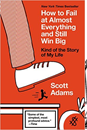 If you don’t know who Scott Adams is, odds are high that you would give a pass to a book with such a cheesy and hackneyed title. But if you did that it would be a big mistake. Scott’s book is one of my all-time personal favorites and I can vouch for the tremendous utility of his methods.
For the uninitiated, Scott Adams is the creator of Dilbert, one of the most popular and widely distributed comic strips of the past century. He has been a full-time cartoonist since 1995, after sixteen years as a technology worker for companies like Crocker National Bank and Pacific Bell. Apart from being a cartoonist, he has written many bestselling books and is sought after speaker in corporate circles.
The title of the book is intriguing and Scott claims that he has at least failed in 36 different businesses. But in the process of failing he kept accumulating useful knowledge and skills about business, marketing, product, customers etc.
[show_to accesslevel=’almanack-all’]
Based on his personal experience he has charted a template for success which, according to him, will not guarantee success but definitely increase your odds.
This is a story of one person’s unlikely success within the context of scores of embarrassing failures…Was my eventual success primarily a result of talent, luck, hard work, or an accidental just-right balance of each? All I know for sure is that I pursued a conscious strategy of managing my opportunities in a way that would make it easier for luck to find me. Did my strategy make a difference, or is luck just luck, and everything else is just rationalization? Honestly, I don’t know. That’s why I suggest you compare my story with the stories of other people who found success and see if you notice any patterns.
That’s the kind of honest confession I look for from anyone whose advice I am willing to take. Let me now discuss some of the big ideas from this book.
Work with Systems Not Goals
About 50-100 years ago the nature of work which most people did was pretty simple. It didn’t change much over their lifetimes. In this scenario it made sense to set goals about how much to accomplish every day or every month. But the element of complexity in our work and environment has increased enormously today.
According to Scott, attempting to chase goals in this complex environment is akin to a man who is on galloping
horse, holding a bow and arrow trying to shoot a moving target that is somewhere in the forest covered with dense fog. It’s just too difficult and unpredictable.
Problem is that with lots of people on horses shooting lots of arrows, some are going to hit the target invariably. They go and write the books on how to set goals which mislead people into thinking that setting goals is a successful strategy.
So what’s better than goals?
A system. Scott defines a ‘system’ as something which you do on a regular basis, that improves your odds (not in a way that it has a specific goal attached to it). In other words, your chances of success are better but you don’t know the exact direction from where the success will come. A system ensures that your personal value is increasing even though your projects are failing miserably.
Walking every day for 2 km is a goal, however putting on your walking shoes and just stepping outside the house is a system. Somedays you may hit the goal of 2 km, some days you may just stroll for 5 minutes and come back.
Following your system is easier and doesn’t require much willpower. Very soon the system installs the new habit and you find yourself following the healthy routine effortlessly.
This strategy relates very well with investing too. Element of luck and uncertainty are invariable components of stock market investing. Buying undervalued and quality companies and holding them for long term is a system. Whereas buying a stock and expecting it to go up by 20% next year is a goal.
The key insight here is to keep following a system while upgrading yourself through your failures.
Scott suggests that there are certain basic skills that everybody should have to increase their chances of success. Skills like public speaking, business writing, accounting, persuasion, design basics, grammar, technology and conversation skills. You need to systematically become good at these types of skills that work well together. You have better chances by being good at two complementary skills than being excellent at one. He writes –
I’m a perfect example of the power of leveraging multiple mediocre skills. I’m rich and famous cartoonist who doesn’t draw well. At social gatherings I’m usually not the funniest person in the room…none of my skills are world-class…but when my mediocre skills (meagre business skills and fairly ordinary writing talent) are combined, they become a powerful market force…With each new skill, my odds of success increased substantially
That’s a powerful strategy. Isolated ideas and skills aren’t much useful until you find a way to combine them, layer one over other, find connections, and synergies, and build something useful. Using this strategy Scott created the Dilbert empire which runs in more than 2,000 newspapers and 65 different countries.
Passion is Overrated
Scott’s insights on the matter of passion are very interesting and unconventional. He writes …
You would often hear advice from successful people that you should “follow your passion.” Passion will presumably give you high energy, high resistance to rejection, and high determination…My hypothesis is that passionate people are more likely to take big risks in the pursuit of unlikely goals, and so you would expect to see more failures and more huge success among the passionate. Passionate people who fail don’t get a chance to offer their advice to the rest of us. But successful passionate people are writing books and answering interviews questions about their secret for success every day…Passion sounds more accessible…[But] it’s easy to be passionate about things that are working out, and that distorts our impression of the importance of passion.
If you’re passionate about a project to begin with and it doesn’t go anywhere for long time, your passion might soon dissipate and evolve into annoyance and frustration. Whereas any small hobby that meets an early success can generate more passion inside you which can go in positive feedback loop and become a hugely successful endeavour.
So it’s the success that causes passion rather than passion causing success. Scott concludes …
So forget about passion when you’re planning your path to success…I’ll describe some methods for boosting personal energy that have worked for me. You already know that when your energy is right you perform better at everything you do including school, work, sports, and even your personal life. Energy is good. Passion is bullshit.
Sure there are people who are born with natural talent at some activities and then passionately devote their lives to pursuing them. But that’s true for a very small set of people. Most people don’t have any such talents so what are they supposed to do until they find their passion or ‘the calling’?
The aim should be to maximize one’s personal energy, which means eating right, exercising, avoiding stress, getting enough sleep and having something in life that makes you excited to wake up every morning.
Luck Can Be Manipulated
Luck is the giant elephant in the room which most people are uncomfortable talking about as it relates to success.
Getting lucky is like being struck by lightning. Can you willingly get struck by lightning? Perhaps no. But what if you go outdoor especially during thunderstorm, and climb on a mountain wearing a metal cap with lightning rods on it? Your odds are much better that way.
Same is with the luck. You can’t control the odds but you can go where the odds are better. People who seem to have good luck are often the people who have a system that allows luck to find them. Scott writes –
A big part of my system involves generating lots of opportunities for luck to find me and taking the sort of risks that will allow me to come out ahead even if the project fails.
Understanding Psychology Matters
It’s hard to imagine any business or social activity”, says Scott, “that doesn’t require a basic understanding of how human brain perceives the world. Psychology is embedded in everything we do. Psychology was a huge factor in my eventual success with Dilbert. It’s a good idea to make psychology your lifelong study.
By understanding the human behavioural quirks and cognitive biases you can make your product and yourself more attractive and useful to others.
As per Scott, on a scale of one to ten, the importance of understanding psychology is a solid ten.
Conclusion
Scott’s book is full of refreshing insights on ways to think about the process of finding happiness and success. He concludes the book thus –
..always remember that failure is your friend. It is the raw material of success. Invite it in. Learn from it. And don’t let it leave until you pick its pocket. That’s a system.
I have read this book three times so far and found something new and useful every time. It’s unlike any other self-help book and doesn’t bore you with a complicated preaching.
Scott, being a cartoonist, has a way for delivering maximum value with minimum words and that too with loads of humor. I have resolved to read this book at least once every year to keep pounding the all-important concepts on my head.
I hope you will also find this book immensely useful and life changing.
[/show_to] [hide_from accesslevel=’almanack-all’]- Spotlight: Big ideas from Value Investing and why applying them in your investment decision making will be a great deal
- InvestorInsights: Interviews with experienced value investors, learners, and deep thinkers
- StockTalk: Thorough analysis of business models of companies (without any recommendations)
- Behaviouronomics: Deep analysis of human behaviour and how it impacts investment decision making
- BookWorm: Reviews of the best books on Value Investing and related subjects
- Free Course – Financial Statement Analysis for Smart People (otherwise priced at Rs 5,900)
- Archives: Instant access to our huge archive from the past three years