
Yuval Harari is arguably the most influential thinker and writer of this century. His books will make you think in ways you haven’t thought before. Harari brings remarkably original ideas gift wrapped in a captivating style of expression. In Sapiens, Harari showed us where we came from. In Homo Deus, he shows us where we’re going.
Yuval Harari’s first book, Sapiens, turned my world upside down. Technically, it was a book on human history but the insights were anything but ancient. It was jaw dropping from the first word to the last. Sapiens ranks among the five best books that I have read, ever!
[show_to accesslevel=’almanack-all’]
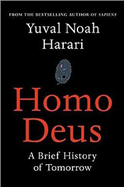
Where Sapiens swept the cobwebs out of my brain, Home Deus marinated my grey cells with an intoxicating brew of science, philosophy, and futurism. In Sapiens, Harari explained how homo sapiens came to be the planet’s dominant species. In Home Deus, he examines the new religion called Humanism – a creed which rests on the notion of individual choice and worship of the individual. However, the most exciting part of the book is where Harari intelligently speculates on the future of humankind. He argues that science and technology will eventually make humans subservient to computer algorithms.
Let’s dive deeper into some of the ideas from Homo Deus.
The Human Agenda
To figure out where the human race is heading, it would require us to imagine the goals that would occupy mankind’s mind in future. And to know what projects will interest us going forward, we need to understand the major problems that have kept humans busy in last few centuries.
For thousands of years, writes Harari, “the same three problems preoccupied the people of twentieth-century China, of medieval India and of ancient Egypt. Famine, plague and war were always at the top of the list. Generation after generation humans continued to die in their millions from starvation, epidemics and violence.”
For example, in France between 1692 and 1694, famine killed 15 percent of the population (that’s about 2.5 million people). The infamous Black Death pandemic killed between 75 and 200 million in Eurasia in the 1330s. And in ancient agricultural societies, human violence caused about 15 percent of all deaths.
Today, man has tamed these three problems to a large extent. In the 21st century, sugar possesses a bigger threat than the gunpowder. For the first time in history, argues Yuval, “more people die from old age than from infectious diseases; and more people commit suicide than are killed by soldiers, terrorists and criminals combined.”
So what projects will replace famine, plague and war at the top of human agenda in the twenty-first century? Harari speculates that humanity’s next targets are likely to be immortality, happiness and divinity.
Having reduced mortality from starvation, disease and violence, we will now aim to overcome old age and even death itself. Having saved people from abject misery, we will now aim to make them positively happy. And having raised humanity above the beastly level of survival struggles, we will now aim to upgrade humans into gods, and turn Homo sapiens into Homo Deus.
The Paradox of Knowledge
What are the chances that the prediction of an Israeli historian will come true?
In the 19th century, Karl Marx predicted the collapse of the capitalist system. But capitalists took Marx’s warning seriously and embraced many of the tools and insights of Marxist analysis. As people adopted Marxist diagnosis, they changed their behaviour accordingly and Marx’s prediction never materialized, precisely because people took him seriously and acted on it.
This is the paradox of historical knowledge. Knowledge that does not change behaviour is useless. But knowledge that changes behaviour quickly loses its relevance. The more data we have and the better we understand history, the faster history alters its course, and the faster our knowledge becomes outdated.
The probability of Harari’s prediction coming true depends on how many people ( and how seriously) act on his insights. So rather than looking at the prophecies made in this book as a measure of future, they should be used for discussing the present-day dilemmas and change the future.
Harari on the importance of studying history:
If history doesn’t follow any stable rules, and if we cannot predict its future course, why study it? …the study of history aims above all to make us aware of possibilities we don’t normally consider. Historians study the past not in order to repeat it, but in order to be liberated from it…Studying history aims to loosen the grip of the past. It enables us to turn our head this way and that, and begin to notice possibilities that our ancestors could not imagine, or didn’t want us to imagine. By observing the accidental chain of events that led us here, we realise how our very thoughts and dreams took shape – and we can begin to think and dream differently. Studying history will not tell us what to choose, but at least it gives us more options.
Humanism
From time immemorial, humans looked above for authority. When a man wanted to know which book to read he turned to the priest who told him that the best book to read was the religious scripture. The moral dilemmas were resolved by taking command from the heaven, from the god.
However, as human advanced and tamed the availability of food, developed a defense against diseases and reduced the violence, the authority shifted to a new religion called Humanism which gave highest weightage to human feeling. Humanism dictated that a human being has the right to do anything which a he feels good about and doesn’t harm other humans.
Humanism sees an individual’s experience as the basis for authority in society. Who decides elections? The voter. And where is the beauty to be found? In the eye of the beholder, of course.
Whether business or ethics, all discussions revolve around the basic premise of human feelings. Today, the highest virtue for any one is the ability to think for himself and follow his heart. In other words, freewill is the true north.
The question is, how free is the freewill?
The humanist belief in feelings has enabled us to benefit from the fruits of the modern covenant without paying its price. We don’t need any gods to limit our power and give us meaning – the free choices of customers and voters supply us with all the meaning we require. What, then, will happen once we realise that customers and voters never make free choices, and once we have the technology to calculate, design or outsmart their feelings? If the whole universe is pegged to the human experience, what will happen once the human experience becomes just another designable product, no different in essence from any other item in the supermarket?
Dataism
In 2013, Hollywood celebrity Angelina Jolie underwent a preventive double mastectomy, i.e., she had both her breasts removed surgically. Jolie had no signs of cancer till then and she felt absolutely healthy. However, her family had a strong history of breast cancer.
Moreover, genetic testing revealed the presence of a defective BRCA1 gene which put her odds at 87 percent for developing breast cancer later in life. So, she chose to go with what the data was telling her and ignored her “feeling of well being.”
Jolie’s case is a glimpse of how humans will make decisions in the future.
By equating the human experience with data patterns, Dataism undermines our main source of authority and meaning, and heralds a tremendous religious revolution, the like of which has not been seen since the eighteenth century. In the days of Locke, Hume and Voltaire humanists argued that ‘God is a product of the human imagination’. Dataism now gives humanists a taste of their own medicine, and tells them: ‘Yes, God is a product of the human imagination, but human imagination in turn is the product of biochemical algorithms.’ In the eighteenth century, humanism sidelined God by shifting from a deo-centric to a homo-centric world view. In the twenty-first century, Dataism may sideline humans by shifting from a homo-centric to a data-centric view.
Conclusion
In 2016, I had covered Harari’s other book – Sapiens – in Almanack and I concluded that post with following statement.
Reading this book [Sapiens] rekindled my interest in history so much that, if I had a time machine, I would prefer going back to history than traveling to the future.
After reading Homo Deus, Harari has left me confused. I now want to go to future as much as I want to see the past. In fact, it doesn’t matter for both past and the future will both jolt my brain with equally severe shock. So, I am game for both!
Harari’s third book, 21 Lessons for the 21st Century, is scheduled for release in August this year and I can’t wait to get my hands on it.
[/show_to] [hide_from accesslevel=’almanack-all’]- Spotlight: Big ideas from Value Investing and why applying them in your investment decision making will be a great deal
- InvestorInsights: Interviews with experienced value investors, learners, and deep thinkers
- StockTalk: Thorough analysis of business models of companies (without any recommendations)
- Behaviouronomics: Deep analysis of human behaviour and how it impacts investment decision making
- BookWorm: Reviews of the best books on Value Investing and related subjects
- Free Course – Financial Statement Analysis for Smart People (otherwise priced at Rs 5,900)
- Archives: Instant access to our huge archive from the past three years