
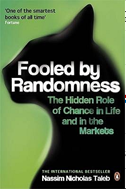
The world we live in today is more random than we would like to think. A human mind is a meaning-making machine. Through millions of years of evolution, nature has hardwired the human brain to seek patterns and consistencies everywhere. But as civilization has progressed the world around us has become increasingly random i.e., uncertain and unpredictable.
Nassim Taleb is one of those thinkers of modern times who is ardently loved by many intellectuals and criticized by probably more. In his talks and public interactions, Taleb comes out as someone who has a knack for rubbing off people the wrong way. His writing style has been labelled as excessively rhetoric and provocative.
Even Howard Marks, a very successful and highly respected value investor, said this about Fooled by Randomness- the most important badly written book.
As for Nassim, whether you like him or hate him, one thing is for sure - his ideas can’t be ignored. Once you set aside those minor personality issues and get past the resistance created by Taleb’s unique writing style, his books are a treat to read and choc full of thought provoking arguments. In my library, this book is probably the most highlighted, underlined and annotated one.
[show_to accesslevel=’almanack-all’]
The central idea of Taleb’s book is that the world we live in today is more random than we would like to think. A human mind is a meaning-making machine. Through millions of years of evolution, nature has hardwired the human brain to seek patterns and consistencies everywhere. But as civilization has progressed the world around us has become increasingly uncertain and unpredictable. The main culprit for our inability to acknowledge the randomness is hindsight bias. When we look back at things that have happened we see them as less random than they actually were. As they say, the hindsight vision is 20/20. Once we know the outcome of an event, we find it hard to imagine the other possible ways in which things could have happened. Taleb writes -
It is as if there were two planets: the one in which we actually live and the one, considerably more deterministic, on which people are convinced we live. It is as simple as that: Past events will always look less random than they were (it is called the hindsight bias). I would listen to someone’s discussion of his own past realizing that much of what he was saying was just backfit explanations concocted ex post by his deluded mind.
Letting randomness fool us is hazardous especially when it comes to investing and making decisions involving money.
Risk Blindness
Let’s assume there are two investors: Steady Steve and Rash Robin. Steve, using his conservative investing philosophy, generates a compounded annual growth rate (CAGR) of 15 percent over a period of 10 years. Robin, with his aggressive investing strategies including derivatives, leverage etc., boasts a CAGR of 30 percent for the 10-year period. Which investing strategy do you think is better? The information is insufficient to answer the question because we don’t know what kind of risks were assumed by Steve and Robin. A better number to compare would be the risk-adjusted returns. Let’s understand the difference between returns and risk-adjusted returns.
The real question to ask would be - if there were 1000 people like Mr. Steady Steve (following the conservative investing principles) and another 1000 people like Robin Rash (mimicking the aggressive investment strategy) at the beginning - then how many ended up with similar returns as Steve and Robin in respective groups? What if I told you that about 750 in Steve’s group managed a CAGR of 15+ percent and only 10 finished with returns less than 10 percent. But the story in Robin’s group is much wilder. Only 10 in Robin’s group could flash their 30+ percent CAGR and rest of them actually ended up with less than they started i.e. negative returns. We cannot ignore these statistics because it gives a very crucial clue about the riskiness (and rashness) of Robin’s strategy. Comparing only the winners of each investment philosophy will lead you to arrive at seriously flawed conclusions. The number of losers and the severity of their losses tells the complete story.
Taleb uses the analogy of Russian roulette to illustrate this concept. He writes -
Imagine an eccentric tycoon offering you $10 million to play Russian roulette, i.e., to put a revolver containing one bullet in the six available chambers to your head and pull the trigger. Each realization would count as one history, for a total of size possible histories of equal probabilities. Five out of these six histories would lead to enrichment; one would lead to a statistic…The problem is that only one of the histories is observed in reality; and the winner of $10 million would elicit the admiration and praise of some fatuous journalist (the very same ones who unconditionally admire the Forbes 500 billionaires)..the public observes the external signs of wealth without even having a glimpse at the source.
Earning $10 million through Russian roulette is like playing with risky investing strategies in the stock market. It’s not the same as creating wealth using conservative and long term value investing principles. To an external observer, Rash Robin stands out as a clear winner but no one knows that for every surviving Robin there were 99 other who got wiped out following the same path. The earnings produced by Steve’s strategy are qualitatively much superior.
$10 million earned through Russian roulette does not have the same value as $10 million earned through the diligent and artful practice of dentistry, argues Taleb, “They are the same, can buy the same goods, except that one’s dependence on randomness is greater than the other. To an accountant, though they would be identical; to your next-door neighbor too. Yet, deep down, I cannot help but consider them as qualitatively different.”
Probability Blindness
Human race has come a long way from the invention of zero to the current state where we seem to have mastered the use of numbers. Still the time period for which numbers and humans have coexisted is almost negligible in front of our entire evolutionary history. Homo sapiens started using numbers about 8000-10000 years ago, almost at the time of agriculture revolution. But our mind is still of a hunter gatherer. A hunter gatherer never had to deal with probability.
Consider a bet you make with a colleague for the amount of $1,000, which, in your opinion, is exactly fair. Tomorrow night you will have zero or $2,000 in your pocket, each with a 50% probability. In purely mathematical terms, the fair value of a bet is the linear combination of the states, here called the mathematical expectation, i.e., the probabilities of each payoff multiplied by the dollar values at stake (50% multiplied by 0 and 50% multiplied by $2,000 = $1,000). Can you imagine (that is visualize, not compute mathematically) the value being $1,000? We can conjure up one and only one state at a given time, i.e., either 0 or $2,000. Left to our own devices, we are likely to bet in an irrational way, as one of the states would dominate the picture - the fear of ending with nothing or the excitement of an extra $1,000.
Most investors are routinely stumped by situations presented by stock market investing. Human mind has a tendency to either feel too optimistic about the prospects of making a lot of money or experience extreme fear about the potential losses. We find it hard to fathom the results produced by a balanced portfolio over long term.
If It’s Being Sold to You, Don’t Buy It
To market their skill as luck, financial industry relies heavily on exploiting the survivorship bias. In 2014, I remember meeting a financial advisor (rather a glorified salesman peddling his AMC’s latest fund) who showed me one of his funds which had outstanding 10-year performance track record. When I asked him about how many different funds that AMC had in the past and how many of those had lost money in last 10 years, he simply dodged that question. Taleb explains -
It is not uncommon for someone watching a tennis game on television to be bombarded by advertisements for funds that did (until that minute) outperform others by some percentage over some period. But, again, why would anybody advertise if he didn’t happen to outperform the market? There is a high probability of the investment coming to you if its success is caused entirely by randomness. This phenomenon is what economists and insurance people call adverse selection. Judging an investment that comes to you requires more stringent standards than judging an investment you seek, owing to such selection bias. For example, by going to a cohort composed of 10,000 managers, I have 2/100 chances of finding a spurious survivor. By staying home and answering my doorbell, the chance of the soliciting party being a spurious survivor is closer to 100 percent.
Guy Spier, a noted value investor, has a remarkable way to deal with this problem. Spier, in his book Education of a Value Investor, writes -
…I soon began to see that I made lousy decisions when I bought things that salespeople were hawking to me. The problem is that my brain (and most likely your brain too) is awful at making rational decisions when confronted with a well-argued, detailed pitch from a gifted salesperson. So I adopted a simple rule that has proved extraordinarily beneficial. When people call to pitch me anything at all, I reply in as pleasant a manner as possible, “I’m sorry. But I have a rule that I don’t allow myself to buy anything that’s being sold to me.
No matter how knowledgeable you are about the value investing and business analysis, trying to outwit an expert salesman is futile and even dangerous. You may have all the reasons to prove that fund being sold to you is worthless but the guy in front of you is probably a master in persuasion tricks. The odds are high that your lizard brain - the irrational mind - will give in to the behavioural biases intentionally and skillfully triggered by that salesman.
Conclusion
Any book that can be summarized is not worth reading, goes the adage. So the idea of this post is not to give you a summary of the book because it’s not possible. Any such attempt from me would not only be futile but a great disservice to you. My intention is to give you a glimpse of what the book holds. The real pleasure in reading such rich books is to relish every sentence. As each thought-provoking argument cuts through the dense conditioning of the mind, it feels like a bulb flashing inside my head.
Every book has the potential to break an old thought pattern, build fresh neural pathways, and give birth to extraordinary insights. You don’t have to agree with everything the author says. Just the willingness to entertain a thought - one that vehemently contradicts your long-cherished beliefs - creates a small opening in the wall of preconceived notions. That way reading a book which you don’t necessarily agree with is a great exercise for your thinking muscle.
The best thing about reading a book is you can have a conversation with the author without the awkwardness of disagreeing with him on his face. I occasionally voice my disagreement by writing notes on the book margins. Many times, during my second or third read, seeing my own marginalia I get to observe the evolution my own thought process.
Devdutt Pattanaik, a mythologist and great writer, recently said, “A person who has read a book argues but the one who has read an entire library watches in silence.”
The more books you read, the more you’ll realize how much more there’s to know. Reading book, thus, is less about acquiring knowledge and more about discovering the limits of your own ignorance. As the saying goes - larger the island of knowledge longer the shoreline of wonder. So, the only wish I have for you is to have the longest shoreline of wonder.
[/show_to]
[hide_from accesslevel=’almanack-all’]
- Spotlight: Big ideas from Value Investing and why applying them in your investment decision making will be a great deal
- InvestorInsights: Interviews with experienced value investors, learners, and deep thinkers
- StockTalk: Thorough analysis of business models of companies (without any recommendations)
- Behaviouronomics: Deep analysis of human behaviour and how it impacts investment decision making
- BookWorm: Reviews of the best books on Value Investing and related subjects
- Free Course – Financial Statement Analysis for Smart People (otherwise priced at Rs 5,900)
- Archives: Instant access to our huge archive from the past three years