
A few years back, I wrote an essay on the mental model of Redundancy. In that article, I mentioned how Bill Gates reasoned using Redundancy that saving lives in Africa will contain the country’s population growth over the longer term. One reader pointed out that Gates’ insight originally came from another guy named Hans Rosling.
A little bit of research revealed that Hans Rosling had a decisive impact on how Bill Gates thought about his philanthropy work in African countries. No wonder, when Rosling’s book came out, Gates was among the first to publish a review. He wrote —
Hans, the brilliant global-health lecturer who died last year, gives you a breakthrough way of understanding basic truths about the world—how life is getting better, and where the world still needs to improve. And he weaves in unforgettable anecdotes from his life. It’s a fitting final word from a brilliant man, and one of the best books I’ve ever read.
[show_to accesslevel=’almanack-all’] Rosling, in his multi-decade research, discovered that all over the world people’s knowledge (about facts related to wealth, population growth, births, deaths, education, violence, gender, health, energy, and environment) is woefully misplaced. So why is that a matter of worry?
With google at fingertips, we don’t really bother memorizing the facts and figures and we don’t need to. But when our misconceptions about truth are rooted in strong intuitions, then we don’t feel the need to verify the correctness of our beliefs. There lies the danger.
How could policy makers and politicians solve global problems if they were operating on the wrong facts? How could business people make sensible decisions for their organizations if their worldview were upside down? And how could each person going about their life know which issues they should be stressed and worried about?
The book is devoted to ten instincts which Rosling calls the mega misconceptions. These instincts mistakenly lead us to embrace an over-dramatic, stereotyped, inflexible, and unduly pessimistic view of the world. Hans writes —
I will teach you how to recognize overdramatic stories and give you some thinking tools to control your dramatic instincts. Then you will be able to shift your misconceptions, develop a fact-based worldview, and beat the chimps every time.
The Gap Instinct
The first of the ten instincts is the gap instinct. The natural human tendency to paint everything in black and white leads to the world view where most people believe that the world population is divided into binary classes — the rich and the poor. The developed and the developing. That was true half a century back. But today’s world is much more nuanced than that. By dividing the world into two misleading boxes — poor and rich — it completely distorts all the global proportions in people’s minds, writes Rosling.
…human beings have a strong dramatic instinct toward binary thinking, a basic urge to divide things into two distinct groups, with nothing but an empty gap in between. We love to dichotomize. Good versus bad. Heroes versus villains. My country versus the rest. Dividing the world into two distinct sides is simple and intuitive, and also dramatic because it implies conflict, and we do it without thinking, all the time.
Hans offers a new framework for how to think about the world. A better way to model the world population, as proposed by Rosling, is to slot it into four income groups as illustrated in the image below. Each human figure in the image represents one billion population.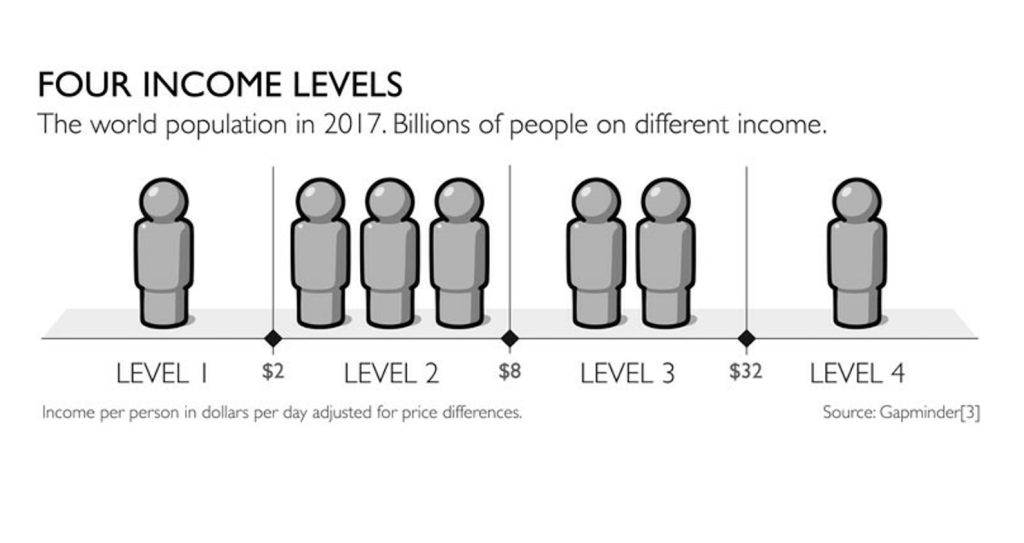 As you can see, a massive chunk of the world population is the differentiated middle-class (earning more $2 per day but less than $8) which is where most of the world’s population lives. The Gap Instinct, reasons Rosling, makes us see the world as being more fractured than it really is. This instinct is like standing on top of a skyscraper and looking down at a city. All of the other buildings will look short to you whether they’re ten stories or 50 stories high. It’s the same with income. Life is significantly better for those on level 2 than level 1, but it’s hard to see that from level 4 unless you know to look for it.
Recently I stumbled upon the following data which dissipates the gap instinct misconception in the context of our own country.
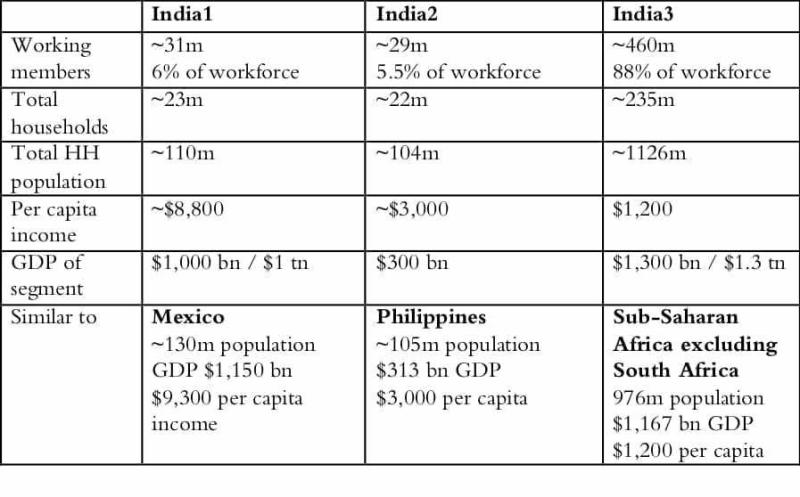
These facts are important for entrepreneurs because it allows them to position their products and services to the right customer segment and it’s equally important for the investors because they can estimate the real addressable market.
Unpack The Averages
Averages often hide crucial information and create an illusion of gap.
When we compare two averages, we risk misleading ourselves even more by focusing on the gap between those two single numbers, and missing the overlapping spreads, the overlapping ranges of numbers, that make up each average. That is, we see gaps that are not really there.
Whenever you encounter arguments that are founded on comparison of averages, take a minute and drill down into the data. The veil of average can shroud the truth. Ask, “What’s the spread underlying these average figures? Is there a data overlap?”
Much more often, gap stories are a misleading overdramatization. In most cases there is no clear separation of two groups, even if it seems like that from the averages. We almost always get a more accurate picture by digging a little deeper and looking not just at the averages but at the spread: not just the group all bundled together, but the individuals. Then we often see that apparently distinct groups are in fact very much overlapping.
In short, the way to overcome the gap instinct is to avoid comparing simple averages, not drawing too much from extreme examples of wealth or poverty, and checking how our own biases might be leading us to false conclusions.
Don’t Be Fooled by Extremes
Rosling continues —
…stories of opposites are engaging and provocative and tempting—and very effective for triggering our gap instinct—but they rarely help understanding. There will always be the richest and the poorest, there will always be the worst regimes and the best. But the fact that extremes exist doesn’t tell us much. The majority is usually to be found in the middle, and it tells a very different story.
Using the example of income inequality in Brazil, the author explains that the fact that 10% of the wealthiest Brazilians make 41% of the total income is misleading. But if you look at the income distribution from the lens of Hans’ four-level framework, you’d draw a different picture.
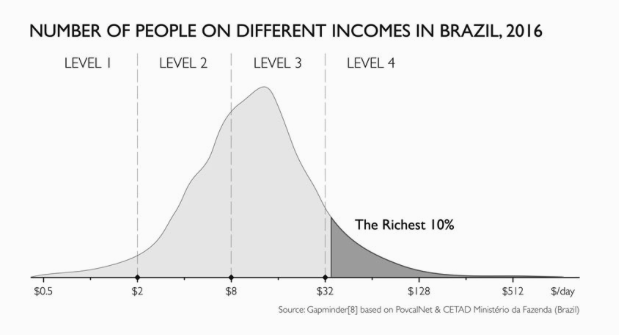
Most people in Brazil have left extreme poverty. The big hump is on Level 3. That’s where you get a motorbike and reading glasses, and save money in a bank to pay for high school and someday buy a washing machine. In reality, even in one of the world’s most unequal countries, there is no gap. Most people are in the middle.
View from The Top
You and I belong to level 4 and as explained using the example of skyscraper earlier, it’s hard for people like us to imagine the difference between the other three lower levels.
…the struggles people go through on Levels 1, 2, and 3 will most likely be completely unfamiliar to you. And they are not described in any helpful way in the mass media you consume.
Your most important challenge in developing a fact-based worldview is to realize that most of your firsthand experiences are from Level 4; and that your second-hand experiences are filtered through the mass media, which loves nonrepresentative extraordinary events and shuns normality.
When you live on Level 4, everyone on Levels 3, 2, and 1 can look equally poor, and the word poor can lose any specific meaning. Even a person on Level 4 can appear poor: maybe the paint on their walls is peeling, or maybe they are driving a used car.
It’s hard to spot the gap when you’re looking down from the top. And if you’re reading this, you’re on the top.
Conclusion
The book will pop the bubble. It will take you from being confidently wrong to factually right about how the world really is. Being Factful is being ready to replace the instinctive reaction with critical thinking, being curious and being humble about our fallibility.
Rosling —
Factfulness, like a healthy diet and regular exercise, can and should become part of your daily life. Start to practice it, and you will be able to replace your overdramatic worldview with a worldview based on facts. You will be able to get the world right without learning it by heart. You will make better decisions, stay alert to real dangers and possibilities, and avoid being constantly stressed about the wrong things.
He spent his life not only understanding how global health was improving, writes Gates, “but sharing what he learned in a fun, clear way with a broad set of people.”
Factfulness is a fantastic book, and I hope more people read it.
Note: As a supplement to this book, I urge you to watch this presentation by Mr. G. Maran (Unifi Capital). He takes the inspiration from Rosling’s book and details several eye opening facts about India.
[/show_to] [hide_from accesslevel=’almanack-all’]
- Spotlight: Big ideas from Value Investing and why applying them in your investment decision making will be a great deal
- InvestorInsights: Interviews with experienced value investors, learners, and deep thinkers
- StockTalk: Thorough analysis of business models of companies (without any recommendations)
- Behaviouronomics: Deep analysis of human behaviour and how it impacts investment decision making
- BookWorm: Reviews of the best books on Value Investing and related subjects
- Free Course – Financial Statement Analysis for Smart People (otherwise priced at Rs 5,900)
- Archives: Instant access to our huge archive from the past three years