• Skip to primary navigation
  • Skip to main content

The One Percent Almanack

Wit and Wisdom on Investing, Business, and Life

  • Home
  • Members
  • Log In
  • Show Search
Hide Search

Corporate Governance: Charlie Munger on Governance

May 20, 2015

Charlie Munger is widely quoted in value investing community for his multidisciplinary ideas. However, he has some unconventional advice on the subject of corporate governance also which deserves a discussion. Let’s look at some of the insights from Munger on the issue of governance.

Munger believes more in the spirit of corporate governance rather than enforcement of compliance rules and regulations. If the intention is not right, people can always bend the rules and find workarounds for carrying out unethical practices without breaking the law. But when you know that the intentions are right then even an occasional instance of non-compliance doesn’t bother you because you trust the person and know that things will eventually get sorted out.

Munger is of the opinion that different companies have different cultures and you cannot come up with a one-size-fits-all solution in form generic compliance rules. An organization is made up of diverse set of people with different interests and values. Such collection of people behaves as a complex adaptive system. The moment complex rules are infused to command more control it invariably results in unintended consequence. So the solution is not to device more rules but to make the system simpler.

In the annual meeting for Wesco Financials in 2007, Munger pointed out –

A lot of people think if you just had more process and more compliance—checks and double checks and so forth—you could create a better result in the world. Well, Berkshire has had practically no process. We had hardly any internal auditing until they forced it on us. We just try to operate in a seamless web of deserved trust and be careful whom we trust.

This brings us to the Munger’s first idea for simplifying the corporate governance puzzle.

Seamless Web of Deserved Trust

A system in which the individuals making decisions do not bear the consequences of those decisions seems incompatible with a seamless web of deserved trust. Munger explains –

Good character is very efficient. If you can trust people, your system can be way simpler. There’s enormous efficiency in good character and dis-efficiency in bad character.

Moreover, unethical behavior is contagious. Gresham’s law says that bad values (or currency or people) drive out the good values from a system. If you find that it’s easy to cheat and steal in an organization, it’s just a matter of time before majority of the people in that system start exhibiting dishonest and unethical behaviour. Even if everybody was absolutely honest to begin with. Such is the human behaviour.
[Read more…] about Corporate Governance: Charlie Munger on Governance

InvestorInsights: Jae Jun, Old School Value

May 10, 2015

Jae Jun is the founder of Old School Value, a deep fundamental analysis tool that helps value investors make speeds up the analysis process and make better investment decisions.

Safal Niveshak (SN): Could you tell us a little about your background, and also about your wonderful blog Old School Value?

Jae Jun (JJ): I believe my path to investing is very similar to most people. I met a life insurance salesman who convinced me that I needed life insurance that also acted as an “investment” account. A 2-in-1 deal which I blindly agreed to without doing any homework.

The reason for my poor decision was because I saw friends and colleagues making money in stocks and I wanted to do the same. I also believed that anyone in the financial industry knew a lot more than I ever would. After I started Old School Value, I realized it was the opposite. Most people in the finance industry don’t know a thing about finance.

After several months, I would check my shiny new “investment” account, but things didn’t look right. The market was up 10%, but my account was doing nothing and a lot of the insurance premium were deducted as fees. After some digging around, the veil fell from my eyes and I saw the sucker I was. I immediately cancelled the life insurance, forfeited all the money and locked in my first 100% investment loss.

I figured that, if I wanted to lose money, I could do it myself and at least have some fun doing it. That’s when I started digging into articles, magazines and books and documented my learning through Old School Value.

I thoroughly enjoy sharing and educating people and the blog is an outlet for me so that I don’t have to bore my wife or friends to death about balance sheet analysis and how to value stocks.

Coming from a telecommunications engineering background, I grew up with tunnel vision. I never considered the possibility that I would enjoy business or finance. So my entire schooling years was dedicated to math, physics and other engineering courses. I never took a course in accounting, business or economics. Investing and starting Old School Value really opened my eyes to a new world.

SN: What got you interested in investing, and how you’ve evolved over time as an investor?

JJ: My dad is a trader and I witnessed the emotional highs and lows he experienced from making and losing a huge amount of money. At an early age, I concluded that investing in the stock market was equivalent to gambling.

After having lost everything that I put into the life insurance investment account, the initial anger was a huge motivator for me to put aside my biases about the stock market and to really learn how it worked.

My wife (girlfriend at the time) had a book called “The Intelligent Investor” which was recommended to her because she too wanted to become a life insurance saleswoman.
[Read more…] about InvestorInsights: Jae Jun, Old School Value

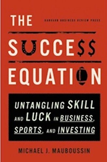
BookWorm: The Success Equation

May 8, 2015

In the last fifty years, Warren Buffett has recommended quite a few books in his lectures and writings. But there is one book that can boldly claim to have found its way to Warren Buffett’s reading desk. And that book is The Success Equation, authored by Michael Mauboussin.

Michael belongs to the breed of those rare investment strategists who have spent their life puzzling over the really crucial questions in the world of decision making. He is an expert in one of the most debatable topic in the field of business strategy i.e., role of luck in defining the success for an individual as well as an organization.

Apart from being a successful investor, Michael also teaches at Columbia Graduate School of Business. He has authored three other books out of which I have read two and found both of them equally insightful.

Let’s dive straight into the book first.

Many of us have heard the biblical story of David and Goliath. It tells how David, a young shepherd was pitted against a ferocious warrior named Goliath. David accepted the challenge when Goliath invited him for one to one fight. David was clearly an underdog. However, everybody was stunned when David killed the giant Goliath with a slingshot.

The truth is that it’s not easy to recognize the remarkable war strategy hidden inside the story. What strategy?

I’ll let you live with the curiosity for few more minutes and reveal the secret little later in this article.

The world we live in today has become terribly interconnected. This introduces a high degree of complexity which in turn leads to lot of randomness and unpredictability in the outcomes of events. When this randomness operates at an individual level, it translates to either good or bad luck.
[Read more…] about BookWorm: The Success Equation

Behaviouronomics: Mental Accounting

May 5, 2015

Imagine you are in Las Vegas with your friend. While walking on the Las Vegas Boulevard you find a US$ 10 bill sticking out from the side of the pavement, as if it’s telling you “Pick me!” You pick up the note and feel happy about your moderately good fortune.

“Wait a minute! Is that a sign from the universe?” you whisper to yourself. Perhaps Lady Fortuna is nudging you to try out your luck using this US$ 10 totem. After all it’s Las Vegas…the gambler’s paradise.

Your friend however is tired and heads back to the hotel. But you just can’t ignore the sign from above. Taking this as an omen, you enter the first casino and head straight to the roulette table. You want to bet on your lucky number i.e., 7. Sure enough, the roulette ball hits 7 and 35-1 bet wins you US$ 350. You let your winnings ride and the ball lands on 7 again, paying you US$ 12,250. And so it goes. Within an hour you are a multimillionaire with US$ 50 million in your kitty.

Feeling like Daniel Ocean from Ocean’s Eleven, you intend to bring the house down with your raging streak of luck. Being just one step away from becoming a billionaire you bet all your money on number 7 one last time – only to lose it all this time. Broke, dejected and little flabbergasted you walk down several miles to join your friend in the hotel room.

“Where were you man?” asks your friend as you enter the room.

“Playing roulette.” You’re still feeling a little shaken.

“How did you do?”

You cut the story short and tell him, “Not bad. I lost ten dollars.”

My question to you is – “Did you really just lose $10?”

If your answer is yes, then perhaps you are unaware of the behavioural bias called Mental Accounting.
[Read more…] about Behaviouronomics: Mental Accounting

Spotlight: Where Do Great (Investment) Ideas Come From?

May 3, 2015

It was sometime in 2003 when, after joining my job as an equity analyst and after getting my first measly paycheque, I wanted to get my rented apartment painted. I was about to get married and welcoming my bride in a house with unpainted walls was a bad idea.

So, with the little I could afford then, I searched for the cheapest painter, and with him, went searching for the cheapest paint. But I couldn’t find one. In fact, no paint store was willing to sell me the cheapest paint, and instead, everyone seemed to nudge me to buy the most expensive of the lot.

“Sir, you would get your house painted once in five years, so why go for a cheap, low-quality paint?” one shopkeeper tried his persuasion technique, “So my suggestion is that you must go with this XYZ brand of paint.” My painter added, “This brand is really good, sir. Or why would everyone buy this one only?”

“But isn’t this expensive as compared to other brands?” I revolted.

“If you don’t buy this now and come back a year later,” a shopkeeper warned me, “it would get even more expensive!”

“How can you say that?” I retaliated. “Because this company has been raising its prices every year,” he replied, “and despite this, more and more people are buying it.”

Well, what I had heard from these paint shopkeepers was true, as I saw from the previous years’ financial statements of this XYZ company. Year after year, the company had been raising the price of its products, and year after year, its volume sales were also rising.

When I talked about this business with my senior colleague, he dismissed it as a random idea coming from a junior.

“But see the pricing power,” I told him, “And everyone is buying its products despite the constant increases in prices every year! And the company has no debt. And the management is clean.”

I tried to hard-sell this idea to my seniors, but not many took it seriously. And I, being an obedient, inexperienced junior into his very first job, stopped taking it very seriously, and did not buy the stock. What a huge mistake of omission it turned out to be!

If you have not realized by now, the XYZ company was Asian Paints, and the quoting price then was less than Rs 30 per share. Today, it’s around Rs 800, a 27-bagger in 12 years, or a 31% CAGR return.

I did not buy Asian Paints in 2003, which was otherwise a great insight then and one that was sparked off by nothing more than an observation of what people around me were buying and what people around me were hard-selling.

If I were to use the language of human psychology, Asian Paints was a business (and still is) that benefited tremendously from the biases of social proof (everyone was buying) and anchoring (high and rising price, and thus better products). And, to repeat, I got the insight out of simple observation and common sense, and no deep analysis of the business and no complex theories to support my arguments.

“My simple art,” said Sherlock Holmes in The Blanched Soldier, “is but a systematized common sense.”

Many times in life, all we need is a touch of common sense to reach a Eureka moment. And of course, we need the knowledge of separating sense from nonsense, because the latter is in great supply all around.
[Read more…] about Spotlight: Where Do Great (Investment) Ideas Come From?

  • « Go to Previous Page
  • Go to page 1
  • Interim pages omitted …
  • Go to page 65
  • Go to page 66
  • Go to page 67
  • Go to page 68
  • Go to page 69
  • Interim pages omitted …
  • Go to page 72
  • Go to Next Page »

Handcrafted with in India