
In 1987, an investment banker named Steven Rothstein bought a special pass called AAirpass which gave him lifetime privilege of booking first-class American Airlines tickets from anywhere to anywhere in the world for free. The pass wasn’t cheap. It cost him a quarter of a million dollars. But Rothstein was so happy with the deal that in 1989 he paid an additional $1,50,000 to buy a companion pass which allowed another person to accompany Steven in first-class.
One interesting fact about Steven’s companion pass was a clause that he added in his contract about his wife. The agreement stated: “If spouse is the companion, the spouse will be allowed to travel separately from Holder, provided that the spouse travels on the flight immediately prior to or just after the flight taken by Holder.” Steven reasoned that in the unlikely event of a crash, at least one of them would be alive for their three children. It looks like Steven took the idea of risk mitigation too far.
[show_to accesslevel=’almanack-all’]
Flight being the safest mode of travel (statistically), why would someone worry so much about that rare event of a crash? Families fly together all the time, don’t they?
But Steven was an outlier. Remember, he spent close to half a million dollars in the 1980s to buy the AAirpass. To the most frequent of frequent fliers, it is not all that hard to run through a few hundred thousand dollars of tickets at first-class prices. And Steven wasn’t just a frequent flyer. Some accounts say that he recovered the cost of his pass in the first two months.
In 1980, American Airlines was going through a tough phase. They had posted a $76 million loss and the newly elected CEO, Robert Crandall was looking for creative ways to cut the losses and turnaround the company. So in 1981, he introduced the AAirpass. It was an attempt to lock in its best customers and also an unconventional way to raise capital from their own customer base by selling its wealthiest customers the “ultimate travel perk” — an unlimited first-class ticket for life.
Steven Rothstein, over the next 25 years, proceeded to book more than 10,000 flights. Another guy named Jacques Vroom took advantage of the AAirpass and flew more than 2 million miles over two decades.
As you can tell, the scheme didn’t turn out to be as profitable as Crandall thought it would be.
Paul Oyer, in his article on HBR, wrote —
So what did American Airlines do? They raised the AAirpass price. But then only people who used it even more than the original group bought it. The cost of serving the customers went up just as quickly as the price went up because the pool of customers just got more and more expensive. After several price increases topping out at $1 million for an AAirpass, they gave in to the inevitable death spiral and stopped offering the deal.
This class of mistakes in business is termed as adverse selection. Adverse selection is the result of another error called selection bias. Selection bias occurs when a sample is selected that is not representative of the broader population of interest.
Groucho Marx said it best —
I don’t care to belong to a club that accepts people like me as members.
In the case of AAirpass, the terms of the clause and high upfront cost ensured that only those frequent fliers bought it who saved a lot of money relative to paying for each flight. Which was a losing deal for the airlines because what they lost in terms of revenues from these best customers couldn’t be made up by other AAirpass customers who would underuse it because there wasn’t any customer who was underusing the AAirpass.
Gabriel Weinberg, in his book Superthinking, explains —
A similar selection bias occurs with parents and school choice for their kids. Parents understandably want to give their kids a leg up and will often move or pay to send their kids to “better schools.” However, is the school better because there are better teachers or because the students are better prepared due to their parents’ financial means and interest in education? Selection bias likely explains some significant portion of these schools’ better test scores and college admissions.
Another type of selection bias, common to surveys, is nonresponse bias, which occurs when a subset of people don’t participate in an experiment after they are selected for it, e.g., they fail to respond to the survey. If the reason for not responding is related to the topic of the survey, the results will end up biased.
For instance, let’s suppose your company wants to understand whether it has a problem with employee motivation. Like many companies, you might choose to study this potential problem via an employee engagement survey. Employees missing the survey due to a scheduled vacation would be random and not likely to introduce bias, but employees not filling it out due to apathy would be nonrandom and would likely bias the results. That’s because the latter group is made up of disengaged employees, and by not participating, their disengagement is not being captured.
That’s like a professor trying to figure out if anyone is sleeping in his class and he asks, “Please raise your hands if you’re awake.” By design, those who are asleep will not respond and skew the results badly.
In Fooled by Randomness, Nassim Taleb writes —
It is not uncommon for someone watching a tennis game on television to be bombarded by advertisements for funds that did (until that minute) outperform others by some percentage over some period. But, again, why would anybody advertise if he didn’t happen to outperform the market? There is a high probability of the investment coming to you if its success is caused entirely by randomness. This phenomenon is what economists and insurance people call adverse selection. Judging an investment that comes to you requires more stringent standards than judging an investment you seek, owing to such selection bias. For example, by going to a cohort composed of 10,000 managers, I have 2/100 chances of finding a spurious survivor. By staying home and answering my doorbell, the chance of the soliciting party being a spurious survivor is closer to 100 percent.
A money manager who has a great track record doesn’t need to go out and solicit investors. Typically only those fund managers need to market themselves heavily who aren’t doing well. That’s why investors need to spend time and effort to find the best money manager (or mutual funds) on their own instead of sitting at home and selecting from the options which are being advertised to them.
In his book, Education of a Value Investor, Guy Spier, a noted value investor, writes -
…I soon began to see that I made lousy decisions when I bought things that salespeople were hawking to me. The problem is that my brain (and most likely your brain too) is awful at making rational decisions when confronted with a well-argued, detailed pitch from a gifted salesperson. So I adopted a simple rule that has proved extraordinarily beneficial. When people call to pitch me anything at all, I reply in as pleasant a manner as possible, “I’m sorry. But I have a rule that I don’t allow myself to buy anything that’s being sold to me.
No matter how knowledgeable you are about the value investing and business analysis, trying to outwit an expert salesman is futile and even dangerous. You may have all the reasons to prove that fund being sold to you is worthless but the guy in front of you is probably a master in persuasion tricks. The odds are high that your lizard brain - the irrational mind - will give in to the behavioural biases intentionally and skillfully triggered by that salesman.
Plus, as pointed out by Taleb, the selection bias phenomenon dictates that the likelihood of a great investment opportunity coming to you is very less as compared to the case when you go out and look for it on your own.
I’ll leave you with this thoughtful observation from Dilbert.
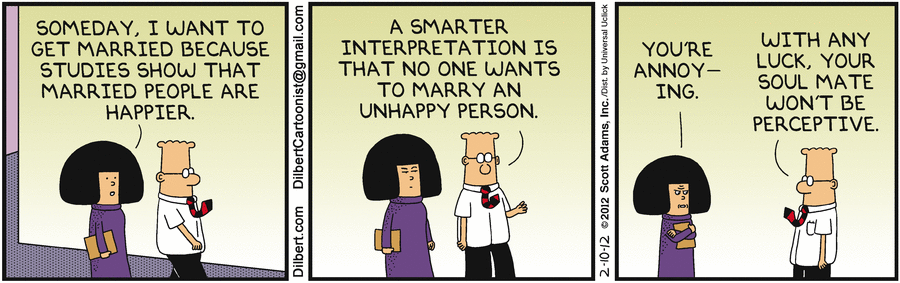
[/show_to]
[hide_from accesslevel=’almanack-all’]
- Spotlight: Big ideas from Value Investing and why applying them in your investment decision making will be a great deal
- InvestorInsights: Interviews with experienced value investors, learners, and deep thinkers
- StockTalk: Thorough analysis of business models of companies (without any recommendations)
- Behaviouronomics: Deep analysis of human behaviour and how it impacts investment decision making
- BookWorm: Reviews of the best books on Value Investing and related subjects
- Free Course – Financial Statement Analysis for Smart People (otherwise priced at Rs 5,900)
- Archives: Instant access to our huge archive from the past three years