
On March 24, in his address to the nation, when our Prime Minister Mr. Narendra Modi announced the 21-day nationwide lockdown, he drew the country’s attention to an alarming fact about the spread of coronavirus.
He informed us that it took more than two months for the number of coronavirus cases to go from zero to one lakh. But it took two weeks for the next one lakh cases. And then the subsequent one lakh cases came in less than one week.
[show_to accesslevel=’almanack-all’]
In about one month from that point, today Covid19 cases have multiplied by nine times to 27 lakhs.
The spread of highly infectious diseases follows an exponential curve and humans are not wired to wrap their heads around the idea of exponential growth.
Unfortunately, the world is being reminded of the force of exponential growth in a tragic way. Tim Harford, in his recent article titled “Why we fail to prepare for disasters,” writes —
We find exponential growth counterintuitive to the point of being baffling — we tend to think of it as a shorthand for “fast.” An epidemic that doubles in size every three days will turn one case into a thousand within a month — and into a million within two months if the growth does not slow. Donald Trump’s boast, on March 9, that there had been only 22 deaths in the US, was ill-judged in light of what we know about exponential growth, but he is hardly the only person to fail to grasp this point.
Harford calls it Exponential Myopia — the inability to make sense of this non-linear growth pattern.
Physicist Albert Allen Bartlett noted that the greatest shortcoming of the human race is our inability to understand the exponential function. Bill Gates in his recent blog post wrote this —
Exponential growth is not intuitive. If you say that 2 percent of the population is infected and this will double every eight days, most people won’t immediately figure out that in 40 days, the majority of the population will be infected.
Now hold that thought on exponential viral growth for a few minutes while I take you on a trip to South India.
Ambalappuzha Sri Krishna Temple is situated in the Alapuzha district of Kerala. It is believed that the temple was built during the 17th century by the local ruler. It has an interesting connection with Tipu Sultan but I won’t get into details. You can read about it on Wikipedia.

In Ambalappuzha Temple, every day they serve Payasam — a sweet pudding made of rice and milk. It is believed that Lord Krishna visits the temple daily to accept the offering.
The story goes — disguised as a sage, Lord Krishna once appeared in the court of the king who ruled the region and challenged him for a game of chess. Being a chess enthusiast himself, the emperor gleefully accepted the invitation. The prize had to be decided before the game, so the king asked the sage to choose his prize in case he won. The sage told the king that all he wished was a few grains of rice. He proposed that the amount of rice can be decided by using the chessboard. One grain of rice would be placed in the first square, two grains in the second square, four in the third square, eight in the fourth square, sixteen in 5th square and so on. In other words, every square will double the number of grains.
The ruler laughed it off as a meager prize and agreed. As you’d have guessed, the king lost the game and the sage demanded his prize. As the king’s staff started adding grains of rice to the chessboard, it dawned upon them the true nature of the sage’s demands. The king realised that he will never be able to fulfil the promised reward as the number of grains was increasing exponentially and the total amount of rice required for a 64-squared chess board would translate into trillions of tons of rice.

Upon seeing the dilemma, goes the legend, the sage told the king that he could pay off the debt over time — EMI if you will. From that day, payasam is being served freely to the pilgrims every day.
This chessboard anecdote has some interesting insights if you care to dig deeper into it with some elementary maths.
For the first 32 squares, the amount of rice is still pretty much manageable. The number of grains on the first half of the chessboard is 1 + 2 + 4 + 8 + … + 2,147,483,648, for a total of 4,294,967,295 (232 − 1) grains, or about 214 tonnes of rice (assuming 50mg as weight of one grain). I’m sure the ruler wouldn’t have broken much sweat over that. But the moment one steps into the second half of the chessboard, the enormity starts baffling the common-sense.
So you see, even while it’s halfway through the exponential curve, the mind is yet to fathom the power of non-linear growth. From 33rd square onwards, the bewilderment begins.
That’s the common characteristic of all exponential systems. The rate of change during the initial phases is too insignificant to attract any attention. And during later stages, all expectation barriers are shattered.
Compound interest is one such exponential system.
Compounding can apply to areas beyond finance, writes Shane Parrish, “personal development, health, learning, relationships, and more. For each area, a small input can lead to large output, and the results build upon themselves.”
Here’s an interesting graph depicting Warren Buffett’s net worth (y-axis) plotted against his age (x-axis).
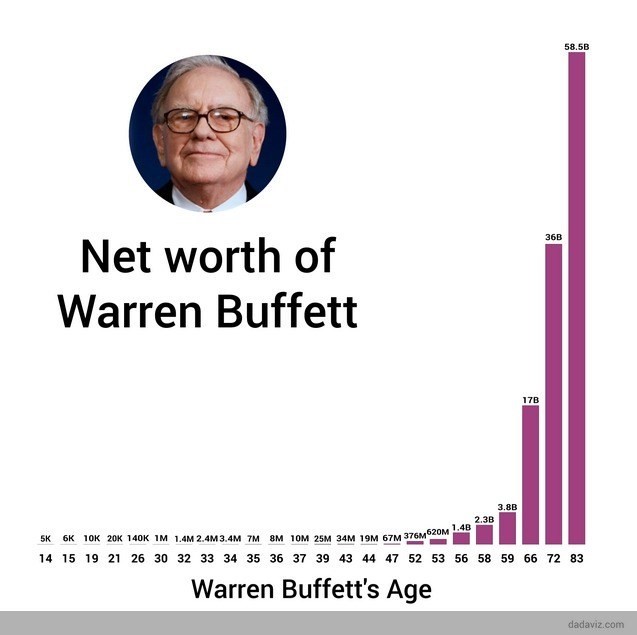
As you can see, the inflection point came after Buffett turned 50. Does it mean nothing was happening for the first fifty years? Of course not. Buffett bought his first stock at the age of 11 and he became a serious investor at the age of 20. Isn’t it obvious that for the 3-4 decades of his investing, he was quietly stacking up his grains of rice?
This exponential myopia is what trips most new investors. They’re not able to see that even a modest 12-15% consistent returns over a long period can turn an initial investment into a large sum.
Because of our exponential myopia, we fail to see the massive changes that can be summoned just by putting in grain-sized efforts consistently for long periods. John Wooden, one of the most successful coaches in the history of basketball, observed —
“When you improve a little each day, eventually big things occur … Don’t look for big, quick improvement. Seek thesmall improvement one day at a time. That’s the only way it happens and when it happens, it lasts.
It’s not yet known who said it first but the quote is often attributed to Bill Gates. He said —
Most people overestimate what they can achieve in a year and underestimate what they can achieve in ten years.
Gates’ observation is true for the accumulation of wealth, health, knowledge, and goodwill. It’s the consistency and persistence in taking small actions that build an emotional maturity which then carries you all the way to transformational results.
[/show_to] [hide_from accesslevel=’almanack-all’]- Spotlight: Big ideas from Value Investing and why applying them in your investment decision making will be a great deal
- InvestorInsights: Interviews with experienced value investors, learners, and deep thinkers
- StockTalk: Thorough analysis of business models of companies (without any recommendations)
- Behaviouronomics: Deep analysis of human behaviour and how it impacts investment decision making
- BookWorm: Reviews of the best books on Value Investing and related subjects
- Free Course – Financial Statement Analysis for Smart People (otherwise priced at Rs 5,900)
- Archives: Instant access to our huge archive from the past three years