
Before we begin, let me dazzle you with my secret superpower — the ability to assess people’s personality without meeting them. In other words, even though I don’t know you personally, I can make a reasonably accurate prediction about your personality. I just need one thing from you. Think of a number between 5 and 10 and keep it at the back of your mind while I recite the results of your instant personality assessment test.
Here we go —
[show_to accesslevel=’almanack-all’]
“You’re the kind of person who is inherently empathetic, but also marked by a strong sense of independent thinking. You have a great deal of potential but it has mostly remained unused which makes you critical of yourself. Disciplined and self-controlled outside, you tend to be worrisome and insecure inside. And that’s why security is one of your major goals in life. At times you are extroverted, affable, sociable, while at other times you are introverted, wary, reserved. Some of your aspirations tend to be pretty unrealistic.”
On a scale of 1-5, rate the accuracy of my assessment. One means not accurate at all and five means very accurate. How did I do?
Irrespective of the score, I am sure you are smart enough to figure out what’s going on here. All the statements in my assessment pitch are quite vague and have a dash of positive traits. Most people wouldn’t disagree with the sentences framed above. This is known as the Barnum effect.
Barnum effect says that people give high accuracy ratings to descriptions of their personality that supposedly are tailored specifically to them, that are in fact vague and general enough to apply to a wide range of people. Because the assessment statements are so vague, it’s easy to draw out meaning that confirms our existing beliefs and thus the statement feels “personal.”
Barnum effect explains the widespread acceptance of many woo-woo practices including but not limited to astrology, fortune telling, aura reading, and some occult forms of personality tests.
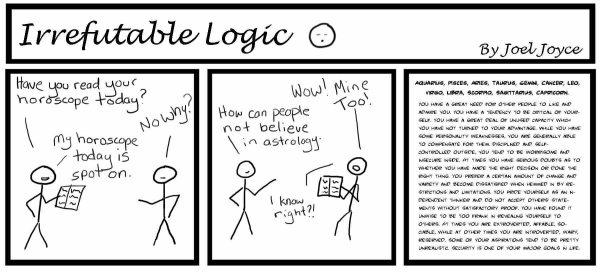
Barnum effect is named after P.T. Barnum, a 19th-century American showman who used “pseudo-successful” psychological tests to engage with his audience. The credit for discovering this psychological bias goes to Bertram Forer. Barnum effect is sometimes also referred to as Forer effect. In 1948, Forer found that on average his students rated their personality description with a 4.2 on a 5-point scale. Not bad for a description that – in reality – was the same for everyone.
Derren Brown is a famous English illusionist and mentalist. He’s an expert in designing social experiments with unsuspecting people to demonstrate how a mix of magic, suggestion, psychology, misdirection, and showmanship can fool people into forming irrational beliefs.
Watch this video where Derren Brown recreates Forer’s experiment.
So how does this bias affect an investor? In his excellent book The Art of Thinking Clearly, Rolf Dobelli explains it this way —
Whatever tricks astrologers and palm readers can turn, consultants and analysts can, too: “The stock has significant growth potential, even in a very competitive environment. The company lacks the necessary impetus to fully realize and implement ideas from the development team. Management is made up of experienced industry professionals; however, hints of bureaucratization are noticeable. A look at the profit and loss statement clearly shows that savings can be made. We advise the company to focus even more closely on emerging economies to secure future market share.” Sounds about right, no?
What makes Barnum effect work? Two things — feature-positive effect and confirmation bias.
When the things mentioned in those generic sentences have positive connotation about yourself or about the financial product that your broker is peddling you, then it creates a strange subconscious pull. Who would like to deny statements which put them on a high pedestal? As they say, praise is something which someone tells you which you’ve suspected to be true all along. Isn’t it?
The second, confirmation bias is our mind’s tendency to remain consistent with its beliefs and assumptions. Anytime a piece of new information presents itself which contradicts our long-held notions about ourselves or about the workings of the world around, our brain has two choices — to accept the new information and modify our beliefs or to reject it and continue clinging to our prior worldview. It’s much easier to choose the latter because it requires less mental effort.
Changing our old beliefs is hard. Devilishly hard. Beliefs aren’t just at the level of memory. They’re rooted deeply into the annals of our brain. That’s why they’re called beliefs because they define how we make decisions. A belief literally translates to specific neural connections in our brain’s structure and those connections are pretty strong. It means updating beliefs is akin to dissolving a mental muscle. A mental muscle takes years to develop by reinforcing itself on confirmation bias, i.e., accepting and thinking only that which validates the existing line of mental reasoning.
Barnum effect is a powerful persuasion trick. As we’ve seen above, this trick is a favourite among fortune-tellers and astrologers. Bart Shutz on his blog Wheels of Persuasion writes —
If you want your customers to personally bond with your brand, or if you can otherwise use ‘a feeling of recognition within your prospect,’ in order to persuade him:
- Refer to rather vague and general personality traits (e.g., “Are you the kind of person that likes to share knowledge?”).
- List mainly positive traits of your brand or products.
- Mention that your solution is perfect for ‘these kind of people’ (and test with having ‘an authority’ mentioning it about you).
By the way, if you’re vigilant, you must be wondering why did I ask you to think of a number between 5-10 before I started reciting your personality traits. Maybe it was just misdirection — a redundant step — just to make it look like I have some psychic power to read your mind.
Well, the ask was not for nothing. I was trying to prime your subconscious with numbers higher than five so that later when asked to rate the accuracy of the personality assessment, you’d be more inclined to choose a bigger number and hence convince yourself that the personality assessment was indeed accurate because you gave it a higher rating. Another twisted but very effective manipulation trick employed by persuasion experts. It’s called priming and piggybacks on confirmation bias.
Once priming subconsciously directs your action (choosing a higher rating) confirmation bias kicks in and in future whenever you recall the incidence, you remember that you had given it a higher rating which in turn reinforces your belief that the assessment was indeed very good. Voila! I have a returning customer who will also refer my services to others.
People (including you and I) like to think that they’re funnier, smarter, better looking and kinder than the average person. But that’s a statistical impossibility. Charlie Munger made an obvious (but undeniable) observation when he said, “Only 50 percent of the people can be above average.” Which means many of us necessarily fall into the category of those who are less funny, less clever, less beautiful and crueller. But if everyone accepted this fact then who would feed the palm readers, fortune tellers, crystal ball gazers and astrologers?
So next time when you listen to a talking head on the financial news channel trying to predict the direction of the stock market or the state of economic conditions in the next few months, notice if she is making generic and unfalsifiable statements which would apply to almost any kind of economic situations. That’s how Barnum effect works in investing.
Typically one place that most people would expect to find the highest level of human rationality is financial markets. Surprisingly, among investors irrationality is a rule rather than the exception.
In Behaviouronomics series I attempt to explore the human irrationality in the context of money and investing. So far we’ve learnt about 47 such behaviour patterns which routinely lead to erroneous and costly investing mistakes.
If you’ve been able to avoid even one mistake so far because of Behaviournomics, I will consider it a massive achievement on my part. [/show_to] [hide_from accesslevel=’almanack-all’]
- Spotlight: Big ideas from Value Investing and why applying them in your investment decision making will be a great deal
- InvestorInsights: Interviews with experienced value investors, learners, and deep thinkers
- StockTalk: Thorough analysis of business models of companies (without any recommendations)
- Behaviouronomics: Deep analysis of human behaviour and how it impacts investment decision making
- BookWorm: Reviews of the best books on Value Investing and related subjects
- Free Course – Financial Statement Analysis for Smart People (otherwise priced at Rs 5,900)
- Archives: Instant access to our huge archive from the past three years