
It took the world by surprise when Warren Buffett announced that he’d be donating all his personal wealth to Bill Gates foundation. Till then people imagined Buffett and Gates as two fierce businessmen trying to outdo each other for the top spot on the Forbes list of billionaires. Bill Gates has dominated that list for a good part of last 25 years. Buffett has also remained in top five for the same period.
So Buffett’s decision came out as a shocking announcement. However, very few people knew that Warren Buffett and Bill Gates had been very close friends since 1991. They watch movies, go on family vacations and play bridge together.
In 1996, Bill Gates wrote about an incidence when Buffett invited him to play a game of rolling dice. He showed a set of four dice to Gates and proposed that both of them choose once die each from the set and discard the remaining two. Then whoever rolls a higher number most often would be the winner.[show_to accesslevel=’almanack-all’]
Gates knew there was something fishy when Buffett graciously offered to let him choose the die first. On carefully examining the four dice he found that they were unusual. The numbers on the dice were arranged in a complex way. This is how they looked –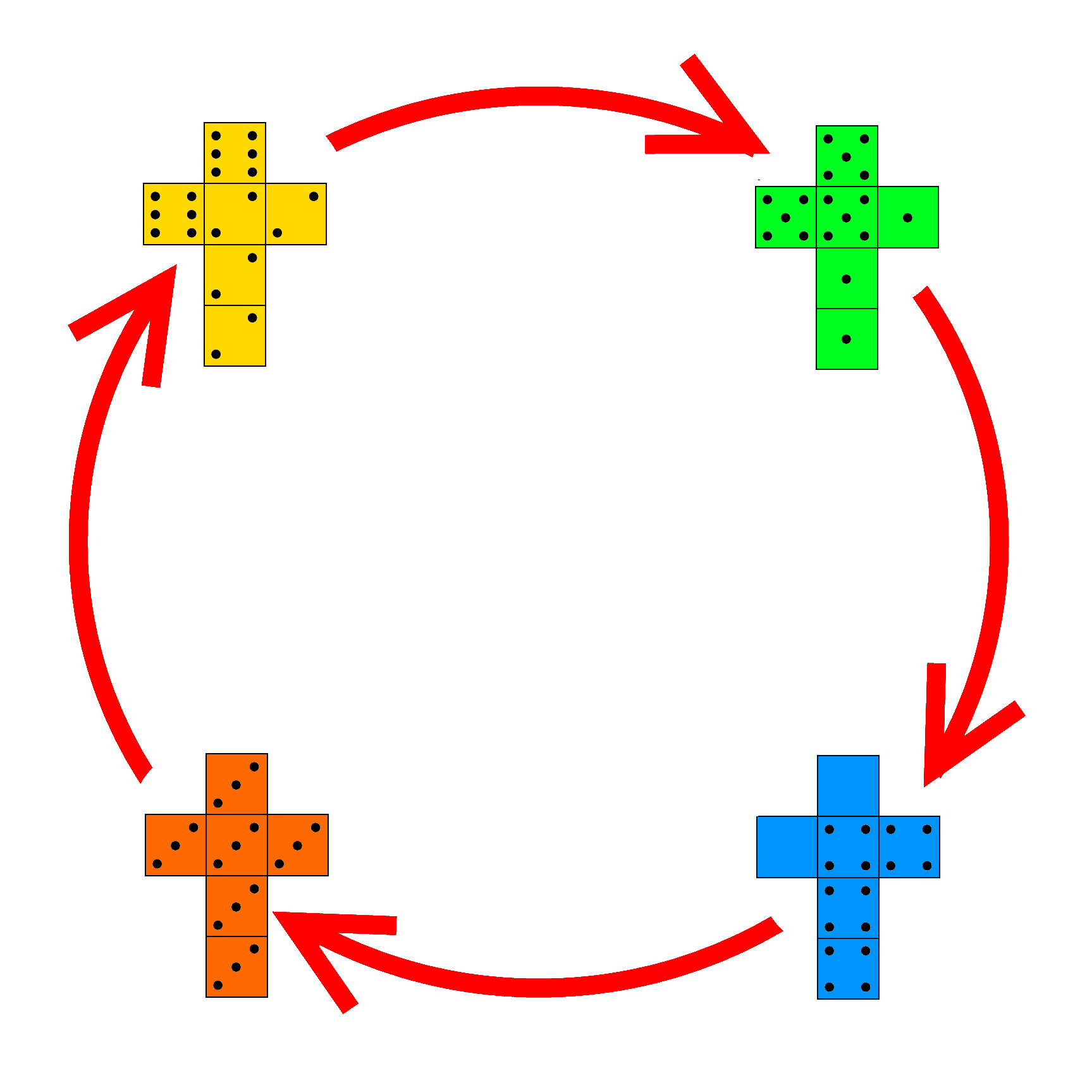 After studying the numbers on the dice Gates said, “This is a losing proposition. You choose first.”
He was one of three people, writes Buffett, “I ever showed them [dice] to who figured the trick.”
What was the trick? The dice were non-transitive.
In mathematics, whenever an element A is related to B and B is related to element C and if that implies that C is related to A, then we say that the relationship between A, B, and C is transitive. So if A, B, and C are numbers and if we can say that A is greater than B and B is greater than A then it can be derived that A is greater than C. So “greater than” is a transitive relationship.
In our set of four abnormal dice, a transitive relationship doesn’t hold. Let’s try to understand why is it so.
Let’s pick yellow die and the red die. The yellow die will show the number 6 one-third of the time and the number 2 two-thirds of the time. Whereas the red die will always come up with 3. So red die will beat the yellow die two-thirds of the time, i.e., in a game of 10 throws, the red die would likely win more number of times than yellow.
If you do a similar analysis, you’d realize that yellow die beats green die more often. Green beats blue more often and blue beats red. It’s quite peculiar and counterintuitive scenario but you can’t question the maths behind it.
So irrespective of the first person’s choice, the second player can always choose a die which will beat the first person’s die more often. Which means, if Gates chose red, Buffett would’ve picked blue die. If Gates selected green, Buffett would have taken red and so on.
Gates didn’t take much time to figure out that the odds were against the first mover in this game. Put simply, the trick to winning the game is in making the opponent choose first. It’s a game designed to favour the second mover.
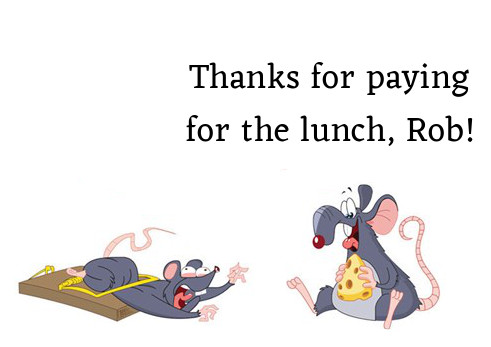
The early bird may get the worm, goes the adage, but the second mouse gets the cheese. In the common mousetrap design, the first mouse attempting to take the cheese out of the trap would probably be injured or killed. Once the trap has been triggered, the cheese becomes freely available and the second mouse can comfortably grab it without any risk.
If you’ve played tic-tac-toe, you’d realize that it’s a game opposite to the game of dice. Tic-tac-toe also needs two players. A 3×3 grid is drawn on the paper and each player chooses their mark – either X or 0. The player who succeeds in placing three of their marks in a horizontal, vertical, or diagonal row wins the game.
The game is structured to benefit the first mover. If you get the first turn, and you put your mark on the center square in the grid, you cannot lose the game even against a tic-tac-toe grandmaster.
People who belong to the tic-tac-toe school of thought argue that the first company to enter the market has a decisive edge over those who step in later. In many cases, the market does reward the first-movers with monopoly status and high margins.
Often, the late entrants face the challenge of attracting customers from the first-mover firm, because the customer might face switching cost when adapting to the new product. Not only that, it might be hard to convince users to switch to a new product when they are accustomed to one brand or are familiar with the first-mover’s products.
Liquid soap is a pretty standard product for every household these days but in the late 70s, it was just sold by one tiny company, Robert Taylor’s Minnetonka. That brought the attention of much larger companies, which could rapidly produce an imitator with better distribution and marketing. However, the FMCG giants didn’t realize that there were only two suppliers for the plastic pump dispenser which the liquid soaps needs and Taylor had already purchased the entire amount that those two suppliers could produce for next two years.
That’s the kind of advantage first movers can sometimes afford. Taylor captured a considerable market share. Colgate Palmolive had to buy out Taylor’s company eventually. Although this was more of an example of a shrewd move than business strategy, it still highlights the dynamics of the situation where being first mover can stall the competitors.
Now, in spite of first-mover advantage being instrumental in building market share, it may not always translate into business success.
The lesson we can draw from this Buffett-Gates wager is that “first mover advantage” doesn’t always work. Sometimes, the odds of the business game are such, writes Prof. Bakshi, “that it is advantageous for you to allow your opponents to make the first move and then decide your own move (including whether you want to move at all or not).”
Google wasn’t the first search engine. Neither was Facebook the first social network. Amazon wasn’t the first e-commerce company either. And Apple certainly wasn’t the first company to create personal computers. IBM was first. I am not trying to make a point by cherry picking the names which confirm my hypothesis. I intend to highlight the case studies which can help you find patterns where second-mover can have a structural advantage over the first movers.
When you’re the first to market, the onus of doing all the initial heavy lifting is on you. Since you’re entering unchartered territory, there is no clear road map to follow. You need to innovate rapidly and fail forward through your experiments because the problems you face have never been encountered by anybody before. And while you do that, the second-movers are usually waiting on the sidelines, taking notes and learning from your mistakes.
Take the case of Uber and Lyft. If you’re in India chances are you haven’t heard of Lyft. It’s a hailing taxi service like Uber and Ola. Even though Lyft is not as big as Uber, it’s far more profitable than Uber. The first-mover advantage for Uber has been very costly for them.
Meanwhile, second-mover Lyft had to raise less money is in a much healthier position. Taxi service is not an easy industry to crack. It has a lot of regulations and Uber had to spend a lot of time, money and effort to work with those regulatory challenges to pave its way. Lyft didn’t have to shell out a single dime to deal with those regulatory hurdles. Uber did it for Lyft.
Pioneers usually die of bug bites and dysentery, writes Bill Green in his insightful article, “Unless your goal is to be known as an innovator and not a business leader who wants to build businesses that will be successful, your chances are success are far greater by watching the mistakes others make and improving upon them. There is no shame in being a second-mover. At least, no more shame than being a promising first-mover who ends up losing ground to a faster, smarter second-mover.”
So what can investors learn from all this rant?
One lesson is to buy businesses that have the second-mover advantage. In his book The Dhandho Investor, Mohnish Pabrai has discussed in detail how Ray Kroc (founder of McDonald’s) and Bill Gates thrived by exploiting the second-mover advantage.
Ray Kroc and Bill Gates are the great business successes of our era – and shameless lifters of other people’s great ideas. Sam Walton was a lifelong student (and lifter) of other retailers’ models. Most of Wal-Mart’s business model was lifted from Kmart. If you carefully study the most successful businesses around, you’ll notice that much of it has been lifted and scaled by great executors.
In seeking to make investments in the public equity markets, ignore the innovators. Always seek out businesses run by people who have demonstrated their ability to repeatedly lift and scale.
Pabrai has done the same three times in his career – successfully. The first business that made him a millionaire, Trans Tech, was an idea that he got from his earlier employer. His investment business, Pabrai Funds, was a clone of Warren Buffett’s partnership structure. And Pabrai’s philanthropic organization – Dakshana – is a copy of Anand Kumar’s Super-30 model.
Now, that’s a roundabout way to benefit from the second-mover strategy. However, there’s a direct way to apply this into your investment process. It’s called cloning. Pabrai has recently popularized cloning in the value investing community.
The idea is to generate your investment ideas from the companies that other people. These are the people who you admire for their investment skills. And then from that list you pick up the businesses that you understand for more in-depth analysis.
Please don’t confuse cloning with coat-tailing. Cloning is just a starting point for your investment analysis. Cloning is a second mover advantage not a second mover guarantee. The idea is to increase your odds of success by narrowing down your universe of available investment ideas to a smaller set of qualified businesses that have already passed the test of other intelligent investors.
First mover advantage is an age-old idea. But second mover advantage is probably the new kid in the block. Even the Devil likes it.
Devil and his friend were pursuing a man who was walking down a street. Suddenly they saw God approaching the man ahead of them. The friend asked the devil, “What’s God going to tell that man?”
“God is enlightening him with the supreme truth,” said the Devil.
“That is very bad business for you, then,” said his friend. “Oh, not at all,” the Devil replied, “I am going to let him organize the truth into a religion.”
Devil clearly had the second mover advantage, didn’t he?[/show_to] [hide_from accesslevel=’almanack-all’]
- Spotlight: Big ideas from Value Investing and why applying them in your investment decision making will be a great deal
- InvestorInsights: Interviews with experienced value investors, learners, and deep thinkers
- StockTalk: Thorough analysis of business models of companies (without any recommendations)
- Behaviouronomics: Deep analysis of human behaviour and how it impacts investment decision making
- BookWorm: Reviews of the best books on Value Investing and related subjects
- Free Course – Financial Statement Analysis for Smart People (otherwise priced at Rs 5,900)
- Archives: Instant access to our huge archive from the past three years