
Prof. Sanjay Bakshi once observed —
People in the investment community are often too judgmental about developments. They forget the Pari-mutuel nature of markets where the behaviour of others changes the odds. They indulge in first level thinking and don’t pause, reflect and ask questions like “and then what?” If the development is unfavourable, the pain avoidance mechanisms in their brains make them run away from a situation which is getting even more attractive because others are running away.
And Then What?
“And then what?” is a very important filter for robust decision making.
Every action has consequences: intended and unintended. No matter how carefully we plan, we can’t anticipate everything. We live in a universe governed by multi-variate cause-effect network. Focusing on one variable can almost always distract you from the unexpected side effects.
[show_to accesslevel=’almanack-all’]
Charlie Munger —
…the consequences have consequences, and the consequences of the consequences have consequences, and so on. It gets very complicated.
The problem is grounded deep into the nature of things, in the principle that in a complex system you can never ‘do merely one thing.’ When one variable is maximized other variables often get minimized in an undesired way.
And there is no other place like Stock Market where trying to pin down the arrow of causality to a single reason will get you in trouble. Always.
Stock market can be characterised as a weighing machine built on many investors’ individual views and transactions (and their behavioural biases). This weighing machine is continually adapting to new information under conditions of uncertainty and complexity.
One can’t simply look at a single investor’s action or one industry performance or an isolated econometric parameter to predict the behaviour of stock market.
So when you’re trying to wrap your head around the puzzle of why certain business has a long profitable runway ahead, don’t forget to ask “and then what” for each of those future scenarios. If you keep doing it honestly, it will certainly lead you to some very interesting (and even obvious) insights.
Compared to What?
Investing is essentially a game of choices — which stocks to choose and which to let go — comparing different alternatives or opportunities. And when a choice is made, an opportunity is taken, it always comes at the cost of a comparable alternative left unpursued. What would have happened if that alternative path was pursued?
Asking “compared to what” is a smart trick to understand when someone is trying to explain to you ‘why a particular outcome happened.’
Bevelin explains —
Try to find out what is different when things go wrong. What was different — the underlying conditions, some variable, the behavior — when you had the problem compared to what normally happens in similar situations. Or if a problem persist over time, what factor, etc. is consistently different when we have problems? Also, ask ‘what normally causes this kind of problem?’ It could of course also have been a pure random event.
Famous blogger Tim Urban who writes at Waitbutwhy.com, shared following image on Twitter sometime back.
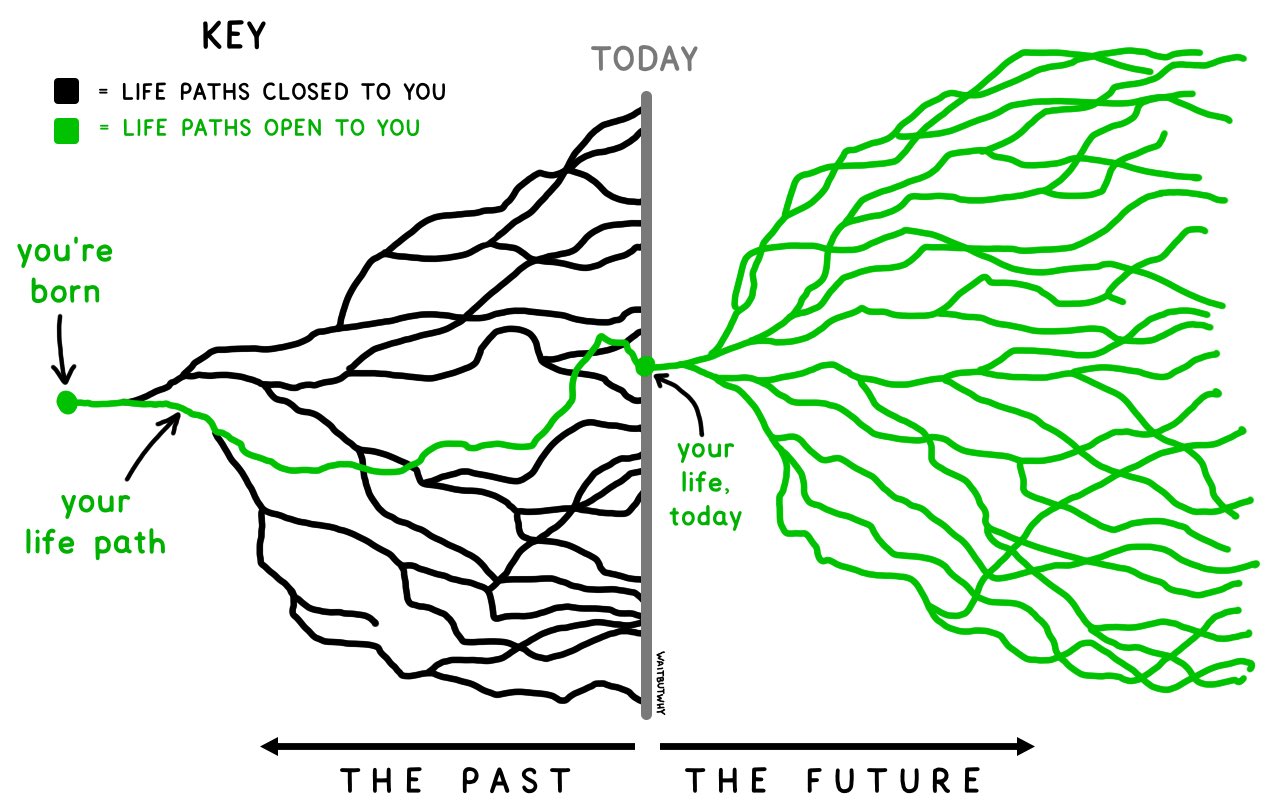
While Tim’s point was about appreciating the future choices we still have to bring meaningful change in our lives, what caught my attention was that future paths were all painted green — the color of your life path which brought you to today. And the way I interpret is that the path that’s visible to us between past and today — the green one — is going to have its flavour onto all the future paths that we’d take.
If you weren’t blind to all the black paths in the past, I posit, your future paths will be more colorful rather than being limited to shades of green.
Keep asking “compared to what” and that might unlock the important (and colorful) insights.
[/show_to] [hide_from accesslevel=’almanack-all’]- Spotlight: Big ideas from Value Investing and why applying them in your investment decision making will be a great deal
- InvestorInsights: Interviews with experienced value investors, learners, and deep thinkers
- StockTalk: Thorough analysis of business models of companies (without any recommendations)
- Behaviouronomics: Deep analysis of human behaviour and how it impacts investment decision making
- BookWorm: Reviews of the best books on Value Investing and related subjects
- Free Course – Financial Statement Analysis for Smart People (otherwise priced at Rs 5,900)
- Archives: Instant access to our huge archive from the past three years