
One of my college professors who guided me during my final year BTech thesis often said —
If I ask you something and you don’t know the answer then you may look like a stupid for that moment. But if you don’t figure out the answer then you remain stupid forever.
At that time, his statement didn’t seem anything more than a witty remark. But as years have passed, I have slowly come to realize that it was a piece of deeply profound advice.
Being ignorant is okay. Everyone is ignorant about something or the other. However, once my ignorance is shown to me and then I don’t do anything about it, then it’s pure stupidity.
Humans have been in existence for hundreds of thousands of years. If you take the homo sapiens from 100,000 years back and compare his anatomy with that of a modern-day human, it’ll be pretty much the same. Even their brain structures wouldn’t be much different. But compare the progress mankind has made in terms of development and scientific know-how about nature’s secrets, the world we live in today is unrecognizable from the world a few hundred years back.
Sample this —
[show_to accesslevel=’almanack-all’]
- In the year 1500, there were about 500 million Homo sapiens in the entire world. Today, there are 7 billion.
- In 1500, few cities had more than 100,000 inhabitants. Today, more than 125 cities in the world have a population of 1 million or more.
- The total value of goods and services produced by humankind in the year 1500 is estimated at $250 billion, in today’s dollars. Nowadays the world GDP is close to $60 trillion.
- In 1500, humanity consumed about 13 trillion calories of energy per day. Today, we consume 1,500 trillion calories a day.
- Prior to the sixteenth century, no human had circumnavigated the earth. Today anyone with a few hundred dollars can safely and easily circumnavigate the globe in just forty-eight hours.
- In the entire history of evolution, no organism had managed even to leave the earth’s atmosphere. That changed in the late 19th century with the invention of airplanes and now humans have their footprints on the moon.
This breakneck speed of development in the past five centuries came to be known as The Scientific Revolution. What triggered this revolution in the last 500 years and why hadn’t it happened earlier?
Until 1500 AD, when people were confounded by anything, they looked up in the sky or went to their priests who would attribute all the mysteries to God. Priests alleviated the seeker’s curiosities and sufferings by telling them some version of this — “That’s how God does it. That’s how God wants it. Do XYZ to keep the Gods happy.”
But that attitude changed around 1500 AD. Yuval Harari in his book Sapiens writes —
During the last five centuries, humans increasingly came to believe that they could increase their capabilities by investing in scientific research. This wasn’t just blind faith – it was repeatedly proven empirically. The more proofs there were, the more resources wealthy people and governments were willing to put into science. We would never have been able to walk on the moon, engineer microorganisms and split the atom without such investments.
These investments channeled the research towards the acquisition of useful knowledge. Knowledge fueled growth. Growth propelled the research deeper and further. This feedback loop created a virtuous cycle of discovery and development which humankind had never witnessed before.
This thirst for knowledge stood on the acceptance that we were ignorant and something had to be done about this ignorance. Harari writes —
The Scientific Revolution has not been a revolution of knowledge. It has been above all a revolution of ignorance. The great discovery that launched the Scientific Revolution was the discovery that humans do not know the answers to their most important questions.
The willingness to admit our ignorance was the primary catalyst that started rolling the snowball of knowledge. Harari again —
Premodern traditions of knowledge such as Islam, Christianity, Buddhism and Confucianism asserted that everything that is important to know about the world was already known. The great gods, or the one almighty God, or the wise people of the past possessed all-encompassing wisdom, which they revealed to us in scriptures and oral traditions. Ordinary mortals gained knowledge by delving into these ancient texts and traditions and understanding them properly. It was inconceivable that the Bible, the Qur’an or the Vedas were missing out on a crucial secret of the universe – a secret that might yet be discovered by flesh-and-blood creatures.
Ancient traditions of knowledge admitted only two kinds of ignorance. First, an individual might be ignorant of something important. To obtain the necessary knowledge, all he needed to do was ask somebody wiser. There was no need to discover something that nobody yet knew.
The willingness to admit ignorance has made modern science more dynamic, supple and inquisitive than any previous tradition of knowledge. This has hugely expanded our capacity to understand how the world works and our ability to invent new technologies.
Unlike the scholars and prophets of the premodern era who claimed that their respective versions of truth were right, the scientists and Nobel laureates today happily admit the fact their discoveries only reveal part of the truth. Most scientists don’t shy away from accepting the limitations of their theories and that’s what keeps them busy — an ending scientific investigation to answer the unexplained parts of their discoveries.
In one of his talks, the famous Indian spiritual teacher Sadhguru Jaggi Vasudev explained that as a kid it was easy for him to accept that he didn’t understand most of the things around him. This attitude required him to pay enormous attention to everything he came in contact with. This need to pay unwavering attention to anything he chose to focus on made him even more curious and pushed him deeper into the rabbit hole. He stopped taking things for granted. That attitude, according to him, sowed the seed for developing a far more nuanced understanding of things than most others.
Embracing our ignorance is an idea based on the Latin injunction ignoramus — ‘we do not know.’ Perfect knowledge is unattainable but acknowledging that we don’t know can set us on the path of developing a broader perception about things which would be much more useful than basking in the comfort of false confidence derived from half-baked truth.
Sometime back Vishal drew a simple yet powerful illustration which captures this idea well.
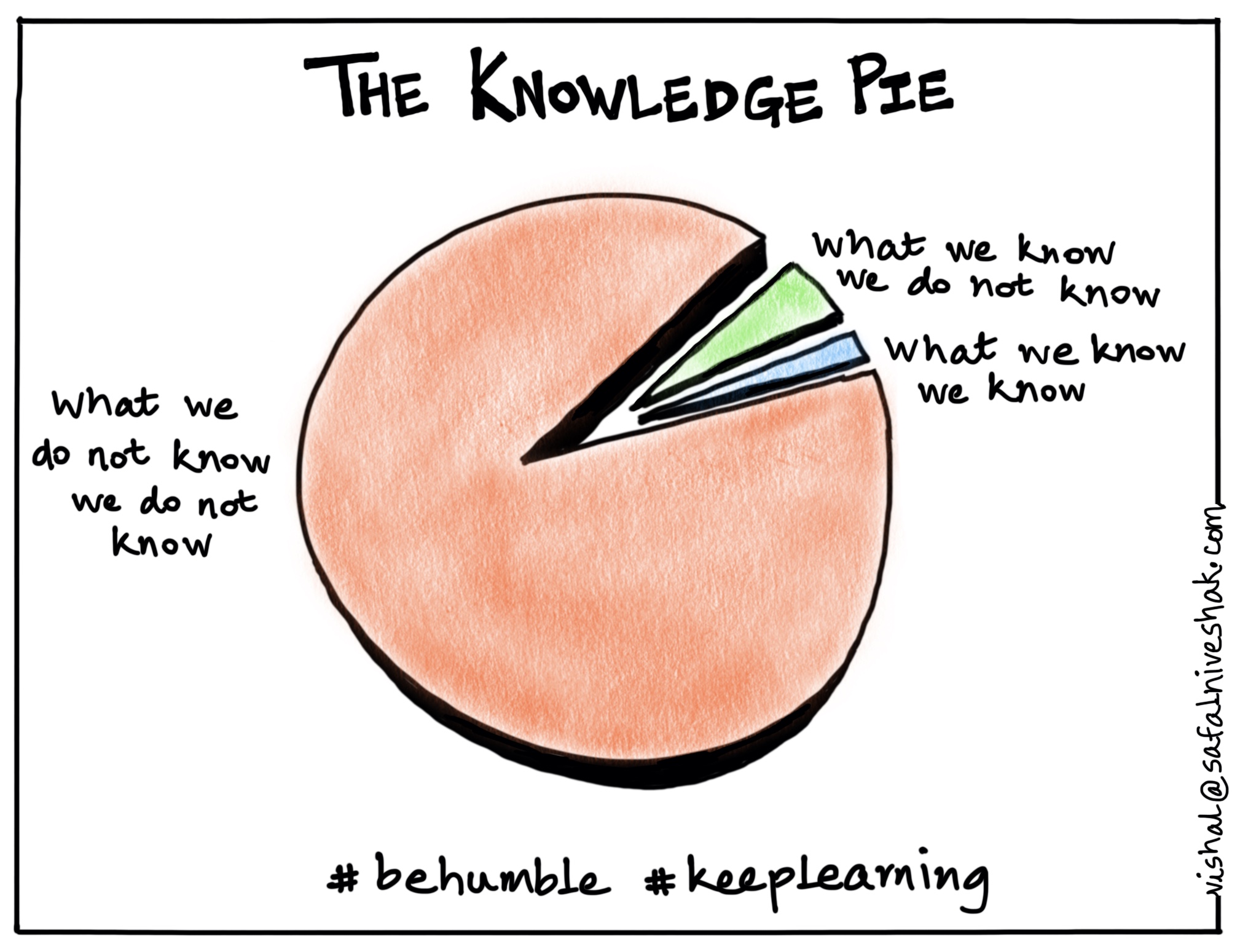
A fascinating (and sometimes demotivating) effect of this idea — acknowledging our ignorance — is that by nibbling away the ignorance, we increase it further. That’s counterintuitive.
As I said earlier, working towards eliminating ignorance gives you a worldview which may be better than your earlier version of the truth but it will nevertheless be incomplete. The only unchangeable truth that you realize every time is that the more you know, the more there’s to know — much more than you imagined.
I often remind myself of this metaphor — The Island of Knowledge.
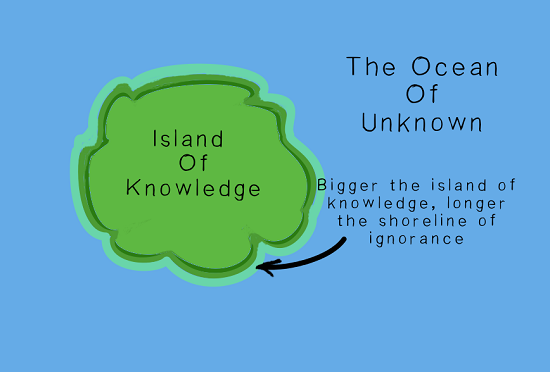
In that sense, the quest for seeking wisdom is nothing but a long, arduous search for spotting the fence that separates unknown from the familiar.
Ignorance, they say, is a bliss. That bliss, however, is usually short-lived and has hard consequences over the long term.
But when one takes their ignorance and turns it into motivation for discovery then there’s a massive upside to it. A constant pursuit for unearthing our ignorance is not only beneficial but a very satisfying way to live a meaningful life.
In the context of investing, Warren Buffett’s idea of circle of competence is nothing but choosing to focus on ignorance. When Buffett says that one should be more concerned about the boundaries of the circle of competence rather than the size of it, he’s telling us to focus on that shoreline of the island of knowledge.
Almost everything we know today has an expiry date. What works today may stop working tomorrow. Or what didn’t work earlier may become relevant today and start working. To make effective decisions based on some piece of knowledge demands that we’re sure about the expiry date. But when it comes to what we don’t know, expiry date doesn’t matter. Allow me to explain.
When you know what you don’t know it becomes easier to avoid it so it can’t hurt you. That’s why awareness about ignorance is a more robust form of wisdom than knowledge itself.
In the end, the two most important ideas that have turned my world upside down in recent years are —
- Not taking my knowledge very seriously and;
- Not letting that stop me from acquiring more knowledge.
Because it’s not the knowledge itself but the knowledge about our ignorance that will save us from big blunders.
There’s something magical about these words — I don’t know but let me figure out. So keep figuring out. Keep pushing the boundaries of your ignorance. Keep looking like a stupid — about different things; about new things. [/show_to] [hide_from accesslevel=’almanack-all’]
- Spotlight: Big ideas from Value Investing and why applying them in your investment decision making will be a great deal
- InvestorInsights: Interviews with experienced value investors, learners, and deep thinkers
- StockTalk: Thorough analysis of business models of companies (without any recommendations)
- Behaviouronomics: Deep analysis of human behaviour and how it impacts investment decision making
- BookWorm: Reviews of the best books on Value Investing and related subjects
- Free Course – Financial Statement Analysis for Smart People (otherwise priced at Rs 5,900)
- Archives: Instant access to our huge archive from the past three years