I have two stories for you today.
Mafias of Silicon Valley
In 2002, eBay acquired Paypal, an online payments company, for $1.5 billion. Unfortunately, the founding members and early employees of PayPal couldn’t adjust to the new corporate culture. Shortly after the acquisition, they left eBay. A number of these ex-PayPal employees worked together to form wildly successful companies in subsequent years. You may recognize some of these names – Elon Musk founded Tesla and SpaceX, Reid Hoffman created LinkedIn, and Steven Chen built YouTube. This group of PayPal alumni became so prolific that a new term was coined for them –PayPal Mafia.
Fortune magazine popularised the term when it published a photo of these former PayPal employees in gangster attire.
The PayPal Mafia (Image Source: Wikipedia)

But PayPal mafia wasn’t the first Mafia group of Silicon Valley. The history goes back to a time when the Silicon Valley didn’t exist.
<!–more–>[show_to accesslevel=’almanack-all’]
In 1956, John Bardeen, Walter Brattain, and William Shockley were awarded the Nobel prize for discovering transistor as a new alternative to vacuum tubes. Next year
Shockley quit Bell Labs, moved to Palo Alto and built a team of eight talented PhDs. But soon those eight engineers left Shockley and founded their own company called Fairchild Semiconductor.
Here’s what became of those Traitorous Eight.
One of those eight was Gordon Moore. Remember Moore’s law?In 1968, Robert Noyce, another one of those eight, along with Moore co-founded Intel. In 1969, Jerry Sanders from the same group founded AMD. Today, Intel and AMD with a combined market cap of $200 billion dominate the microprocessor market. In 1972, yet another of the Traitorous Eight, Eugene Kleiner, co-founded the venture capital fund, Kleiner Perkins Caufield & Byers. The firm would go on to fund Amazon, Google, and many other leading companies.
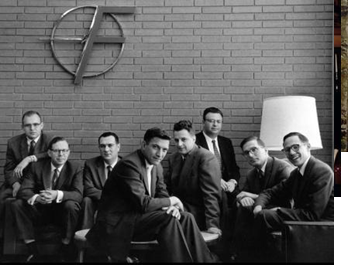
The Traitorous Eight (Image Source: Wikipedia)
So this was the first Mafia to come out of Silicon Valley. Or shall we say, Silicon Valley came out from Fairchild Mafia? That’s because Paul Alto and its neighbouring cities in California were first christened Silicon Valley on 11 January 1971, when the weekly trade newspaper Electronic News, inspired by the most important material used in semiconductors, i.e., Silicon, started a new series of articles titled “Silicon Valley in the USA.”
The Genesis of iPhone
In 2000, Steve Jobs charged Mike Evangelist’s team with developing a simple way to turn a home movie into a DVD. For weeks Mike and his team worked hard to refine their ideas for an interface that would be user-friendly enough for Steve and prepared to share their work with him by creating all kinds of sample screens and verbal explanations.
They would never get a chance.
On the day of their presentation, Jobs walked into the room, ignored their work, and walked right up to the whiteboard. “Here’s the new application,” he said. “It’s got one window. You drag your video into the window. Then you click the button that says ‘Burn.’ That’s it. That’s what we’re going to make.
Seven years later, on 9th January 2007, Apple announced the iPhone. It had one button.
The Lesson
So, what’s the point of these two stories? Is there a message in these anecdotes? Can we draw any useful lessons from them?
To be honest, the answer is a no. Although both the stories that I narrated above are true, equally gripping and entertaining, there’s little you can learn from them as far as the content of the stories is concerned.
A story usually portrays a lopsided view of the reality. A story that appeals to the mind follows a single line of causality and ignores all the other possibilities that could have been but didn’t transpire. Because of the survivorship bias, making decisions based on stories is bound to lead to mistakes.
Practicing rationality requires ignoring the seduction of great stories.
Having said that, there’s still a lesson here. Not in the stories but in the way those stories were told. A meta-lesson if you will.
Since both the stories above describe real events, I could have simply stated the facts. But weaving an engaging narrative makes the impact more powerful and lasting.
The cat sat on a mat is a fact. The cat sat on the dog’s mat is a story. Moreover, a story doesn’t have to be fictional. Truth, they say, is stranger than fiction.
Narrating a tale is a handy tool to initiate and sustain conversations. Anecdotes engage people immediately because the human mind is built to seek narratives. Stories are a great way to attract attention and package your message in a way that it registers and sticks with your audience.
Anyone who has built successful business is usually a great storyteller. Running big companies requires channelling the energy and attention of the large group of people in a single direction. It can’t be done just by offering money. Money may entice the rational side of the brain, but stories trigger the emotions.
So, telling true stories in an impactful manner is a remarkable quality. And this is the quality that an investor should look for in the person who is running the business.
But don’t forget, there’s a massive difference between a story that drives home the truth and a narrative that obscures the truth. Unfortunately, it’s not easy to differentiate if the CEO is telling a tale to lead or mislead, to convince or to manipulate.
However, there is one way in which you can learn this. And that’ by becoming a good storyteller yourself.
Stories Source: Creative Catalog
Further Reading:
• Latticework of Mental Models: Storytelling
- Spotlight: Big ideas from Value Investing and why applying them in your investment decision making will be a great deal
- InvestorInsights: Interviews with experienced value investors, learners, and deep thinkers
- StockTalk: Thorough analysis of business models of companies (without any recommendations)
- Behaviouronomics: Deep analysis of human behaviour and how it impacts investment decision making
- BookWorm: Reviews of the best books on Value Investing and related subjects
- Free Course – Financial Statement Analysis for Smart People (otherwise priced at Rs 5,900)
- Archives: Instant access to our huge archive from the past three years