We are galloping towards a world when machines will be doing most of the work. That’s good news and bad news. On one hand, it means that most work will get done faster, cheaper and with fewer errors. On the other hand, it means a lot of people will lose their jobs, especially those who do things which a machine can do more efficiently, like driving cars or crunching numbers.
This demands that we build skills which artificial intelligence can’t copy, at least not as easily and not sometime shortly.
Writing is one such soft skill. The ability to form an emotional connection with other human being using words is a skill that can future-proof one’s career.
No matter who you are or what kind of job you do, ability to write well isn’t a “good to have” have skill anymore. It’s a prerequisite to survive the onslaught of technological disruption staring at you. It’s going to be the most important block in the future talent stack.
Now that I have convinced you why you should improve your writing skills let me offer you some insights on nuts and bolts of good writing skills.
<!–more–>[show_to accesslevel=’almanack-all’]
Monkey with A Typewriter
The most common advice received by budding writers is this – write a lot. After all, to become good at something, you must spend a lot of time doing that activity. Isn’t it?
The famous 10,000-hour rule confirms this hypothesis. It states that expertise in any field demands ten thousand hours of practice. When they hear this, the aspiring writers get busy accumulating their hours.
The only problem with this approach is, as a mathematician would say, it’s a necessary but not a sufficient condition.
For example, the infinite monkey theorem states that an infinite number of monkeys hammering random keys on their personal typewriters, one of them would (with 100 percent certainty) will end up producing complete works of Shakespeare. In computer science, it’s called the brute force approach.
Fortunately, we’re not monkeys. So, we’ll use our above-monkey-average intelligence and use some time-tested strategies to improve our odds. The first thing we can do is to learn the rules of the game.
Learn the Rules
Vocabulary and grammar are the basic building blocks of any language. They ensure your writing makes sense. Rules are meant to be broken, goes one adage. Yes, but only after you have learned and practiced those rules. The right to break the rules is earned by mastering them first. Having said that, writing is an art. Any art form serves as an outlet for human creativity. And no creative pursuit can be contained by rules. So, don’t get chained by rules.
The purpose of rules and guidelines is to ease the lives of your readers and you. Use words and phrases that come readily to hand. Don’t open a Thesaurus and start replacing your words with synonyms.
Similarly, don’t obsess over perfect grammar. Do you worry about grammatical correctness when talking to a friend? No, right? So, just focusing on telling a good story.
But don’t let the creative expression become an excuse for not improving your knowledge of the language. The best book to get a handle on the rules of English language is Elements of Style.
After you have learned the basics, pick the next low hanging fruit for better writing, i.e., eliminate the common mistakes that most writers do. Error-free writing reduces cognitive load. In fact, learning the do’s is as important as avoiding the don’ts. This strategy will immediately put you in the top ten percent. For example, learn the difference between “it’s” and “its,” between “then” and “than.” These blunders prick any knowledgeable reader right in the centre of his eye. It won’t take more than few hours. Maximum return on your time and investment. Once you drop a pebble of your writing into the ocean of the internet, you don’t know how far and wide the ripples will travel. Maybe a young aspiring writer in an obscure corner of the world is fascinated with your ideas and decides to learn from you. Isn’t it your responsibility to not screw up his writing skills?
Reuse the Giants
Steve Jobs said, “good artists copy; great artists steal.” No wonder Jobs stole that quote from Pablo Picasso. He practiced what he preached. Of course, if you give appropriate credit then, in the real sense, it’s not stealing. It’s leveraging. Powerful words have the same effect irrespective of the source.
Isaac Newton said, “If I have seen further it is by standing on the shoulders of giants.” The software people took Newton’s statement little too literally. Part of the reason why the world of software has progressed with a maddening pace in past few decades is a concept called reusability. A piece of hardware, like a car tyre or a brick in the wall, can be used physically only once. Software doesn’t have that limitation. At the most fundamental level, a software code is nothing but text, like a forwarded message in WhatsApp. It can be shared with as many people as many times as one wants. The cost and the time required for creating an extra copy is close to zero.
The principles of good programming lay huge emphasis on something called code-reuse. Reusability saves time, effort and avoids repetition of same errors. People who reuse others code don’t have to reinvent the wheel. Heck, they don’t even have to know how that piece of reusable code works as long as they understand what it does and how it’s supposed to be plugged into other places.
So, as writers, that’s the first lesson we can draw from the world of computer programming. Reuse. Leverage the work that giants have done. They have already packaged the words in a way that creates impact. Imitate it. That’s what I did when I quoted Steve Jobs or when I parroted Isaac Newton.
I may not yet know why Jobs’ or Newton’s words sound unusually convincing. All I understood is that those words, in their original form, sound far better than what I could hope to write myself. So, I figured that I could reuse them. I have used this trick liberally in all my blog posts in last three years. It works. If I can find someone smarter than me who has said the same thing in a more convincing way, why shouldn’t I reuse it? Why reinvent the wheel?
But use this idea with caution. Don’t forget to give appropriate credit, else it’s called plagiarism, a fancy word for petty theft.
The side effect of imitation is that it rubs off on you. Who’s the first person who reads the stolen word? The person sitting on your chair. You. Every time you read it, it rewires your brain a bit. Subconsciously, your ability to express your thoughts improves. That’s the spillover effect of stealing like an artist.
After reuse comes imitation.
Imitate
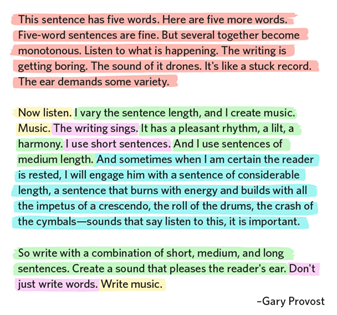
Imitate people who are good writers. And the imitation could start from borrowing their words verbatim. Here’s an interesting experiment. Read the following paragraph from Gary Provost and then write it (or type it on a keyboard) as it is with your own hand.
Notice how it feels to have those words flow through your hands. It’s a useful learning hack. The great American inventor and statesman, Benjamin Franklin devised a system based on imitation to improve his writing skills. Franklin wrote –
I took some of the papers, and, making short hints of the sentiment in each sentence, laid them by a few days, and then, without looking at the book, tried to complete the papers again, by expressing each hinted sentiment at length, and as fully as it had been expressed before, in any suitable words that should come to hand.
Then I compared my Spectator with the original, discovered some of my faults, and corrected them. By comparing my work afterwards with the original, I discovered many faults and amended them; but I sometimes had the pleasure of fancying that, in certain particulars of small import, I had been lucky enough to improve the method or the language, and this encouraged me to think I might possibly in time come to be a tolerable English writer.
Benjamin Franklin method is an excellent example of how Deliberate Practice can be used to master any skill.
Now, the million-dollar question at this stage is – how do you find stuff worth reusing and imitating? By reading. A lot.
Read with Writer’s Mind
Reading for entertainment doesn’t count. It’s not reading when the words flow over you like a warm water bath. Read with a writer’s mind.
What is a writer’s mind? When a normal person encounters a stimulating piece, his or her mind comprehends the meaning, relishes the feeling and then quickly moves on to the next sentence. A writer’s mind does the same, but it doesn’t stop there. It goes to the next level. A writer deconstructs the sentence, evaluates the choice of words, analyses the length of the prose, and notices any unusual metaphors or adjectives used by the author. He thinks about how else the same sentence could have been written. A writer rips apart the text like a curious toddler dismantling his new toy.
This sounds hard. Doesn’t it? That’s why it can’t be done with everything that you read. That’s why everything you read doesn’t add to your writing skill. But the more you read with writer’s mind, the better you become as a writer.
Write Like You Talk
Paul Graham is a very successful entrepreneur and venture capitalist. He’s also known for his thought-provoking essays which he’s been writing for past 15 years on his blog. A simple trick for getting more people to read what you write, Graham says, “is to write in spoken language. Written language is more complex, which makes it more work to read. It’s also more formal and distant, which gives the reader’s attention permission to drift. But perhaps worst of all, the complex sentences and fancy words give you, the writer, the false impression that you’re saying more than you actually are.”
How do you know what you’ve written sounds like you’re talking? A simple way to test that is read out loud what you’ve written. Graham suggests –
Before I publish a new essay, I read it out loud and fix everything that doesn’t sound like conversation. I even fix bits that are phonetically awkward.
So, use conversational voice. Write as if you are talking to a friend. Make it personal. This is where the habit of journaling helps a lot. In journaling, you’re talking to yourself without worrying that anyone else is ever going to read it. That unblocks the creative channels. This habit also makes you comfortable in writing simple sentences capturing mundane thoughts.
Learn Persuasion
Writing is about clarity and persuasion, writes Scott Adams, creator of Dilbert, “The main technique is keeping things simple. Simple writing is persuasive. A good argument in five sentences will sway more people than a brilliant argument in a hundred sentences. Don’t fight it.”
Good writing stimulates by triggering new thoughts in a reader’s mind. This requires pressing the right buttons. Persuasion principles help you find those buttons. For a long time, the art of persuasion was reserved for the expert sales people and marketing professionals. Using persuasion tricks is still thought of as an act of manipulating people into doing things which they won’t otherwise do. That’s not always true. Persuasion is about understanding the human nature.
The best book to read on this topic is Robert Cialdini’s Influence – Psychology of Persuasion. In his book Cialdini describes the six most fundamental principles of persuasion.
Write Daily
This sounds like an advice which I bashed at the beginning of this post.
“Isn’t writing daily a brute force approach? Didn’t you just ridicule it?” You might say at this point. Allow me to explain. Brute force is solely hard work. But there’s no getting away from hard work even if after you’ve learned the tricks that we discussed above.
Almost every successful writer I have read about makes it a point to write daily. Many of those people do it first thing in the morning. Many set aside a dedicated time slot (which doesn’t change) to ensure it becomes a habit. Writing routines is a great resource for learning about various methods successful writers use for producing quality content consistently.
As I said earlier, the purpose of improving writing skills is not to become a professional writer but to add to your talent stack and make yourself indispensable in a world where automation is gobbling up jobs like a Pacman. So you may not need to reserve 3 hours every day for practicing writing. It could be as little as 15 minutes a day. Or 500 words every day. Whatever works for you. If you don’t feel like writing, just write one word at a time. Like a marathoner who focuses on just putting one foot ahead of the other.
Thanks for reading.
[/show_to] [hide_from accesslevel=’almanack-all’]- Spotlight: Big ideas from Value Investing and why applying them in your investment decision making will be a great deal
- InvestorInsights: Interviews with experienced value investors, learners, and deep thinkers
- StockTalk: Thorough analysis of business models of companies (without any recommendations)
- Behaviouronomics: Deep analysis of human behaviour and how it impacts investment decision making
- BookWorm: Reviews of the best books on Value Investing and related subjects
- Free Course – Financial Statement Analysis for Smart People (otherwise priced at Rs 5,900)
- Archives: Instant access to our huge archive from the past three years