
On August 5, 1949, at 4.10 pm local time, a crew of fifteen Smokejumpers — United States Forest Service’s elite airborne firefighters — parachuted into Helena National forest in the state of Montana.
The fire started when lightning struck the south side of Mann Gulch at the Gates of the Mountains, a canyon over five miles, running along the Missouri River. A gulch is a topographic structure with slopes on both sides running down to a ravine.
First spotted by Jim Harrison, a firefighter himself, the fire was spread over an area of 50-60 acres wide.
By the time the smokejumpers landed on the top of the north side hill, Harrison had been fighting the fire alone for the past four hours.
[show_to accesslevel=’almanack-all’]
Wagner Dodge, an experienced smokejumper foreman, was leading the team. He planned to trek down on the north slope of Mann Gulch to the River and cross over to the south slope where the fire was burning.
As the crew descended the steep north slope towards the river, they didn’t realize that a spot fire had started at the bottom of the north slope also, directly downhill from the men. The time was 5.30 pm.
Fifteen more minutes passed until Dodge noticed the spot fire on his side of the valley. It took him a second to figure out that the fire was about to come roaring up the north slope towards the smokejumpers.
It was as if the fire didn’t like the intruders and decided to deal with them first.
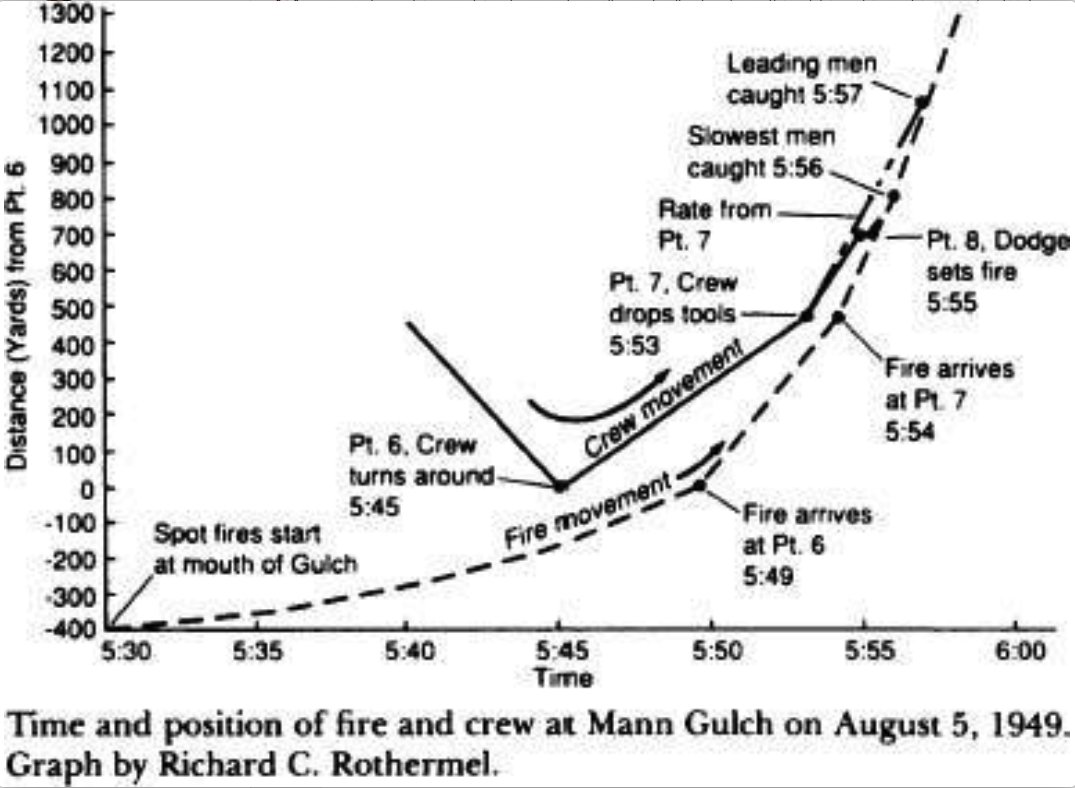
Dodge immediately waved at his team to turn around and run back up the hill. It took only four minutes for the fire to reach the point where the crew had turned around. When the fire was just a minute behind them, the troopers decided to drop their gear to run faster.
How do you outrun a 30 feet firewall being fueled by 30 mph winds while you’re climbing a 75-degree slope? You can’t.
Less than two hours from the time those 15 men set foot on Montana hill, thirteen were dead. The Mann Gulch tragedy was the subject of Norman Maclean’s book Young Men and Fire.
The following chart describes the speed at which wildfire engulfed the smokejumper team.
But this post isn’t about the death of 13 daredevil smokejumpers. It’s about the survivors. Specifically about Wagner who was among the three who didn’t die that day.
The other two — Bob Sallee and Walter Rumsey — managed to escape through a crevice and get away from the fire. The luck found them before fire could.
Dodge, true to his name, dodged the death through an ingenious counterintuitive tactic — he lit an escape fire.
At 5.55 pm, Dodge lit another fire in front of him, covered his face with a wet handkerchief and dived face down into the ashes left by this second smaller fire. By letting a new fire consume the dry grass around him, he starved the fire behind him.
Dodge fought the fire with fire.
Although the idea of escape fire wasn’t unknown at that time, it wasn’t part of the firefighter training. Dodge came up with this trick on his own, right in the middle of a life and death situation. The insight was a product of creative desperation.
The Mann Gulch story comes from Garry Klein’s book — Seeing What Others Don’t.
Klein writes —
In his work on chess grand masters the Dutch psychologist Adriaan de Groot used the term “creative desperation” to describe some of the brilliant strategies that players invented when they got into trouble. The clock would be winding down, they’d be in tough situation, none of the plausible moves worked, and then, out of desperation, they would find an unorthodox line of play that would save them, gambling on some leverage they might never have tried to use if any of the acceptable moves had looked promising.
History, they say, is written during wars.
For decades, nations have been worrying and silently preparing for the third world war. It would be foolish (and irresponsible) of me to claim that this is the beginning of the third world war. But the turn of events has been unprecedented.
Wagner Dodge was at war with wildfire. Today, we’re at war with an invisible enemy. The Covid-19 outbreak has pushed us to the wall.
Thousands have died and it looks there’s no stopping for the infection to reach millions in the next few weeks. It’s uncertain how long this war will last. But what’s certain is that this is a moment of creative desperation.
Which means, escape fire like inventions are inevitable. Not just in terms of finding a cure but also building our response and support systems.
Morgan Housel, in his recent blog post, observed —
The Great Depression brought unimaginable financial pain. It also brought us supermarkets, microwaves, sunscreen, jets, rockets, electron microscopes, magnetic recording, nylon, photocopying, teflon, helicopters, color TV, plexiglass, commercial aviation, most forms of plastic, synthetic rubber, laundromats, and countless other discoveries.
Same for World War II, which is responsible for both the most risk and the most rapid invention of any six-year period in history. The war began with troops on horseback. It ended by splitting an atom in half.
The war gave rise to everything from penicillin to radar to nuclear power. All of those ideas had been largely discovered, at least on paper, before the war. But the life-or-death urgency of the situation sparked rapid refinement and deployment, in some cases generating the kind of technology advancement you might expect to occur in a generation into literally a few months.
The most important innovations are born from panic-induced necessity more than cozy visions. That’s been true for a long time, and I can say with high confidence that it’s true today.
A random mutation in nature has brought us at the door of a unique uncertainty.
We may not be prepared for it but we’ve never been so capable in the entire human history.
On one hand, there’s concern that the health care systems world wide are soon going to run out of resources. On other hand, smart innovators are coming together to design ventilators and 3D print them for mass production. Hackathons are being organized to create softwares and tools that will help those who are on the front line fighting the outbreak.
Nassim Taleb in his book Antifragile wrote —
Wind extinguishes a candle and energizes fire.
Likewise with randomness, uncertainty, chaos: you want to use them, not hide from them.
You want to be the fire and wish for the wind.
I hope the Corona wind energizes the fire of human ingenuity and survival spirit.
Stay at home,
Stay safe, and
Keep washing your hands.
[/show_to] [hide_from accesslevel=’almanack-all’]- Spotlight: Big ideas from Value Investing and why applying them in your investment decision making will be a great deal
- InvestorInsights: Interviews with experienced value investors, learners, and deep thinkers
- StockTalk: Thorough analysis of business models of companies (without any recommendations)
- Behaviouronomics: Deep analysis of human behaviour and how it impacts investment decision making
- BookWorm: Reviews of the best books on Value Investing and related subjects
- Free Course – Financial Statement Analysis for Smart People (otherwise priced at Rs 5,900)
- Archives: Instant access to our huge archive from the past three years