
Heraclitus, the Greek philosopher who lived during 5th century BC, said –
A man can never step into the same river twice, for it’s not the same river and he’s not the same man.
I would like to posit that Heraclitus’ observation applies to books also. Unlike the river, a book doesn’t change much but the reader does.
When you reread a book, what you see and understand is very different from what you saw when you read it the first time. It’s true for the good books as well as the bad ones. In your second reading, you may realize that the book you initially thought as amazing wasn’t really so and vice versa.
[show_to accesslevel=’almanack-all’]Any good book is typically a result of an author’s years of research and thinking. Without rereading, it may be impossible to appreciate the author’s subtle talents or to wrap your head around the intricate ideas and themes in the text. The author must have spent countless hours agonizing over what he should include in the book and what should be left out.
It’s not given that anything he decides to omit from the final draft of the book was unimportant. Maybe it was unimportant from the author’s point of view because as far as the ideas presented in his books are concerned, everything is crystal clear in his own head. He might be suffering from the curse of knowledge.
In his mind, he’s already connected all the dots. So tossing out few intermediate dots may seem harmless. But most readers are normally unfamiliar with the new idea. Moreover, unlike the author, they haven’t sweated over the same thoughts.
For any book that has unusual insights which most people aren’t aware of, the first reading is guaranteed to confuse most readers. It’s the second and the subsequent readings that refine the understanding.
Have you ever noticed how a very high-resolution image loads on your internet browser? It first loads the whole picture but it’s very blurry. Then it progressively sharpens the resolution. It’s called progressive rendering. The image below is an illustration of how progressive rendering for images work –
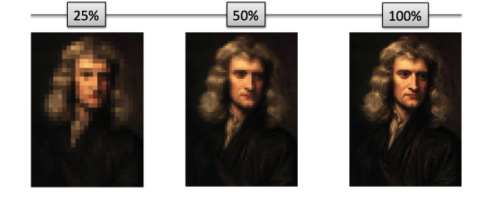
Deriving useful insights from books is like progressive rendering. Your learning goes through a process of incremental refinement. If you’ve found a book worth reading, make sure you re-read it. And after few months, maybe after few years when you come back to it the third time, you’d find surprising insights. In the intervening time, you must have read other books, absorbed many other ideas which changed your brain. It’s not the same brain which read the book the first time.
It’s like weight training. Lifting 20 kgs prepares you to lift 30 kgs and more.
Straining the body slightly beyond its capacity breaks the muscle fibers. During the recovery period, those muscle fibers don’t just grow back to their original strength. They come back bigger, better and stronger. That’s the antifragility of the human body.
Reading is like that. An antifragile process. It needs iterations and feedback.
Any book worth reading is worth reading twice, says Nassim Taleb, author of wildly popular books Fooled By Randomness, The Black Swan and Antifragile.
The biggest injustice that you could do to a great book (and to yourself) is to read the book only once.
Reading books is just one of the tools for learning. And depth scores over breadth when it comes to learning anything. In other words, deeply reading one book is far more useful and meaningful than racing through ten books. British author Frances Osborne said it best –
A few books well studied, and thoroughly digested, nourish the understanding more than hundreds but gargled in the mouth.
Josh Waitzkin, in his book The Art of Learning, writes –
The learning principle is to plunge into the detailed mystery of the micro in order to understand what makes the macro tick.
Another analogy I find very convincing is that of an onion. Reading a good book is like peeling the onion. There are multiple layers to it. Every pass through the book gives you access to the next layer. The more you peel them back, the more likely you’re going to stumble upon new insights that you missed previously.
In fact, if you find a book which keeps revealing deeper insight every time you re-read it, it qualifies as a Supertext. A supertext is something which never loses its relevance. The more you read it, the more useful it becomes. Supertext never ages, in fact, it reverse ages.
Prof. Sanjay Bakshi, in the note he shared with Vishal on what to read for investors, wrote –
I found out that the answer is yes and the discovery is to do with the science of sleep. I found that if I read some random passage from a “super text” (e.g., some page from Poor Charlie’s Almanack or some passage from the letters of Warren Buffett or Common Stocks and Uncommon Profits by Philip Fisher) just before I sleep, then while I slept what I had read does things inside my brain. When I wake up, I get fresh insights which I can use.
Some of the books which I have read more than once and intend to read again are –
- Thinking, Fast and Slow by Daniel Kahneman
- Seeking Wisdom by Peter Bevelin
- Poor Charlie’s Almanack by Peter Kaufman
- The Dhandho Investor by Mohnish Pabrai
- All books by Nassim Taleb (Fooled By Randomness, The Black Swan, Antifragile, Skin In The Game)
- All books by Yuval Noah Harari (Sapiens, Homo Deus)
- How to Fail at Almost Everything and Still Win Big by Scott Adams
- Influence by Robert Cialdini
Interestingly, none of these books came into my life because I read the reviews on Amazon. In my opinion, online reviews are not the best way to find Supertexts. The most reliable source for discovering super texts is to ask people who you know are voracious readers and seem to have mind-stretching insights.
Nassim Taleb, in his latest book Skin In The Game, writes –
Many book reviewers are intellectually honest and straightforward people, but the industry has a fundamental conflict with the public, even while appointing itself as representative of the general class of readers.
Nor can book reviewers – by the very definition of their function – judge books that one rereads.
Learning is rooted in repetition and convexity, meaning that the reading of a single text twice is more profitable than reading two different things once, provided of course that said text has some depth of content.
So how many books should you read every week, every month, every year?
As we’ve seen, that a wrong question. Stop counting the books you’ve read. And if that’s the reason you’re reading the book, you are in the wrong game. Tracking book count is, at best, a means to stroke the ego.
A more useful question to ask is – how many books have you re-read? Is there a book which you have read three or four times, or even more? So that’s what I do now. Whenever I seek book recommendation, I don’t ask for favourite books. I ask for books which people have re-read.
In fact, that’s a great bullshit busting question. If someone names a book as his favourite and he hasn’t re-read it, chances are he hasn’t even completed it once. He’s just hand-waving, trying to look smarter.
My version of Taleb’s quote is – a book worth reading is worth reading twice and worth owning in both formats, i.e., print and the Kindle version. In fact, my list of books are precisely the books that I have given out most as gifts. [/show_to] [hide_from accesslevel=’almanack-all’]
- Spotlight: Big ideas from Value Investing and why applying them in your investment decision making will be a great deal
- InvestorInsights: Interviews with experienced value investors, learners, and deep thinkers
- StockTalk: Thorough analysis of business models of companies (without any recommendations)
- Behaviouronomics: Deep analysis of human behaviour and how it impacts investment decision making
- BookWorm: Reviews of the best books on Value Investing and related subjects
- Free Course – Financial Statement Analysis for Smart People (otherwise priced at Rs 5,900)
- Archives: Instant access to our huge archive from the past three years