Lots of people I know have been victims of harassment and trolling on social media. Over the years, and especially in recent times, I have also been picked on by a few trolls to the point where it became ridiculously easy to predict exactly what they’re going to do on something I post or tweet, and how they are going to blow everything I say out of context, and how they’re going to whine and make a big deal out of things that shouldn’t even be of their concern to begin with.
Earlier I used to respond to these trolls with clarifications and counter-arguments. As I realized, that was useless and disturbing, especially for all others who were also hearing the noise coming out of my home (where these trolls had barged into).
Then I stopped replying to such criticism and kept quiet till people got personal – like someone recently calling me “grossly overrated value homeopathic quack.” 😉 And then I started blocking people sending such stinkers. In fact, I used the blocking tool generously.
Now, I realize even that tool does not serve much purpose. This is because even when I block people sending me negative criticism (and that too personal), I am still giving them and their thoughts some importance.
<!–more–>[show_to accesslevel=’almanack-all’]
This realization set in when I asked a question to a person I respect a lot. My question was – “How do you deal with people who negatively criticize you or your work etc. on social media platforms? I allow for some such criticism and then block people who continue to do it. Is this the right/wrong thing to do?”
He replied, “Block trolls. Allow constructive criticism of ideas. If it gets personal, block.”
Before I could reply, he sent me another email with the message, “And have an inner scorecard. You don’t have to give much weight to what someone unimportant to you thinks of you.”
Inner Scorecard?
This last point – about having an inner scorecard – got me thinking. Interestingly, I had come across this thought just a few days back while reading Warren Buffett’s biography Snowball.
In this book, Buffett is quoted in Chapter 3 as saying…
The big question about how people behave is whether they’ve got an Inner Scorecard or an Outer Scorecard. It helps if you can be satisfied with an Inner Scorecard.
I always pose it this way. I say: ‘Would you rather be the world’s greatest lover, but have everyone think you’re the world’s worst lover? Or would you rather be the world’s worst lover but have everyone think you’re the world’s greatest lover?’ Now, that’s an interesting question.
Here’s another one. If the world couldn’t see your results, would you rather be thought of as the world’s greatest investor but in reality have the world’s worst record? Or be thought of as the world’s worst investor when you were actually the best?
In teaching your kids, I think the lesson they’re learning at a very, very early age is what their parents put the emphasis on. If all the emphasis is on what the world’s going to think about you, forgetting about how you really behave, you’ll wind up with an Outer Scorecard.
Now my dad: He was a hundred percent Inner Scorecard guy. He was really a maverick. But he wasn’t a maverick for the sake of being a maverick. He just didn’t care what other people thought. My dad taught me how life should be lived. I’ve never seen anybody quite like him.
These are special words, and you must read them again. Like I did after receiving the email from the gentleman I admire a lot.
Let’s face it. Not a day goes by that we are not tempted to glance to the left and to the right to see how we measure up to the people around us and what others think of us and our work. But it doesn’t stop there, does it?
We’re tempted to compare our children to other children, our spouse to other spouses, our salary to others’ salaries, our car to others’ cars…and our stocks to others’ stocks. It’s frustrating. It’s exhausting. And as Buffett would tell you, it’s a trap.
This act of comparison with others – or seeking validation from others – is what is driven by living with an Outer Scorecard. And all it leads to is constant frustration, because we will never stand up perfectly to what everyone else wants us to look like or be like. Over that, there are many of those who are waiting to criticize and pull us down, whatever we say or do.
No One Ever Kicks a Dead Dog
When you are kicked and criticized, remember that is often done because it gives the kicker a feeling of importance.
It often means that you are accomplishing something and are worthy of attention. Many people get a sense of savage satisfaction out of denouncing those who are more successful.

Consider this story that Dale Carnegie shared in his book How to Stop Worrying and Start Living of Admiral Robert Peary who…
…startled and thrilled the world by reaching the North Pole with dog sleds in 1909 – a goal that brave men for centuries had suffered and starved and died to attain. Peary himself almost died from cold and starvation; and eight of his toes were frozen so hard they had to be cut off. He was so overwhelmed with disasters that he feared he would go insane. His superior naval officers in Washington were burned up because Peary was getting so much publicity and acclaim. So they accused him of collecting money for scientific expeditions and then “lying around and loafing in the Arctic”. And they probably believed it, because it is almost impossible not to believe what you want to believe. Their determination to humiliate and block Peary was so violent that only a direct order from President McKinley enabled Peary to continue his career in the Arctic.
So if someone like Admiral Peary who achieved something amazing and praise worthy can still be criticized/trolled, perhaps his story can give us comfort the next time we’re attacked by unjust criticism.
As long as in your heart you know you did the right thing or you believe in what you did, unjust criticism should be considered and analyzed whether it truly has any merit, but not be given permission to belittle what you are trying to achieve.
Also remember what Carnegie wrote in his book…
“…unjust criticism is often a disguised compliment. The more important a dog is, the more satisfaction people get in kicking him.”
Inner Scorecard and Investing
The concept of Inner Scorecard isn’t restricted to how you live your life alone, but also follows through to how you invest your money.
Howard Marks wrote this in Chapter 10 of The Most Important Thing…
…thoughtful investors can toil in obscurity, achieving solid gains in the good years and losing less than others in the bad. They avoid sharing in the riskiest behavior because they’re so aware of how much they don’t know and because they have their egos in check. This, in my opinion, is the greatest formula for long-term wealth creation – but it doesn’t provide much ego gratification in the short-term. It’s just not that glamorous to follow a path that emphasizes humility, prudence, and risk control. Of course, investing shouldn’t be about glamour, but often it is.
And then, remember what Ben Graham wrote in The Intelligent Investor?
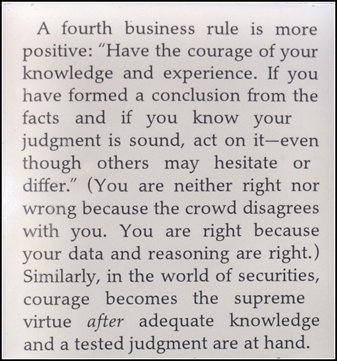
You are neither right nor wrong because the crowd disagrees with you. You are right because your data and reasoning are right.
…and that’s the only thing that makes you right. Then, you don’t have to worry about anybody else.
And then, like Buffett is quoted in Snowball, if your investment results are not there in front of others to see (and this is one grouse a few trolls have with me – they don’t get to see my investment results and thus question it despite I never making much fuss about it), you are better off being thought of as the world’s worst investor when you know that you are doing sufficiently well for yourself.
Conclusion
Thriving in the real world requires the mindset of working with an Inner Scorecard. Not a religious devotion, but a commitment to the work, as opposed to the rewards.
Even if we do everything right, the reaction might be failure, disrespect, jealousy, or even a resounding yawn from the world. If we are motivated by the wrong thing – if ego holds sway – this response will crush us.
I’ve seen it happen a hundred times. I’ve done it myself too. And, yet, far too many of us only feel strong enough to pursue our dreams when we have a team of people cheerleading in the background. That’s having an Outer Scorecard and the problem is obvious.
If you live based on your Outer Scorecard, you fall to pieces when people stop cheering. It’s a brave soul – one with the Inner Scorecard – who can keep moving when all seems lost, all the fans have left the building and, in their place, are people shooting, “Boo!”
The world is, after all, indifferent to what we humans want. What can go wrong will. Only misery and disappointment awaits. But if we can find joy and satisfaction in the work, that can be ours right now.
The biggest lesson of living with an Inner Scorecard is that you must not aim to be the best out there. Rather, you must aim to be the ‘best you’ you can become. And in that pursuit, anyone who sends you his or her unjust or negative criticism, or trolls you, has no space or identity. You must ignore such people completely and, like I have done now, unblock them in case you blocked them earlier. 🙂
Let them say whatever they have to say about you, for you are now working with an Inner Scorecard, not Outer.
[/show_to] [hide_from accesslevel=’almanack-all’]- Spotlight: Big ideas from Value Investing and why applying them in your investment decision making will be a great deal
- InvestorInsights: Interviews with experienced value investors, learners, and deep thinkers
- StockTalk: Thorough analysis of business models of companies (without any recommendations)
- Behaviouronomics: Deep analysis of human behaviour and how it impacts investment decision making
- BookWorm: Reviews of the best books on Value Investing and related subjects
- Free Course – Financial Statement Analysis for Smart People (otherwise priced at Rs 5,900)
- Archives: Instant access to our huge archive from the past three years