
Some of the greatest things, the greatest discoveries, have come about by serendipity. Let’s explore its magic here.
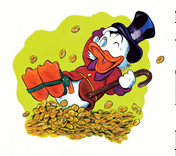 I recently wrote about the mental model of Inversion in Safal Niveshak’s Latticework series. ‘Inversion’ suggests that sometimes you stumble upon very useful insights by inverting the problem.
Now, what use is a mental model if you can’t implement it? So let’s use it, for the sake of personal amusement, to investigate one of the most popular problems in the world.
Yes I am talking about the conundrum of – “How to get rich.” The inherent assumption here is that everyone wants to be rich and they are just looking for the “how” part. Keeping that in mind, one of the ways to invert this question is to ask – “Is getting rich worth it?”
Before you decide to skip this article thinking that it’s another one of those “money can’t buy happiness” rant, just stick with me for few more lines and I promise that you won’t regret.
I consider this as an opportunity to wear my curiosity cap and look at the real and practical problems faced by super rich. Now given the fact that the author, yours truly, isn’t so rich (money wise), is it justified for him to comment on problems of rich? So in my defence all I have to say is that I never let my lack of first-hand experience with a topic stop me from speculating on it.
Unlike previous Life 2.0 articles, this post doesn’t aim to provide any ‘how to’ advice. My intention is to share with you a different perspective, the view from the other side of the fence where grass seems greener.
[show_to accesslevel=’almanack-all’]
This article is inspired from a very interesting discussion thread on Quora. . The participants in this thread include some rich and successful people like Paul Buchheit, who created Gmail. So it’s safe to assume that it’s not a pure thought experiment imagined by an armchair philosopher offering unsolicited advice. Although the Quora thread has lot of hackneyed and philosophical arguments, I have tried to filter out the ones which made some sense to my rational side of brain.
Not every item that I am going to list here is a problem for every rich person, but some, even many, of these are possibilities. And let me remind you again that these are not my views and I don’t necessarily agree with all of them, but they made me smile while thinking about them. Consider them my musings on the topic of unintended consequences of extreme wealth.
On a serious note, if you ever plan to amass wealth and fame, you should at least know what you’re getting into.
The first category of challenge of being rich is related to your social interactions i.e., your equation with people around you. Here is what’s waiting for you…
Your Right to Crib is Revoked
Now that you’re rich (and people know that you’re rich), you are not allowed to complain about anything, ever. Since you’ve just achieved nirvana, you’re no longer allowed to have any human needs or frustrations in the public eye. Yet, you are still a human being, but most people aren’t going to treat you like one.
This may not really be that big a problem because, when you’re rich, you probably won’t care much as to what people think about you. But here is the catch – When you find yourself struggling with a nasty problem, which obviously can’t be solved by throwing money at (remember you’re rich), and you’re desperately seeking help from your family and friends – your folks won’t believe that you’re helpless. You’re pretty much on your own.
Unrealistic Expectations
When you get rich, your relationship with your friends and family will change. It may not get sour but it can get harder. Not because of money but because of change in expectations. Since you’re the superman now and have large resources at your disposal, it’s expected out of you to rescue everybody. You may be expected, not by all but by some among the family members and friends, to dole out interest free (give it and forget it) loans. It doesn’t stop there. You aren’t allowed to get away by giving modest gifts on special occasions.
C’mon man! You’re a millionaire. Don’t be cheap. Shell out some moolah for an expensive gift.:)
Hidden Intentions
Wealth makes you more discoverable unless you put a lot of efforts to lay low. Which means it attracts attention from all sorts of people – genuine and not so genuine. Genuine people may want to share your wisdom, experience and skill and some others may just be interested in a piece of your wealth. Point is that most people now want something out of you, and it can be harder to figure out whether someone is being nice to you because they like you, or because of your money. This is especially true of strangers who know more about your wealth than about you as a human being.
This will lead you to create a filter or a screen to ensure that only genuine people get access to you. But this screen will invariably filter out some good people along with not so good ones. Which means you’ll still be interacting with a mix of people, it’s just that the scale of this problem will be bigger because you’re rich. This can often cause people to cut themselves off from the larger society, out of fear that they will be exploited by selfish motives. As a result the richness and variety in your social circle may become very limited. Whoever said, “It’s lonely at the top,” probably was referring to this effect. Anyways, the next category of challenge is related to your relationship with yourself i.e., the psychological effects of getting rich.
Amplification Effect
Wealth removes constraints, which means becoming wealthy has the potential to mess with you. But it depends on what type of person you are. In general, it makes people more of whatever they already were.
For example, if someone has a serious alcohol or other drug addiction, wealth could be fatal for him. On the other hand if a person is generous, polite, and resourceful, money will amplify those qualities in his or her behaviour.
David Foster Wallace said,
Happy people are often still happy when they become millionaires. Unhappy people are often still unhappy when they become millionaires.
Freedom Brings Dilemma
Money can give you the freedom to focus on the things that truly matter to you. But that comes with the condition that you at least have some idea about what truly matters to you.
Most people work hard and money keeps them focused on earning more, doing the career-ladder thing and working towards their goals, but when they reach that money-goal, it creates weird issues. The void created by financial freedom could be a difficult one to fill. Which is why many supposedly rich people continue to work hard at earning more money because it keeps them busy.
The most profound effect that becoming financially successful can have on someone is the task of answering the question – “I wonder what am I supposed to do next?”
Ironically, the ability to pursue activities that you find meaningful and bring you happiness does not depend on getting rich. Albeit it can mean that insufficient funds calls for some resourcefulness on your part to continue pursuing your passion.
The Paradox of Desire
Now this could appear as an entirely unanticipated downside of getting rich.
Being rich is better than not being rich, but it’s not nearly as good as you imagine it is.
All of the things you picture buying, they are only worthwhile to you because you cannot afford them (or have to work really hard to acquire them). Maybe you have your eye on a new Mercedes car but once you know you can easily afford it, it just doesn’t mean as much to you anymore.
It’s basic human nature that the things which are just out of reach seem desirable. The moment an object of desire becomes easily available to you, its charm loses grip on you. This is especially true for things which are your wants, not needs. Realising that your dreams isn’t always what it’s cracked up to be can bring in disappointment and a boredom can quickly set in.
Diminishing Marginal Utility
Human mind it not good at evaluating things in absolute. It needs a benchmark or something to compare with to assess the value of something. Using this insight let’s see what the law of Diminishing Marginal Utility says –
For each additional unit of a good the added satisfaction you receive from consuming the good decreases.
So the idea is that everything is relative, and you are more or less powerless to that. Yes, the first month you drive the Audi, or eat in a fancy restaurant, you really enjoy it. But then you sort of get used to it. And then you are looking towards the next thing, the next level up. And the problem is that you have reset your expectations, and everything below that level doesn’t get you quite as excited anymore.
A research was done on two sets of people. First group consisted of those who experienced personal tragedies like losing a loved one or even becoming physically handicapped (losing one or more limbs) which diminished their ability to function normally. The second group of people were those who suddenly became rich. The research revealed that in both the groups, people returned to their base level of happiness, one year after the fortunate/unfortunate events happened.
Conclusion
I read somewhere, “Money doesn’t necessarily wipe out all your troubles. It just changes the kind of problems that life presents you. The only people who are completely trouble free are buried in the cemetery.”
If one is not happy now, chances are that he won’t be happy even after he is rich. Let me repeat, the intention in this post is not to pass judgement but to look at a situation from different vantage point. And my goal for compiling these thoughts was more to amuse myself than to educate the reader.
But if you have learnt something from this I would love to hear about it in the Almanack Forum
[/show_to] [hide_from accesslevel=’almanack-all’]- Spotlight: Big ideas from Value Investing and why applying them in your investment decision making will be a great deal
- InvestorInsights: Interviews with experienced value investors, learners, and deep thinkers
- StockTalk: Thorough analysis of business models of companies (without any recommendations)
- Behaviouronomics: Deep analysis of human behaviour and how it impacts investment decision making
- BookWorm: Reviews of the best books on Value Investing and related subjects
- Free Course – Financial Statement Analysis for Smart People (otherwise priced at Rs 5,900)
- Archives: Instant access to our huge archive from the past three years