In my first year in college, Manish lived just two rooms next to me in the hostel. He was 6 feet 2 inches tall, very friendly and very smart. In the first semester, he scored 98.8 percent and was ranked second in the institute. It wasn’t a small feat considering that the institute was IIT Bombay.
I knew his work ethics and diligence in studies so his academic performance wasn’t a surprise. Getting up at 4 am for studying and attending all the classes regularly came naturally to him. Maybe he made it look that way. But there was one thing very unusual about him. On the day of the exam, he always used to wear his favourite pink shirt. People admired him for his intelligence, hard work, and focus but his superstition about pink shirt just didn’t make sense. It even earned him a nickname – Pinky.
Not to mention, there were few other, less irritating, peculiarities about him. For example, both his table-clock and his watch were set 15-minutes ahead of the actual time. He couldn’t tolerate seeing a footwear upside down. And he never missed his 30-minute afternoon nap, come what may.
<!–more–>[show_to accesslevel=’almanack-all’]
I once argued with him, “When you know your clock is 15 minutes ahead, you would work according to that. How does it help? In fact, every time you must mentally adjust the time and then work accordingly. It unnecessarily increases your cognitive load.”
He would brush me off, “It’s a hack and it works for me.” I just couldn’t wrap my head around his strange habits. He knew what he was doing, after all, he was the institute-topper and I barely managed to get passing marks.
One day, his wing mates, including me, decided to play a prank on him. This was February 2000, my second semester of college, and our mid-semester exams had just started. Manish’s routine on exam days was like a clockwork. Our exams would start at 2 pm so he would finish his lunch by 12.30 pm and head back to his room for a 30-minute nap. When he was asleep, we locked his room from outside, changed the time in his alarm clock (and his wristwatch) to 3 pm, turned his footwear upside down and hid his favourite pink shirt.
True to his biological clock, he got up after exactly 30 minutes of nap and found everything wrong. Upside down footwear, locked doors, missing pink shirt and of course the clock said he had overslept. He became agitated and started shouting frantically. That’s when we decided to end the prank and opened his doors. He wasn’t very pleased with our idea of having fun and quietly left for the exams, wearing a different shirt. He scored his 98 out of 100 in that paper.
The day exam results were declared, some of us told him, “See! Your pink shirt doesn’t have any special powers. It’s your superstition.”
“It’s not a superstition. But you guys won’t understand so forget it.” Manish replied. He continued to sport his pink shirt on exam days for the rest of his time in college.
I forgot about this incident until recently when I came across an interesting passage in Rafael Nadal’s autobiography where he describes his routine just before a match –
I sat down, took off my white tracksuit top, and took a sip from a bottle of water. Then from a second bottle. I repeat the sequence, every time, before a match begins, and at every break between games, until a match is over. A sip from one bottle, and then from another. And then I put the two bottles down at my feet, in front of my chair to my left, one neatly behind the other, diagonally aimed at the court. Some call it superstition, but it’s not. If it were superstition, why would I keep doing the same thing over and over whether I win or lose? It’s a way of placing myself in a match, ordering my surroundings to match the order I seek in my head.
So, Manish was right. His pink shirt wasn’t a superstition. It was a way for him to send a subconscious signal to his mind that it’s time to get ready for peak performance. Manish understood what top performing athletes know. It was an intelligent hack which, on the surface, looked like a stupid superstition. No wonder Manish passed engineering at the top of his class, secured a full scholarship from Stanford University for higher studies and bagged the most coveted job in the campus placement. He knew the secret.
Sharpening the mind’s focus on the activity at hand requires deep concentration. Peak performers know the importance of external cues to trigger that flow state. It’s not uncommon to find celebrity sports people having such strange habits which look like superstitions. These are hacks to nudge the subconscious into a specific state. What an ignorant observer thinks of as a superstition is a scientifically proven mental trick to put the mind into an optimal state.
So how can mere mortals like us, who probably are never going to compete professionally in sports or any similar activity, benefit from this idea?
Well, if you are reading this, chances are you work in a setup where being good at reading, thinking and decision making are one of the most important traits for being successful. Whether you are an investor, software engineer, or a business executive, to be able to focus and think deeply about problems should be very important for you. Isn’t it?
In short, the most successful people in the modern world are those who can do deep work for extended periods of time. Deep work, according to Cal Newport, author of the book with the same title, is defined as –
Professional activities performed in a state of distraction free concentration that push your cognitive abilities to their limit. These efforts create new value, improve your skill, and are hard to replicate.
But the constant distraction and information overload of the modern work is the biggest enemy of the deep work. Relying only on your willpower to keep away the distractions and bring focus isn’t going to take you far. You need hacks. Like Nadal does. Like Manish did.
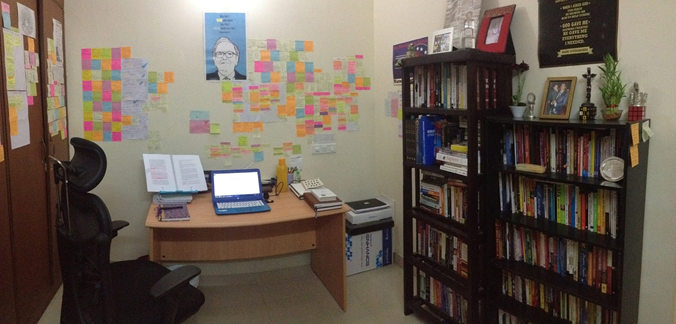
One such hack is to build a magic corner in your home or workplace. If you can afford a separate room or office, nothing like it but getting started with a small corner in your house is perfectly fine. A corner which has lots of visual cues related to the work that you want to learn to become better at. It can have post-it notes with quotes from your people who you want to emulate. You could perhaps have small pictures of them stuck on the wall as a reminder. Post-it notes can have lots of ideas that you find interesting and want to pursue in future.
You could have your bookshelf, reading chair and study table like I have done. See the above a picture of my magic corner at home.
My goal is to become an effective reader and better thinker. And building this magic corner has been the biggest personal discovery for me. This is the place where I spend most of my time reading, thinking, writing, learning, unlearning, imagining, wondering, connecting the dots and even dozing off (to facilitate diffused learning). When you enter the magic corner, its vibrations and energy gets hold of your subconscious and quickly puts you in the zone.
The zone where ideas, insights and creative juices start flowing uninhibited. Your magic corner becomes the pink shirt.
The more time one spends in his magic corner the stronger would be its vibrations and more productive it would become for you. It’s the perfect example of a positive feedback loop working in your favour. Anytime you want to enter your zone, your flow state, all you would need to do is go to your magic corner.
For that matter, a magic corner doesn’t necessarily have to be a physical space. It could be a slice of time in your day. You could carve out 30-40 minutes window of time from your day and reserve that period only for learning purpose. However, it can’t be a moving window. It needs to be a recurring period every day at the same hour. Like magic corner has a fixed place, your ‘magic-time-corner’ needs to be at a fixed place in time. It could be in the early morning, late evening or even during the day but you must mark it fixed. The moment that hour arrives, you must leave what you are doing and resume your creative work.
I have found that a physical magic corner is much easier to implement than a magic-time-corner. You could give a try to both and stick with what works best for you.
I have lost touch with Manish but I am sure by this time he has discovered few more learning and performance hacks. If I meet him again I won’t blow that chance by smirking at his superstitions.
So, what are you waiting for? Arise, awake and get your pink shirt.
[/show_to] [hide_from accesslevel=’almanack-all’]- Spotlight: Big ideas from Value Investing and why applying them in your investment decision making will be a great deal
- InvestorInsights: Interviews with experienced value investors, learners, and deep thinkers
- StockTalk: Thorough analysis of business models of companies (without any recommendations)
- Behaviouronomics: Deep analysis of human behaviour and how it impacts investment decision making
- BookWorm: Reviews of the best books on Value Investing and related subjects
- Free Course – Financial Statement Analysis for Smart People (otherwise priced at Rs 5,900)
- Archives: Instant access to our huge archive from the past three years