 The funny thing about quotes is that you can find anything said by an eminent personality that proves your point. History has produced numerous philosophers and genius thinkers who have made a variety of contradictory statements. Some have contradicted their intellectual rivals and some have even contradicted themselves.
Another risk of using famous quotes to prove your point is that the person reading the quote may not have the proper context in his mind and end up interpreting the sentence in a totally different manner.
Nevertheless, famous quotes are famous for a reason. Einstein’s quotes aren’t famous just because Einstein said them. In fact, many of the aphorisms attributed to Einstein weren’t even uttered by him. The famous quotes have the tendency to get etched in our memory because they pack the right combination of the words to convey a powerful idea in the most efficient manner. They may not be true but they make you think.
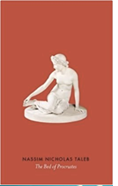
A quote has served its purpose if it makes you think. Whether you agree with it is something you can decide after you have worked out your own mental muscles by giving it an independent thought. That’s why reading a book of quotes can be a very rewarding experience. Especially, if the book has been written by your favourite author. Nassim Taleb, known for writing thick and idea-dense books, has also authored a relatively less known book called The Bed of Procrustes. He writes –
Aphorisms, maxims, proverbs, short sayings, even, to some extent, epigrams are the earliest literary form – often integrated into what we now call poetry. They carry the cognitive compactness of the sound bite….Aphorisms require us to change our reading habits and approach them in small doses; each one of them is a complete unit, a complete narrative dissociated from others.
<!–more–>[show_to accesslevel=’almanack-all’]
This book is a collection of Taleb’s own quotes. And the best part about this book is that Taleb has refrained from adding details to his one liners.
If you want to annoy a poet, explain his poetry.” quips Taleb. “Aphorisms lose their charm whenever explained.
I am sure Taleb would be annoyed to find out that someone (yours truly) tried to add commentary to his aphorisms. Well, in my defense I would say that I don’t see this as commentary. You could call it as a chain of thoughts that popped up in my head while mulling over these short sayings. So you’re free to accept/reject/modify these thoughts. In fact, I would love to hear back from you if you have managed to add other interesting dimensions to these maxims.
The person you are the most afraid to contradict is yourself.
Every year one should be killing one of his best-loved ideas. If that’s not happening you’ve wasted that year, argues Charlie Munger. This means that no matter how much caution and analysis you must have carried out while building your portfolio, you should be ready to accept the fact that one (or even multiple) of your investments is going to turn into a dud in future. Question is, are you afraid to discover it? Right now the risk may be limited to the embarrassment associated with contradicting yourself. If that risk is stopping you from discovering your mistake early on then you’re exposing yourself to a bigger risk – the risk of losing your capital and the risk of not learning from a mistake. The key to minimizing mistakes in investing is, to be honest with yourself.
An idea starts to be interesting when you get scared of taking it to its logical conclusion.
Staying consistent with one’s earlier stand is a trait which comes naturally to most human beings. Commitment-and-consistency is a bias which nature has embedded into human mind. The so-called lizard brain – that part inside human skull which has remained unchanged since our ancestors lived a life of hunter-gatherers in a corner of east Africa – creates immense resistance to accept the facts which seem to go against our long-held beliefs. Instead of changing our beliefs we prefer to discard the disconfirming evidence. The brilliant physicist Richard Feynman rightly recognized this human folly when he said, “One should not fool himself because you are the easiest person to fool.” Don’t be afraid to pursue an idea if it seems to threaten your prior worldview. It’s going to be uncomfortable in short term but it has huge payoffs in the longer term.
The test of whether you really liked a book is if you reread it (and how many times).
I would even go as far as saying this – a book not worth reading more than once is not worth reading at all. Google researchers estimated that approximately 130 million books have been published in the entire history of book publishing business. Typically, less than 1 percent of the published books are worth reading. So chances are that majority of the books that you start reading are going to be useless. Only a handful of books is going to make a significant difference in your life. These are the books that deserve multiple readings. When you find a book you think is very enjoyable and useful, you should make it point to re-read it. Not just once but multiple times. Such books are rare. It’s far better to pick up an old book that you liked than a new one.
As a corollary to this rule, don’t feel guilty about not finishing an uninteresting book. Put that book down and move on. Life is too short to be wasted on bad books. My friend Jana, whenever finds a great book, buys all the three versions of the book – hard copy, Kindle, and the audible. It’s a great way to experience the richness of a book from all three dimensions i.e., look, feel and sound.
People focus on role models; it is more effective to find antimodels – people you don’t want to resemble when you grow up.
Heard of the adage – the purpose of some people’s life is to serve as a warning for others. The most robust strategy to be successful is to find the mistakes that caused the failure and then eliminate those mistakes. Charlie Munger’s famous quote – all I want to know is where I am going to die so that I’ll never go there – may sound like a frivolous attempt at humor but has deep wisdom buried inside it. This is especially true in investing. Success is a lousy teacher because in investing there are a thousand ways to succeed but only a handful ways to fail. To find out those losing strategies, study anitmodels – people who failed spectacularly.
Knowledge is subtractive, not additive, writes Taleb, “what we subtract (reduction by what does not work, what not to do), not what we add (what to do). Taleb calls it Via Negativa. Munger calls it the principle of inversion. Do you want to know what works in investing? Sit down and dissect those stocks where you lost money. Have you ever seen how a plane crash investigation team works? They painstakingly go through every tiny piece of flight remains and then finally unearth the cause of the accident. Every stock where you lost money hides in its belly the clues to your next multibagger. In the complex world of investing, detecting patterns of success is less useful and avoiding the false patterns is more important.
In stock market, in brief: participants are calmly waiting in line to be slaughtered while thinking it is for a Broadway show.
It’s a known fact that 98 percent of the investors lose money in the stock market. Most new investors get lured into the world of investing through derivatives. At the beginning, derivatives create the illusion of an easy and quick way to make money. The brokers and financial institutions who are only interested in their commission hardly take it upon them to educate their clients. With no education about investing, money and stock market every new investor is a sitting duck. If they make money in their initial trades, it’s largely because of beginner’s luck which they mistake for their investing skills. The thrill of watching the price movements creates is nothing less than the effect produced by cocaine. It’s said that most investors think they are investing while they are just speculating; most speculators who think they are speculating are just gambling.
To be completely cured of newspapers, spend a year reading the previous week’s newspapers.
If you belong to the camp where newspapers are considered an important source of vital information then you need to try out this exercise. In fact, try reading one-year-old newspapers. Newspapers are perhaps the worst source of educating yourself. Reading newspapers create only an illusion of knowledge. The only reason one should read newspapers is to get some entertainment. And if entertainment is what you’re looking for then you don’t need the latest newspaper. In fact, you’d be more amused when you read old newspapers because you’ll quickly see, with the benefit of hindsight, that 99 percent of news is irrelevant and useless. If you think that you’re going to miss some piece of information that’s going to change the world then you must read this wonderful piece from Morgan Housel – – What we said when the world changed.. He describes how the newspaper media reacted when the two most important innovations in human history were taking shape – the invention of automobile and the invention of airplane.
The fastest way to become rich is to socialize with the poor; the fastest way to become poor is to socialize with the rich.
It’s not greed that drives the world, goes the adage, it’s envy. Comparison with other people is the deadliest trap that drives people to do crazy things. When a multi-millionaire CEO gets involved in questionable activities so that he can increase his worth by couple of hundred million dollars, his primary motivation is to envy. He can’t stand it that his friends are making more money than him. Inspite of being in a position to buy any luxury in this world, comparison keeps happiness unaffordable for him. So, the best way to feel rich is to count your blessings.
In investing, a missed 10-bagger can make an investor feel very poor especially if one of his friends made money through same stock. And a missed reverse 10-bagger can make one very happy if the same friend of his shirt in the same stock. Once you have enough to lead a comfortable life, the feelings of richness and poverty are all tied to what/who you compare with. For that matter, for most people, financial freedom is much nearer than they think, including your truly.
Here’s a timeless lesson on happiness from what Baloo told Mowgli in The Jungle Book – “Look for the bare necessities. The simple bare necessities. Forget about your worries and your strife.” Being rich, poor or financially free is less about having lots of money and more about having more control of our time. The key to riches is not more money but designing a life around the bare necessities.
Conclusion
The Bed of Procrustes is a short book and can be read in one sitting. And I am sure that one sitting is not going to be very comfortable because Taleb’s style isn’t very amicable. It has offended many people and can have the same effect on you too. But that’s the great thing about learning from books. You can disagree with the author, even voice your disagreement in form of marginalia.
I hope you’ll find some useful food for thought in this short book.
[/show_to] [hide_from accesslevel=’almanack-all’]- Spotlight: Big ideas from Value Investing and why applying them in your investment decision making will be a great deal
- InvestorInsights: Interviews with experienced value investors, learners, and deep thinkers
- StockTalk: Thorough analysis of business models of companies (without any recommendations)
- Behaviouronomics: Deep analysis of human behaviour and how it impacts investment decision making
- BookWorm: Reviews of the best books on Value Investing and related subjects
- Free Course – Financial Statement Analysis for Smart People (otherwise priced at Rs 5,900)
- Archives: Instant access to our huge archive from the past three years