
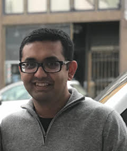
Rishi Gosalia works as a software engineer at Google. He has been investing his own capital since 2007 and more recently managing money for family and friends. He graduated from the University of Texas at Austin in 2003 as a Distinguished Scholar with an undergraduate degree in Computer Science and Pure Mathematics. Outside of engineering and investing, Rishi loves to travel, hike, read, and teach. He lives in San Francisco Bay Area with his wife and two kids.
In this interview, Rishi talks about his journey of self-learning and investing, and his experiences in compounding and multi-disciplinary thinking.
[show_to accesslevel=’almanack-all’]
Safal Niveshak (SN): Please share about your background and your education.
Rishi Gosalia (RG): I grew up in Mumbai, India. At the age of 18, I persuaded my uncle who was a cardiologist in Arizona to co-sign my education loan and I landed in Austin, Texas. I was a dual major in Physics and Computer Science at University of Texas, Austin. I was primarily interested in studying Theoretical Physics and becoming a Physicist. My parents were horrified with the idea that I was going to be a Physics professor and die in poverty! To appease them, I signed up in the Computer Science program as well.
After a semester of taking Physics classes that were very laboratory intensive, I quickly switched my major from Physics to Pure Mathematics. What excited me about Mathematics was that simply with the use of pen, paper and your brain, I could discover absolute truths that hold for eternity! Elements, written by Greek mathematician Euclid is possibly the most influential and successful textbook ever written. Until today, knowledge of Euclid’s elements is required of all students that graduate from high school. What other textbook or scientist can every high school student possibly name from over 2000 years ago?
As I was taking Math classes, I was also taking Computer Science classes. To my surprise, I was enjoying them as well, but I had no particular interest in pursuing a career in Computer Science yet–my heart was set on pursuing a PhD in Pure Mathematics (specifically in the study of numbers).
This changed in my junior (third) year in college. While my parents were visiting me, my father passed away due to cardiac arrest. He was only 52 years old. The stress from running a business got the best of him. My mom, who had never balanced a checkbook until now, had to struggle for a few years after my father passed away, as our family business was going through some financial difficulties. This was the first time I realized that I wanted to be financially independent, so my family would not be stressed about money. I knew that a life as an academic, and particularly a PhD in mathematics, would not cut it. Also, in a field like Pure Mathematics, I was surrounded by other students who had studied Mathematics since they were little kids. My passion would only take me so far in a competitive field where the number of positions for tenured professor were few and far in between.
My wife-to-be was also in UT Austin studying Computer Science with me. I had known her in Mumbai, and I had persuaded her to come to the US. Just like me, she got a loan co-signed by her cardiologist uncle, who was also in Arizona! By the time we graduated in 2003, we had significant student loans between the two of us. Interest rates had started to rise, and I could do the math–if I went down the path of PhD, it would take us more than a decade to pay off our loans. I threw out the idea of pursuing my PhD and becoming a professor. After graduation, we got married and we both took jobs in the tech industry. We continued to live as college students and paid off our loans within the next 3 years.
In 2006, once I got out of debt, through some serendipity, I learnt about value investing. I started reading everything I could find on Buffett and Munger.
My learning really accelerated once I met a group of like-minded people, initially in Austin TX in 2010 (Adib, Brian and Elliott, Jeff and Joel) and later in San Francisco Bay Area (Ashok, Brian, Hari, Jana, Pranesh, Saurabh, Sudhanshoo, and Vijendar) in 2013. I don’t think I could have learned about investing, and about life, if I was not surrounded by people smarter and wiser than me
I started managing my own capital in 2007. About two years ago, I started managing money for a small group of family and friends that have entrusted me with their capital. The fee structure is very simple – zero fees! Fortunately, I am doing okay at Google, and I don’t need the fee income.
SN: That is a roller-coaster journey you have travelled, Rishi. What work do you do at Google?
RG: I work on Google Cloud Platform on the infrastructure team developing software for the Google Compute Engine product. My team works on the software technology that makes provisioning of compute resources possible for customers
Just to give a little background on the cloud business, it is changing how enterprises run their IT. Prior to the cloud, customers spent millions of dollars in capex to build data centers. These data centers were built for peak capacity (e.g. a retailer would have peak utilization in December during the shopping season) with average annual utilization being less than 30%. In addition, running data centers reliably at global scale requires specialized skills of engineers, which doesn’t come cheap.
The public cloud providers (Amazon, Microsoft and Google) aggregate demand across customers in various industries to improve utilization and scale, thereby delivering the same services at lower costs. It allows customer to convert their capital expenditures into operating costs while giving them the agility and velocity. Without the cloud platforms, it’s hard to imagine Netflix, Snapchat, Spotify, or even Khan Academy.
Numbers for this business are not public for Google, but you can see that Amazon is growing this business at high double-digit rates on a base of over US$ 18 billion in revenue annually. Amazon’s operating margins in this business are over 25%, and it pays for all the e-commerce businesses it is building all over the world. What other business do we know that is running billions in revenue, has high margins, growing at such high rates, and has a growing moat?
SN: It’s difficult to find businesses like these, on such solid grounds. However, just to use inversion, what could disrupt this business? We are living in time when even disruptors are getting disrupted, and moats are not as sustainable as they used to be. So what, according to you, could go wrong here?
RG: I cannot comment on the specifics of Google’s business. So I’ll address the general question – what could disrupt the cloud business? Let me ask an alternate question – how difficult is it to disrupt the power utility business?
Bezos views the cloud business like the power utility business that allows customers to only pay for what they use and to increase or decrease their consumption of IT (compute, storage or network) resources at any time. In Brad Stone’s Everything Store, Bezos is quoted saying –
One hundred years ago, if you wanted electricity, you had to build your own little electric power plant, and a lot of factories did this. As soon as the electric power grid came online, they dumped their electric power generator, and they started buying power off the grid.
Note that the minimum table stake to compete in this business at a global scale is very high. Eric Schmidt, at Google Cloud Next ‘17, said, “We put $30 billion into this platform. I know this because I approved it. Why replicate that?” Now, consider the capital that Amazon and Microsoft are investing annually and it adds up to some very large numbers.
Amazon has been building this business since 2006, Microsoft since 2010, and Google since 2012. How many companies in the world have the capacity to invest tens of billions of dollars for years? Do they have an enormous capacity to suffer as they build out this business? Furthermore, do they have the engineering DNA to build a world class reliable platform? Then, consider the amount of catching up they have to do to come up to par to the existing platforms.
Add to this, the network effects that reinforce the leadership of these providers. Even though the three providers make every effort to make their platform easy to use, it’s still a necessarily complex set of tools with rich functionality and a non-trivial learning curve. Once an engineer becomes proficient at building complex systems on a particular platform, they do not want to learn a new set of tools and APIs. In addition, each of these platforms have tens of thousands of what are effectively ambassadors for the platform roaming the world. Software developers changing jobs, moving from one company to another, have become the best sales people for the platform.
Despite these favorable characteristics, the cloud business is not a winner-take-all. In my opinion, there is plenty of room for the three public cloud providers, as well as for providers that specialize in a certain niche (equivalent to the co-existence of Facebook and LinkedIn in social networking) and for providers that are focused in certain geographies (equivalent to Amazon’s e-commerce platform in the US and Alibaba’s in China).
In summary, I think the cloud business is in its early innings for the three providers, all of them have a long runway before possibly getting disrupted, and have the right culture (one possibly more than others :)). But you are right, Technology is a very powerful force and it is quite possible that the cloud business may be disrupted earlier than I think by an unseen new innovation.
SN: So that brings us to an important next question – Given that “disruptors may get disrupted”, how do you I get comfortable investing in technology companies?
RG: I was mostly speaking from someone who works in the technology business. Now, let me switch and put the hat of someone who also invests in the technology sector.
Even though companies like Alphabet, Amazon, Apple and Facebook are categorized in tech sector, they are far more entrenched in our daily lives to be considered simply as technology companies. I think if anyone today says that “easy-to-understand” businesses such as retail or traditional media are in their circle of competence, they are being insincere. The future for these businesses is probably more unknown than that of the “technology” companies. When you think about this, so much of the traditional economy becomes unknowable and hence uninvestable.
Now, technology is not only disrupting the longstanding way of doing things, but as you said, also has the power of disrupting today’s technology. This is an absolute reality – so let’s not run away from this. Rather than look for the mythical business whose moat is so wide that its business is not subject to any change for decades from today, I find it easier to invest in businesses that are on the right side of change today and have the cultural DNA to continue to invest in innovation to continue to be on the right side. Think about what Google would look like if all they did was Search on the desktop. Instead, because of their innovative culture, it has seven amazing products with over a billion users – Android, Chrome, Gmail, Maps, Play, Search, and YouTube. Add to this, the investments it is making in innovations such as AI, Self-Driving Cars, Cloud ..
Also, you don’t have to throw away value investing principles in the process – paying less than what the company may be worth in the future and having a margin of safety – you have to tweak them to the current reality. You have to rethink about how to assess business’ intrinsic value. A modern business today is like a living entity or a complex adaptive system — its value is not some fixed set of numbers derived from assets on the balance sheet that are slow to change over time. Instead, its value may be assessed by looking at the behavior of this complex system under various circumstances. And your margin of safety comes from purchasing the business when you have a high confidence interval around possible future outcomes.
SN: You’re a voracious reader on a wide variety of topics. How did you first get interested in reading?
RG: I didn’t develop the habit of reading until high school. Until then, I spent most of my evenings after school tinkering with legos. When I was in the 10th grade, a distant relative was visiting us. He was a businessman by profession but was deeply interested in theoretical physics. He was very well read, and I was intrigued by everything I heard him say. He left me with a book to read – it was Stephen Hawking’sA Brief History of Time. The book got me started on reading outside of what was required in school. Anyways, I would describe my reading interests in four phases.
In phase one (high school to college graduation), I read lots of math and physics. My favorite books from this time were Fermat’s Last Theorem by Simon Singh, QED: A Strange Theory of Light and Matter by Richard Feynman and The Feynman Lectures on Physics, also by Richard Feynman.
In phase two (2003 – 2006), as I got out of college and in my first job, I realized that I needed to develop my social and leadership skills. My favorite books from this time were How to Win Friends and Influence People by Dale Carnegie, The 7 Habits of Highly Effective People by Stephen Covey, Think and Grow Rich by Napoleon Hill, and Man’s Search for Meaning by Victor Frankl.
In 2006, I discovered Warren Buffett as I was browsing through books in the investing section of a bookstore. The first book I read on investing was Buffett: The Making of an American Capitalist by Roger Lowenstein. To date, its my favorite book on Buffett. From there, I read the classic investing books, Buffett’s letters, Charlie Munger’s writings on mental models, and the usual stuff that most other investors are very familiar with.
SN: These are wonderful recommendations, Rishi, and certainly useful not just for grown-ups but also for students wishing to pursue careers in math and physics. Thanks! How do you retain what you read? Do you have any specific system for making notes and keeping track of what you’ve read?
RG: I don’t like reading on a Kindle – I like to hold a book. I generally have a few books I am reading at the same time.
On my first reading, I read very casually. I am not focused on retention. My goal in this phase is to simply enjoy the book and not be bogged on retention or details. If it doesn’t interest me after spending a day of reading, I don’t force it. I put the book away and may be come back to it later, or maybe never.
I will re-read the book with more attention if I find the content interesting and am inspired to read the book again. On my second reading, which may not happen immediately, I’ll note important points in the margin.
Next, I will read the book a third time if I think there are lessons from the book that I want to retain and incorporate into my life. This also may not happen immediately and only for few of all the books I read. On this reading, I will make detailed notes in a journal and think about how I can really internalize the lessons in my life.
In 2017, the books that made to this phase were: Happiness: A Guide to Developing Life’s Most Important Skill by Matthieu Ricard, Mindset: The New Psychology of Success by Carol Dweck, the Life Principles section of the book Principles: Life and Work by Ray Dalio and lastly How Fat Works by Philip Wood.
In 2016, the books that made it to this phase were Thinking Fast and Slow by Daniel Kahneman, The Power of Habit: Why We Do What We Do in Life and Business by Charles Duhigg and Deep Work: Rules for Focused Work in a Distracted World by Cal Newport.
For these books, my goal is to internalize the lessons contained within them. Making notes are just a starting point. Any good book at this level has more than a few lessons and not all can be internalized at once. I will pick one or two things from the book to start and consciously work on them for a month or so until they become a habit. And then reiterate.
Despite the conscious effort, I often fail at internalizing most of what I read. The key is to be aware of the mistakes you make along the way, to be kind to yourself and to keep trying. Also, it’s very important to surround yourself with family and friends who are supportive and forgiving.
SN: That’s quite a nice structure you follow. Thanks for sharing the same! Anyways, how has your reading style changed in the last 5 years?
RG: Five years ago, I was reading way too many investing books. It was good at that time because it helped me learn the basics of investing. Today, I read very few books on investing. The investing wisdom is in the classics, and I find it more valuable to simply stick with them. Outside of these, most of my investing reading today is devoted to annual reports and conference call transcripts.
My life’s goal is not to be world’s best investor, but to realize my full potential while living a happy, healthy, well balanced life. My reading has really broadened as a result of this. My reading has evolved to include spirituality, meditation, health, psychology, human behavior, teaching and learning.
SN: Using Charlie Munger’s principle of inversion in the context of reading, I think it’s more important to figure out which book to abandon rather than which ones to finish. How do you decide that it’s time to stop reading a book and move on to next one? In other words, what’s your process for separating signal from the noise?
RG: In general, my filtering criteria is not based on whether I can identify signal from the noise, but whether I am inspired and ready to really internalize what I am reading.
Often, I learn different lessons from the same book over time as I go through life. So, I have learned that I may not be ready for the lessons in the book yet. It’s okay to put it down and to come back to it later. If reading the book is not fun at the moment, I don’t try too hard.
SN: What do you consider your biggest mistake in life and what lesson did you learn from that mistake?
RG: I have made this mistake more than once in my life – the mistake of maximizing my life in one dimension and ignoring other areas of my life.
First, I discovered that very few people become exceptional in one field, let alone in all areas of life, or even in many areas of life. More importantly, what I learned is that the more exceptional you are at one field, the more likely it is that you are below average in other important areas of life – look at any extreme achievers.
Thus, I realized that I am not going to measure my life by the CAGR I achieved – being financially independent is important, but I didn’t want my life to be enslaved by some CAGR goal. Once I got to this realization, my entire investing style changed. I started putting a lot of weight on the opportunity cost of my time.
In addition, to be financially independent is not all that hard if you give yourself enough time. One needs to follow Munger’s simple advice – live below your means and invest what you save. I’ll add more to this – start early and live a long healthy life.
SN: True, Rishi. But that’s an insight most people fail to appreciate, despite it being so simple. Maybe because it’s so simple. And, by the way, if you can save and invest 50% of your annual income at 10% for 30 years, you can accumulate 90 times your starting annual income by the end of it.
RG: Right! Anyone starting at the age of 25 can achieve financial independence and be wealthy by the age of 55. This does not require being exceptional. Obviously, this is a very boring proposition and very likely why most people don’t do it.
SN: Indeed! Well, how do you go about learning a new topic? Where do you start?
RG: Let me take a specific example – in 2016, a good friend, someone you have interviewed as well, Jana Vembunarayanan, introduced me to Vinay Parikh. Vinay is one of the finest people I have met. Over our meeting for two hours, I learned an important lesson – the importance of good health starting at a young age. I will be eternally grateful to Jana for making the introduction and to Vinay for being generous with his time and knowledge.
Until then, health was one area of my life I had mostly ignored. I was overweight, I was ignorant about healthy eating, and I was only exercising for the sake of it. I was quite intrigued by what Vinay said, and I decided to learn everything I can.
Vinay made a few book recommendations, and I started there. I started with Dan Zigmond’s Buddha’s Diet and Jason Fung’s Obesity Code. Both books talked about intermittent fasting, cutting out sugar and processed carbs.
Immediately, after I read the book, I shared what I learned with my wife. Both of us immediately started with intermittent fasting (eating meals within a 9 hour window of 9 AM to 6 PM and fasting for the remaining 16 hours). We slowly cut out all sugar and processed carbs (roti, rice, bread). My wife was already exercising regularly. I made exercising three days a week for an hour an absolute priority. It’s been about a year and a half of sticking with the program, and we have seen tremendous results. For the last few months, my health related reading has been focused on understanding the science of metabolism and understanding why the program really works.
In summary, whenever I want to learn something, I start by reading and then I look for ways to incorporate it into my daily life. This process easily applies to mental habits as well. Sharing your goals with someone also helps, because they make you stay accountable to yourself.
SN: What according to you is the most important psychological blind spot that one should try to overcome in order to be a better decision maker?
RG: A lesson I learned early on in life is not to make big decisions when I am having a bad day. It is surprising how obvious this is, yet so many people absolutely miss out on this one.
The second one is confirmation bias – the tendency to interpret new evidence as confirmation of one’s existing beliefs or theories. Despite having read about this bias, I have to pay close attention to avoid making this cognitive error. It is not sufficient to simply be aware of the existence of confirmation bias (or any other bias); instead, one has to develop mental habits to counter these biases from creeping up.
I have found the best tool for fighting confirmation bias is to develop the mental habits that make me radically open-minded — as described in Ray Dalio in his “Principles: Life and Work” book:
• Genuinely worry that you might not be seeing the situation clearly. You are looking for the best answer, not necessarily the one you came up with.
• Sincerely believe you might not know the best possible path. Come up with the right questions and ask other smart people. Take in all the information and then decide.
• Replace your attachment about being right with the joy of learning what is true. Avoid ego. Don’t worry about looking good.
• Are you arguing or seeking to understand. Learning is more important than conveying your thoughts. To gain new perspective, you must suspend all judgement by genuine empathy.
The last one, I didn’t know what it was called, I called it the “ego” bias. My friends, Pranesh Srinivasan at Google and Joel Stevens at Austin Value Capital LLC, pointed out that it is called “Self-Serving Bias”.
SN: Can you please explain with an example?
RG: Yes, let me give you an example to explain this one.
You are driving in your lane and someone suddenly cuts you off. Your obvious conclusion is that the other driver is selfish to think he is the only one that is in a hurry, so you honk at him to show your disapproval. On the other hand, if you are running late and have a genuine emergency and cut someone else off, you will think people they are so impatient and disrespectful when they honk back at you. So, why do we not give the same benefit of doubt to others when the roles are reversed?
Saying this another way, poor behavior in others is so easy for us to observe. Why is it so hard to observe it in ourselves? It’s our ego that leads us down a dark alley and eventually to making poor decisions. What is the countermeasure? Mindfulness and many other Buddhist teachings provide a great countermeasure to this bias and I have been finding, as many have for thousands of years, that meditation is a wonderful tool to fight this bias. Of course, this is easier said than done and requires a great deal of time and effort to develop.
SN: What are some of the books that you’ve re-read multiple times?
RG: Books that I periodically re-read are the ones that make it to phase three I described earlier. To name a few, these include Buffett letters, “The Most Important Thing” by Howard Marks, “Margin of Safety” by Seth Klarman, “Poor Charlie’s Almanack”, Nassim Taleb’s books, “Happiness” by Matthieu Ricard, “Thinking Fast and Slow” by Daniel Kahneman, “The Power of Habit” by Charles Duhigg, and the “Daily Stoic”.
SN: If you were to give away all your books but one, which one would it be and why?
RG: That’s a hard question. I think I would want to keep all the books that I have been re-reading.
SN: What big ideas have you changed your mind on in the last few years?
RG: I never thought I would own a concentrated portfolio of 10-12 high quality stocks and have very little turnover. I thought it was very hard to develop the confidence to own such a portfolio. I have changed my mind of this.
As I came to the realization that investing isn’t the primary focus of my life, I knew I wasn’t the representative small investor that Buffett talks about – one who could compound at 50% annually. Such an investor would be turning lots of rocks, looking at obscure names, and be spending all their waking hours thinking about investing. Not to say there is anything wrong with this – in fact, it is very admirable, I just don’t know if I want to spend the rest of my life doing this.
SN: That brings me to the next question – what made you change your mind?
RG: Let me explain using a couple of points –
(I) How does one go about finding these ideas that you have to live with for a long time?
As I go about living my life, I am going to come upon certain inevitable investable insights. These are not any earth-shattering insights but ones that I can put my confidence into. These may not look like insights of a traditional value investor, but here are few examples of such insights that I have had:
• Long runway and tremendous advantages for (i) digital advertising companies (Google/Facebook), (ii) cloud platform companies (Amazon, Google), (iii) online travel booking platforms (Booking Holdings), (iv) retail e-commerce companies that benefit from volume/low pricing/customer service virtuous loop (Amazon),
• Longevity and tremendous pricing power of super luxury brands such as Hermes, Cartier, and Van Cleef Arpels (last two owned by Richemont).
• Anti-fragile nature of businesses run on value investing principles such as Berkshire, Brookfield, Cheung Kong, Fairfax, and Markel.
(II) Why only 10-12 stocks and low turnover?
I am not going to get a major insight that I can put my confidence into on a daily, monthly or even annual basis. Furthermore, if I am limited to only making a few decisions over a lifetime, then I have to pick and choose my spots very carefully. The upside to this process is that I don’t have to compromise on the businesses I pick. I can have it all as long as I get the thesis right – businesses I understand and in my circle of competence, have excellent economics, have a growing moat, have a long runway, run by exceptional owner operators, and purchased at not necessarily cheap but reasonably fair valuation.
Low turnover ensures that I am careful about making a decision and I infrequently have to make a decision. This reduces the likelihood of being wrong. If every decision I make has a 60% chance of being wrong, the more decisions I make, the more likely I will end up with a poor outcome over time. Lastly, low turnover and infrequent decision means I have freed up my “mental capital” for other thoughts and pursuits.
The two ideas above caused me to change my mind on owning a concentrated portfolio of stocks that are turned over infrequently. These are not ideas that I have come upon on my own. Credit goes to Josh Tarasoff, Vinay Parikh, and Arpit Ranka. I have to thank Saurabh Madaan and Jana, both very intelligent investors themselves, for introducing me to other intelligent investors. I don’t think I would have changed my mind otherwise.
SN: I must say that’s a sound investment process, and you have explained it very well. Thanks for that! I would now like to know your take on Peter Thiel’s famous question – What important truth that you know which most people disagree with you on?
RG: Most people think “it is admirable to become world class at your work and it is absolutely okay to pay whatever price you need to pay along the way.” It is no surprise that so many books are written each year on world class achievers – athletes, businessmen, celebrities and politicians. In the recent few years, the obsession with becoming world class has led to the concept of making “deliberate effort for 10,000 hours” on your craft.
I wholeheartedly agree that it is admirable to strive to become world class in what you do. In fact, the world is a better place because of people like Steve Jobs, Elon Musk and Warren Buffett. I also think the recommendation of deliberate daily practice is a good one – it helps one become better on a daily basis and to realize one’s full potential.
However, I disagree that this achievement is worth any cost – I don’t think people pay enough attention to what sacrifices are needed to become world class. Also, it seems to me that people don’t deeply reflect upon whether these sacrifices are really worth making in the first place.
I think it is important to understand that, despite all the effort you put in, processes you follow and sacrifices you make, very few people are going to be exceptional or world class. In almost anything I do, outcome is dependent on a combination of hard work and luck. Secondly, understand that almost all world class achievers, if not all, are below average in many important areas of their life.
Thus, I think it is important not to take the sacrifices you need to make for granted. In other words, think carefully about what is really important to to you over the long-term. Peter Kaufman explains this: “The 35-year-old self needs to visualize yourself from outside your own frame of reference. When you do it from the reference frame of a 75-year-old, your problems and ambitions will look trivial and you will see what is really important to you.”
Although I am not alone in my belief – Pranesh Srinivasan, a fellow Googler and a value investor, agrees with me on this topic attributing his belief to his favorite book: “How Will You Measure Your Life” by Clayton Christensen.
I also highly recommend the movie “Mr Holland’s Opus”. I urge you to watch the movie if you haven’t before you read the spoiler.
SN: It’s heartening to see you refer to Mr. Christensen’s book’s topic, which was the subject or a post I wrote sometime back. Anyways, what’s one habit that you’re trying to change right now? What new habit are you working on?
RG: After meeting Vinay Parikh, I started learning about meditation and practicing meditation 15 minutes a day. I have been working on it for about a year and been somewhat consistent. I know I can do better though. Friends that have been to the 10-day Vipassana retreat have highly recommended the program as a way to really boost the practice to the next level. I am considering going to the program this year.
SN: Who is your favorite contemporary business owner and why?
RG: I am a huge admirer (in order) of Larry Page, Sergey Brin at Google, Jeff Bezos at Amazon, and Mark Zuckerberg at Facebook. Much has been written about them, so I won’t repeat here.
Instead, I’ll talk about another contemporary business manager and owner, Bruce Flatt. He is the CEO of Brookfield Asset Management (BAM), a leading alternate asset manager based in Canada. This is my largest holding after Alphabet.
Flatt joined Brookfield in 1990 at the age of 25 and became the CEO in 2002. Since 2002, the stock has compounded annually at ~20%. Flatt and senior management of BAM jointly own and control 20% of the company. Flatt’s personal stake is worth over a billion.
Despite this, Flatt is very much under the radar and Buffett-like. He lives in a modest townhouse in Toronto. At office, he sits in a dark gray cubicle. The only piece of art at his desk is a framed cartoon depicting a herd of white sheep moving toward a cliff as a single black sheep heads in the opposite direction.

So what does Brookfield do? They manage, operate and own real assets – real estate (commercial office space and high-quality shopping malls), infrastructure (electric transmission lines, toll roads, cell phone towers and ports), and renewables (hydroelectric power plants and wind power plants).
These assets have high barriers to entry and stable, mostly contractual, and inflation-protected cash flows. The combination produces resilient current income and long-term capital appreciation potential.
In general, the asset management business is an excellent asset-light business, but most active equity managers are facing plenty of headwinds from alternatives such as ETFs, index funds, and robo advisors.
In contrast, Brookfield manages assets in the alternate asset class, which has a long runway (as allocation to this asset class grows), faces no pressure on fees (as operating these assets require deep expertise) and has permanent capital locked up for a long time.
Brookfield has over US$ 280 billion of assets under management. Its clients are sovereign funds and large institutions. Most of the capital is locked up for 10 years or more. Assets under management have been compounding at 11% annually with management fees growing at >30%.
What really sets BAM apart is that they not only manage these assets, they actually co-invest alongside their clients. They have a disciplined value investing approach to buying assets, which is quite unusual for institutional asset managers.
Flatt describes the company’s culture by stating: “We are investors first, asset managers second.” Flatt has built the company by avoiding big mistakes and by making contrarian opportunistic investments – Lower Manhattan commercial real estate post 9/11, distressed Australian infrastructure, US shopping malls during the Global Financial Crisis, and more recently the purchase of wind and solar assets from the bankruptcy of SunEdison.
Brookfield is like Berkshire in many ways – they have a fortress balance sheet. They can execute a large transaction overnight. They have tremendous patience. Case in point – they have operated an office in India for over a decade but did almost no deals during this time, waiting patiently until the opportunity arose in the last two years.
Another way BAM is unique is their operating experience. Unlike other buyers of these assets who are simply financial buyers and outsource the asset operations, Brookfield has over 70,000 operating employees and decades of experience in turning around, expanding and managing these types of assets. This makes Brookfield a preferred buyer of these assets, especially when the seller is a sovereign nation whose selling motive is not simply financial.
At the last Daily Journal meeting, Peter Kaufman said he looked for “five aces in a money manager” and when he finds one he gives them his capital immediately (and lots of it!) These are:
• Total integrity,
• Deep fluency,
• Fair fee structure,
• Uncrowded investment space, and
• Long runway – manager is reasonably young.

Undoubtedly, Brookfield has deep fluency, and they are operating in a space where competition is limited when they are doing large or complicated transactions. Flatt is only 52 years old so the runway is long. Senior managers at BAM have fixed compensation that is below average and have skin-in-the-game as their variable compensation comes from equity–they don’t get compensated in cash from carry pools. Arguably, the fee structure is fair. So, then the question is of total integrity. As far as I can tell, they are very honest and squeaky clean. Tom Gayner has spoken highly of Flatt and has put Markel’s money where his mouth is – BAM is their third largest position (after Berkshire and CarMax).
BAM is not without risk. Operating in dozens of countries globally, what worries me the most is the reputational risk of dealing with governments and possibly corrupt officials. Any damage to their reputation could mean meaningful damage to the business franchise.
I have owned BAM since 2010 but I don’t think I really understood them as well as I do today (and I am still learning). I have to thank my friends, Joel Stevens and Jeff Hood at Austin Value Capital LLC, for the countless hours of discussion I have had on BAM with them. I also have to thank Eric Sprague and Josh Tarasoff for their writings on BAM.
SN: Hypothetical question: Let’s say that you knew you were going to lose all your memory the next morning. Briefly, what would you write in a letter to yourself, so that you could begin relearning everything starting the next day?
RG: I’ll write down the names of the books I reread, a few of my life experiences, and how to use Google!
SN: What would you be doing if you weren’t working in technology? What other things are you occupied with?
RG: If I weren’t working, I would be spending more time travelling the world with my wife and two kids. Also, my wife and I would spend more time hiking.Jeff Hood from Austin TX, a good friend and an excellent investor, recommended two books “Classic Hikes of North America: 25 Breathtaking Treks in the United States and Canada” and “Classic Hikes of the World: 23 Breathtaking Hikes”. We would love to go on these ~50 hikes over our lifetime.
.
A more recent passion of mine is inspiring young kids to appreciate the beauty of mathematics. The quality of mathematics education in the United States is very disappointing. Even in San Francisco, where we have a dominant engineering population and several “excellent” public and private schools, mathematics education at lower levels is primarily focused on speed and computation. Kids have to endure hours of rote memorization of rules and boring repetitive practice. Unconsciously, parents are simply enrolling their kids into a meaningless rat race.
When my daughter (eight years old) got to the third grade, I observed that she was getting bored in her math classes. I knew that math is not about being fast or being able to compute complicated things in your head. I came across two books that opened my mind to the possibility of teaching young kids math the right way -“The Art of the Infinite: The Pleasures of Mathematics” and “Out of the Labyrinth: Setting Mathematics Free”. Both books are written jointly by excellent mathematicians and teachers – Robert and Ellen Kaplan.
They have been teaching math to young kids at Harvard since 1995. Six to eight kids get together once a week in a group called the math circle. The leader poses open ended questions (“Are there numbers between numbers” or “What is the meaning of Area”) engaging the group in a discussion. The leader is like a sherpa leading the group on a mountaineering hike – allowing the group to go where it wants to go while avoiding the crevasses. The atmosphere is friendly and relaxed. Students feel free to express their ideas, suggest their approaches, and to make mistakes. The leader fosters a spirit of friendship, cooperation, and enjoyment of one another. In other words, not too different from how real mathematicians work. As a real life example of how a math circle operates, I highly recommend Bob’s video leading a group of young mathematicians in the making.
So, what have I been doing with this? I reached out to Bob Kaplan about six months ago. Since then, he has been very gracious in allowing me to attend the virtual live math circles he leads. I am observing him lead these classes. I have to tell you – I have not seen a more enthusiastic group of young kids ever before, and I am amazed at the kind of discoveries these kids come up with as they engage in the circle. I have also started a small math circle locally for my daughter and her friends. She looks forward to Thursday evenings when we meet for the circle.
Bob and Ellen have been travelling to Brazil for years to pass on their teaching style to math circle leaders in Brazil. The number of circles in Brazil have grown — now there are more than 80,000 kids between the ages of six and ten meeting in small groups on a weekly basis. If I weren’t working, I would do what Bob has been able to do with his math circle, I would be travelling to India to do the same. If any of your readers are excited about this possibility, please reach out to me!
SN: That was wonderful, Rishi. Thanks for taking out time to share your insights with my readers.
RG: Thank you for the opportunity Vishal. I appreciate you reaching out to me for this interview.
[/show_to] [hide_from accesslevel=’almanack-all’]- Spotlight: Big ideas from Value Investing and why applying them in your investment decision making will be a great deal
- InvestorInsights: Interviews with experienced value investors, learners, and deep thinkers
- StockTalk: Thorough analysis of business models of companies (without any recommendations)
- Behaviouronomics: Deep analysis of human behaviour and how it impacts investment decision making
- BookWorm: Reviews of the best books on Value Investing and related subjects
- Free Course – Financial Statement Analysis for Smart People (otherwise priced at Rs 5,900)
- Archives: Instant access to our huge archive from the past three years