
Sunil Shah has 25-years experience in the Indian equity markets. He started his career in the equity markets in 1994 and worked with Securities Capital before moving to Indsec Securities as Director Equities. In 2003, he moved to ABN AMRO, where he along with his team managed a PMS corpus of Rs 1,500 crore. Then in 2010, he joined Enam Securities Direct as Head of Research. Sunil is currently partners with Turtle Star Portfolio Managers. He qualified as CFA (ICFAI) and CWA (ICWAI) way back in 1997.
[show_to accesslevel=’almanack-all’]Safal Niveshak (SN): What are the key factors that shaped your life as an investor and money manager? What inspired you in your early career and how have you evolved over the years?
Sunil Shah (SS): My journey in the stock market has been a wonderful one since 1994. It was one of the lectures delivered by Late Shri N J Yasaswy that changed my life. Mr. Yasaswy has been one of the founding members of ICFAI and I once heard him talking about how the Indian economy had opened and how things would change in the coming decades. He was a visionary and he explained at length how we as a country would migrate from the grips of license raj to that in the hands of private sector and finance as a field would play a very important role in that transition.
It was after listening to his vision that I decided to take the plunge. As Mr. Buffett says, he was lucky to be born in a recession and he could learn lessons at a very young age. Likewise, I was lucky to start my career with the Indian economy opening up for the private sector. Nothing can beat luck.
I finished my CFA from ICFAI in 1997 and found the course to be extremely interesting. Stock market too was evolving in those days. Both NSE and SEBI got formed in the mid-1990s. The stock market had migrated from an open outcry system to one driven by technology.
It was in 1994 that, whilst pursuing my CFA, I also got an opportunity to work with Mr. Rajsekhar Iyer and Mr. Vinod Ohri. They owned and ran a company in the field of equity research by the name of Securities Capital Ltd. Working there between 1994 and 1999 was one of the best learning periods of my life. Computer technology had just started evolving, and we had just migrated from Lotus 123 to Word and Excel. That was a period of half yearly result reporting by companies. Along with me, there were other friends who went through the same learning process – Rukhshad Shroff (Fund Manager at Jardine Fleming), I V Subbu (Director at Quantum Mutual Fund), Srinivas Rao (Fund Manager at HDFC Mutual fund), and Pankaj Joshi (independent Investment Banker) were few of us.
Each one of us studied various industries using the CRISIL-INFAC reports and EIW, a weekly magazine along with the Financial Express newspaper. Data was scarce in those days. We would make presentations on various industries and companies to both Mr. Iyer and Mr. Ohri. They would mentor us and guide us on how to do research, what aspects to look at while investing, and what traits in understanding management were important.
I was just fortunate and blessed to be with people who held my hand and guided me to make a fortune in the stock market in those days. It was also a time to sow the seeds and the fruits would follow later. It was not only my education of CFA and CWA but also getting practical experience of equity research from the stalwarts of the industry that has shaped my life in the early days.
Just to share one specific learning experience, my first multi-bagger investment came from a small cap company named Omax Auto. As Charlie Munger puts it – “Invert, always invert.” Mr. Ohri would advocate looking at one step backward and one step forward. Omax Auto was a company supplying sheet metal parts to Hero Honda (now Hero Motocorp). Motorcycles from Hero Honda were a big success in the 90s. The stock too had run up and markets had rewarded Hero’s shareholders handsomely.
I decided to invest in Omax Auto at a price of Rs 30 and held it for four years plus and made a 40X, which helped me graduate from a research analyst to becoming an investor. My experience in researching and investing in Omax helped me to connect the dots. It guided me to make sense of my industry and company knowledge as an analyst and taking a decision as an investor by controlling my temperament, taking risk, fathoming market volatility and giving me a glimpse of how much equity investing can yield over a period of time.
Right education, right work environment, and right stock picking became the tripod of my evolution.
SN: How do you find your ideas? What are the necessary conditions that you would look at before you invest in a company and the additional conditions that will just go about reinforcing your confidence in the company?
SS: Stock market is an ever-evolving place. It’s less of science wherein a fixed formula can be applied to get a fixed answer, but more of an art. Hence, a checklist can help to minimize risk.
Over the years, I have learned that applying uncommon-common sense is the most important thing in the stock market. Over periods of time, the only thing the stock market rewards are companies that generate profits on a sustainable basis year after year. I have hence bifurcated companies on one of the following macro-economic themes, wherein companies’ profits are linked in one way or other to following themes –
- Demography / domestic consumption
- Government policy
- Exports / international environment
- Infrastructure
- Interest rate sensitives
I then have a view on the theme for the next 12- 24 months. I try to assess the theme for the near future and how it may perform in comparison to other themes. For example, in the current environment and given the way in which the banking and NBFC sectors are performing, it would be more prudent to keep away from the interest rate sensitive sectors. Likewise, demography / domestic consumption will be an on-going theme for the near future. Hence, the first step of my process is to get a directional call on the macro-economic environment correct.
I bifurcate the top 2,000 companies (by market cap) based on the five themes mentioned above. Post this, I apply filters on the theme I like –
- Filter 1 – Doing away with companies that are not able to generate a sustainable return on equity (ROE) in excess of the risk-free rate of return
- Filter 2 – Doing away with companies that have high debt/equity
- Filter 3 – Doing away with companies where a lot of capital is being stuck in working capital
- Filter 4 – Doing away with companies where growth in revenue and profits is sub-par over the last decade
- Filter 5 – Valuations
The next step is to assess the five non-quantifiable parameters –
- Management quality
- Moat of the business
- Competitive scenario
- Industry life-cycle
- Size of the opportunity of the business
Honestly, not every company can get a tick on all the above parameters, however, it is about being aware of what I am willing to let go and what risk I am willing to take for the price that I would pay to buy the stock.
Once I ascertain the risk and if and only if I am fine with the same, I build my investment thesis. Then, as the journey of an investment starts, I go about reinforcing and checking the investment assumptions and deviations from the same, if any, and keep on regularly monitoring if I am on the right course and then take corrective action if needed.
SN: Compared to when you started investing, the sheer amount of irrelevant information faced by investors is truly staggering today. Today we find ourselves captives of the information age. Anything you could possibly need to know seems to appear at the touch of the keypad. However, rarely, if ever, do we stop and ask ourselves exactly what we need to know in order to make a good decision.
How can investors trapped by irrelevant information make independent investment decisions? What are the few factors investors can use to improve the quality of their decision making?
SS: There is certainly a deluge of data. Information is now available in plenty, but an independent and thoughtful mind is scarce. As I stated earlier, one must find the uncommon-common sense. Investing is an art and it is the ability to differentiate between noise and voice that makes all the difference. The noise keeps on disturbing, and we focus a large part of our time only on a stock’s price. However, the fact of the matter is that price is something that is completely out of hand for an investor. In fact, it is the process of investing that is in the hand of the investor. The voice (talks of smart investors, talks of cycles, of changing trends, of observing things around, of connecting various dots, of the process of investing rather than the end result) is what matters amidst the noise.
As is said, investing is simple but not easy. The current form of social media – trying to grasp anything and everything, even the smallest unnecessary details – often lets the big picture pass. To avoid this, here is a small checklist of what to avoid to deal with a lot of information and cut out the noise –
- Avoid taking investment decision based on what people are saying on social media platforms like WhatsApp, Facebook, Google Groups, Twitter, etc.
- Avoid trying to clone a successful investor’s portfolio – as you may not be able to copy the investor’s mindset
- Avoid taking every information as gospel truth
- Avoid taking an investment decision in haste (a message on WhatsApp/Twitter and click goes the buy/sell button
Now let’s look at some of the do’s in this world of plenty –
Before buying a stock, think as if you are getting into a partnership with the people who run the business and then ask these questions –
- How big can the business become in the future?
- What are the growth prospects of the business?
- Are people running the business prudent?
- Am I paying the right price? (more on valuations later)
- Have I spent time thinking from a long-term perspective than acting on short-term news?
I have seen the entire transition of information age from going and attending AGMs – where management would meet once a year, a phase when company results were declared once in six months. It was an era when there were no company disclosures, no press releases, no conference calls, and the term ‘analyst’ was not heard of. I still remember trying to reach out to companies and if we said we were calling from a securities firm, they would think we were calling from a company looking to hire security guards!
Now, we are in an era where tomorrow’s newspaper is readily available on WhatsApp today. Disclosures are a more powerful source to know activities happening in companies on an almost live basis. So, while data is abundant, actionable information has become scarce. And hence, we need to apply the above do’s and don’ts.
As in Ben Graham’s book The Intelligent Investor, we should prepare ourselves to make Mr. Market our slave then be a slave on every knock from him on our door.
We need to think objectively, restrain impulsive action, and also need to access how much relevant the same piece of information would be after say a month, six months or a year. We need to take lessons from experienced investors on what they share on big-picture ideas like cultural changes, emerging trends, impact of rising standard of living, emulating developed nations, and demographic dividend (Hans Rosling on TED.com) Unbelievable priceless information is available with ease, but we need to be aware to differentiate between noise versus voice. It is this awareness that can help us have a sharp edge as investors.
SN: A lot of long-time investors have said that they took concentrated bets during the initial phase of their investing life, and later they diversified. How has your journey been on this front? What are your thoughts on concentration vs diversification?
SS: I have a slightly different perspective on this topic. I think investors look at investing in a diversified portfolio and then few stocks take off. It is those few stocks that become 30X or 50X or 100X that make the portfolio concentrated. In case those multi-bagger stocks are encashed, then the journey starts again on similar lines by taking diversified bets across say 25-30 ideas and again aiming to repeat the process – albeit the base of investing is bigger now.
Investing is from a futuristic perspective, and no one knows the future. There could be rare events that could happen that were not even dreamt of and the entire investment thesis could go for a toss. Hence, at the time of investing, I would like to be fairly diversified in 25-30 ideas meeting the investment checklist stated earlier and then expect a few of them to outperform to again make a concentrated portfolio at the top.
There is never a limit to greed and the goal post can keep on changing, but if anyone is able to achieve four such cycles in their investment lifetime of say, 30 years, then I am sure the person would have adequate wealth.
SN: Given your long career in the stock market, you have gone through several periods of uncertainties and turmoil. How have you learned to deal with such situations?
SS: At Enam, I got to spend a lot of time working with Mr. Manish Chokhani, whom I consider a guru. One of the things I learned was that everything moves in cycles – the key thing is to understand where we are in the cycle.
Knowing where you are in the cycle is undoubtedly one of the most difficult things. In markets, there will never be a yardstick that would yell and tell that the bull run will start or that it is coming to an end. It is only in hindsight that we realize where we were in the markets at a time. This is what has made me wonder if there can a method to this madness. We all know that investing is simple but not easy. I have hence developed a very simple yardstick of investing in the markets.
One of the observations is that when markets are at their peak, the animal spirit of retail investors get ignited and they participate in the markets with a left out feeling. Also, when novices and first-time participants enter the markets in droves, they tend to flock to low price small-cap stocks. Hence, I try to compare the three indices of Sensex (large cap index), mid-cap index and the small-cap index. At the peak of the markets, the mid and the small-cap indices often jump through the roof and significantly outperform the large-cap index.
I have looked at this data from 2004 (mid and small-cap indices were coined then) and every time when the J-curve hits the mid and small-cap index, the market corrects. At such a juncture, I have observed that new entrants behave as if they have more knowledge than the most experienced fund managers.
Clearly, as the saying goes, “When small men begin to cast big shadows, it means that the sun is about to set.” So, observing people around you plus relying on such simple statistical data helps to gauge where we are in the market cycle.
Likewise, on the downside, a complete inverse happens. The retail investor, after burning out in a crash, promises to never to come back to the market again. Such a time generally coincides when the market capitulates. The valuations that were getting justified on 20-year DCF models suddenly start being available at book value levels.
As a child, I remember a story of a person going to a saint and asking him the secret of life. The saint gives him the secrets written on two pieces of paper and tells him to read them when he feels that the world has been cruel to him. If he feels like ending his life, he should open the first note. And if he achieves everything in life and feels like he is on top of the world, he should open the second note.
Both the notes had the exact same message – “This too shall pass.”
I seriously and genuinely apply this mantra in the stock market and try to pass both the bull and bear phases by maintaining tranquility. The key learning is to realize the true worth of your stock today rather than worry about what it was yesterday or will be tomorrow. The stock market in some sense is also a funny place because the same person who is willing to sell a stock worth a dollar to you for a dime today would come and buy the same stock from you at a much higher price tomorrow. The learning comes only by experience either of your own self or from experience of others or by reading books. So, one does not have to pay the price and time of experience. Think independently and objectively where are we in the market cycle and make points on why, how and when would the market cycle change. Introspection (knowing the temperature around you), observing market participants (understanding the weather conditions) around you and having an overview from space (anticipating when the weather would change) will together help you pass the volatile phases of the markets.
SN: Great analogy there! Anyways, what are your thoughts on investment cycles?
SS: I am a firm believer in investment cycles and like to learn from the simple things in life. Before we get into investment cycles, let us understand the cycle of life itself. A child is born and with passage to time attains adulthood. It is the inputs the child receives and cultivates that leaves an imprint on him as an adult. The adult then uses all his learning of childhood to gallop on a growth path and marches ahead full of energy. As time passes, the adult ages and becomes more mature and learns from his mistakes and tries to consolidate his positions and wants to move ahead albeit at a slow pace. But he does not intend to take a step backward. He then looks at fame, status and intends to leave an imprint on mankind and be remembered as he moves towards the final stage of his life. This is more or less the cycle of life.
I would now connect this cycle with the business cycle of a company or a promoter. Let me elucidate this with an investment that I have done in the past. It was somewhere in 2010 that I first met Mr. Sandeep Engineer (MD) and Mr. Hiranand Savlani (CFO) of Astral Poly. Astral was then was a mere Rs 200 crore market cap company (now around Rs 14,800 crore). Mr. Engineer in my first meeting shared the journey of his life and how he formed Astral and what were his thoughts on how he would take the company forward.
Mr. Hiranand explained to me the size of the opportunity of the business and how he intended to manage working capital and other financial parameters on the growth journey ahead. This to my mind was the first stage of birth of the child and the way forward. Buying shares of the company was the first stage in the investment cycle.
Anyways, over the next few years, I saw Astral working on multi-facets like ensuring R&D to make C-PVC pipes for the first time in India to cannibalize the GI pipes, protecting its supply chain by procuring raw-material from Lubrizol, expanding manufacturing capacity in sync with rising demand, strengthening its distribution reach across India, and simultaneously creating brand by building truthful relationship with customers through plumbers. This journey helped the company migrate from being a child to becoming an adult and taking competition head-on with big names like Supreme Industries and Finolex Industries. I, meanwhile, gained more confidence in my investment in the business, as these pillars were getting established. In fact, I kept on increasing my exposure to the stock as more was getting delivered than was expected.
Astral’s business then entered a phase of consolidation. The slowdown in the real estate sector reduced the growth from high 30% to around 12-15%. The management then took the next leap of growth by getting into acquisitions and that too in an unrelated area like adhesive. They put across their thoughts on how things would be like once the inorganic route delivers growth. The stock did not move much in terms of returns for almost three years. This, as per the investment cycle, is the phase that tests your temperament. This is the period that differentiates a real long-term investor from the so-called long-term investor. Passing this phase is the most challenging as markets keep on throwing up opportunities and you have to go through the grind and understand that diamonds are only lumps of coal that withstood the pressure.
Having passed this difficult phase of the cycle of giving time to my investment, the returns then were manifold. The stock became 3X in less than 12 months, the market cap grew from Rs 200 crore to over Rs 13,000 crore over a 9-year period. This is the bright phase in the investment cycle, however all along the investment cycle, the underlying decision should be based on people running the business and life cycle of the product. People can digress with changing times and products could become obsolete. Both of them should be looked into without emotions and acted upon in the investment journey.
From a portfolio context, look at each company as an individual investment and without emotions keep on checking the business cycle, management appetite for ethical sustainable growth and valuations to decide the corrective action that needs to be taken in the investment cycle.
SN: How do you think about valuations? Are there specific valuation models you prefer over others? If yes, which ones and why?
SS: Valuation is the mother of all of rationale or homework in investments. All is good but at a price. In case one overpays, then the gestation period to generate the returns gets prolonged. Likewise, if the valuations are in the comfort zone, then the loss if the investment thesis goes wrong is minimized.
I have my own valuation pyramid and as we go up the pyramid we overpay. The safest ratio in favour of my investment rationale would be the ‘dividend yield.’ If the stock is available at an attractive dividend yield which can be close to the risk-free rate of return, I would consider it to be one of the safest zones to initiate a buying decision.
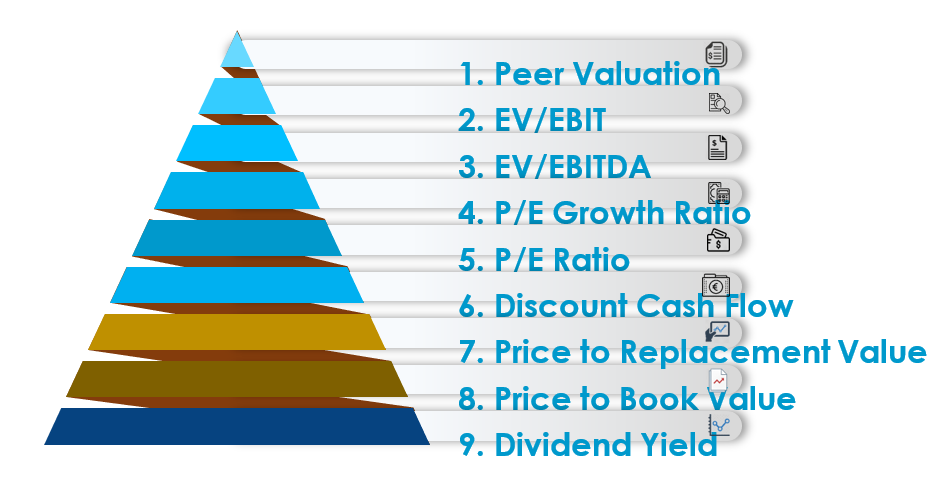
Next comes the price/book value, which gives the cushion of buying the company at the historical cost of assets. Then I look at price/replacement cost, which is one of the ratios to see if the assets are available at a bargain and can largely be applied in cyclical industries. Then next in order will be DCF, PE ratio, PEG Ratio followed by EV / EBITDA, EV / EBIT, finally justifying the price based on peer valuation (this to my mind is the last nail in the coffin). The key message is to understand that as we go up the ladder, we are trying to justify the valuation and are taking higher risk.
The above is the normal course adopted by the markets, i.e., justify a price under one banner of valuation or another. For me, the simple filter criterion is to avoid companies that generate a return on equity (ROE) less than the risk-free rate of return (Rf) over the last decade. The second approach is to see how much premium the market is paying to its book value in comparison to the company’s ROE. Hence, it is a combination of Price/Book value in comparison to ROE/Rf.
There are three other important valuation ratios I look at – Cash flow from operations/ Market cap, Debt/Equity ratio and one of the most important and neglected one is the working capital ratio. Over periods of time, I try to understand the company’s strategy on capital Allocation.
I also try to look at P/E, P/ BV, and Dividend Yield and see where the current ratio fits on the bell curve. This also helps to know where we are in the investment cycle. I apply all of these ratios to check where the company is in its valuation journey.
SN: What are your thoughts on selling stocks? How does one get discipline into the selling process because there are more biases at work here than when one is buying? What selling rules do you follow?
SS: Selling the stock is a much more difficult decision than buying the stock. Before initiating a buy, you have all the time to do all the homework before arriving at a buying decision. There can be two types of sell decisions.
The first is where you have gone grossly wrong on your investment rationale or the company in question is deviating from its track or not walking the talk. In such a situation, irrespective of price or valuation or the quantum of loss, I call it quits on investment.
The other sell decision is even tougher as in such a case, everything is fine, the company is performing in sync with my expectation, and the only reason to be worried is that the valuation becomes expensive. Now, ‘expensive’ is a relative term. I apply the bell curve and calculate in which sigma region is the current valuation.
In my earlier days, if the valuation was upwards +2 std. deviation, I would sell. However, over a period of time, I have learned that the stock still delivers good returns and I end up selling early. I have learned my lesson and now I trim my position and in certain cases, I also adopt a strategy of selling part shares and keep the rest as FOC (Free of Cost). Although it is not a prudent strategy, in such cases then I continue to hold rest of the share perpetually.
Also, as I mentioned earlier, I try to keep a watch on three indices on a normalized manner and in case the mid and small cap index hit through the roof, I relook at my asset allocation and trim my equity exposure and shift to debt. So, this is another sell signal that I follow.
Signals are fine but the ability to act on it comes only with time and the noise around us creates a mist and we cannot gaze our way forward with clarity. We learn from experience that we must follow an objective unbiased approach to selling, lest we come back to square one.
SN: When you look back at your investment mistakes, were there any common elements of themes? What investment process/philosophy you have changed/updated based on your past mistakes? Real-life examples would be helpful.
SS: Stock market is an amazing place. The day you start believing that you have mastered all rules of the game, the game changes. The day you start being arrogant about your success, the stock market hits you hard on your face.
I have made my share of mistakes in my investing career, but the most common element has been to take the management at face value and trust their statements with emotional biases. Inability to decipher corporate governance properly has been the biggest shortcoming in my investment journey.
One of the stock ideas that has taught me this lesson is RICOH India. This was an investment opportunity in the field of business-to-government. Digitalization and less government and more governance was the mantra of the government. The size of the opportunity was huge and RICOH on face value had all the capabilities to make the most of it. I had invested in the stock around Rs 230, and soon thereafter the company announced receipt of an order of Rs 1,370 crore from the postal department to digitize 130,000 post offices across the country. The company was 75% owned by RICOH of Japan. RICOH is a global name in copier machines and such other hardware. The management repeatedly came out with positive announcements. The size of government orders, Indian government talking about digitalization, the parentage of RICOH made entire market believe that a multi-bagger idea was on cards. The stock went up almost 6X in less than 12 months.
Growth, however, brought its set of sins. Alongside more and bigger orders, the company’s debt also kept in growing., I questioned the management and was told that the parent company was bringing in more money as debt to fund the company’s growth phase. This was a story worth believing.
But then, cockroaches from the company’s kitchen started spilling out. The auditor deferred the date of announcement of financial results as the company was not willing to share the required information. Due to non-declaration of results for two quarters, trading in the stock was to be suspended. On this news, I pressed the SOS button and could get an exit around Rs 280. Then the big news came; the company declared results wherein the auditor alleged that the sales were fudged and there was a loss to the extent of around Rs 1,120 cr. The stock got delisted.
The story doesn’t end here. The parent RICOH was one that had got global awards on corporate governance for the last few years. It was also taken aback, given the daylight robbery conducted by the Indian management. The prestige of RICOH was at stake, and hence the parent stated that they would take the entire loss on their books and recoup the company to the extent of loss and not let the minority shareholders suffer. This kind of corporate governance had never been seen in the history of the Indian stock market, wherein the promoter recoups the entire loss in a personal capacity to protect the minority shareholders. RICOH eventually got delisted and is now undergoing NCLT proceedings. The matter is sub-judice and no one knows the way forward.
There was amazing learning here. I just saved my skin by exiting just in time. I just acted on fear and sold rather than being emotionally attached to the company. The talks of management, the size of the opportunity, the backing of a strong global parent, the announcement of government orders, the participation from the promoter to lend debt to fund growth, product visibility in exhibition centers, the ground check by talks with various franchises in many cities were all proven wrong.
At the end of the day, the learning was that despite all checks and balances in place, you could be wrong. Nothing works against bad luck. The biggest learning has been that even on the slightest doubt on corporate governance, take the matter seriously and, if possible, exit.
SN: That made for a nice case study. Thanks for sharing! Anyways, which are some the books on investing, behaviour, and multidisciplinary thinking that have inspired you the most over the years? If you were to give away all your books but one, which one would it be and why?
SS: There are a lot of books which would be close to my heart, but since I must pick just one it would be Poor Charlie’s Almanack. Words cannot sum up the impact it has on me and can have on others who read it too.
SN: Who are some of the people – inside or outside the value investing circles – who have inspired you the most over the years, and why?
SS: I have been a blessed person. One of the most important persons to have inspired me over the years has been my father Mr. Jitendra P. Shah. As I go back and see my childhood, I understand that he gave me the roots to be on ground and wings to fly in the sky. My father is a Chartered Accountant and has a well-established practice but has never asked me to pursue his profession. He lost his mother at the age of seven and he is now 77. He has seen lots of ups and downs in his life but has always taught me to have a balanced attitude and not get carried away with joy or grief. He has cultivated in me a culture to live in the present and not let past bog me down or the future excite. He has always been just and selfless in giving back and has lived an ethical and satisfying life. The learnings look and sound simple, but they are the essence of life.
The other person I respect is one of my relatives, Mr. Manibhai Sanghvi. His is a story from rags to riches by sheer hard work. Mr. Sanghvi is now 81 years old. He left home at the age of 11 to do business, moved to Mumbai when he was 16 years old and successfully ran a business that is still a monopoly for over 60 years now. He owns a shop by name of Tax Print. He has not studied any of Michael Porter’s principles on competition but has kept competition at bay for over six decades. His business has been to sell government forms. Despite being a monopoly, charging customers a fair price, earning a fair share of profits and keeping customer interest first has been the cornerstone of his success. Despite the riches, he has taken care of his brothers, sisters, grandchildren and his huge family comprising of almost 42 people with simple humility and no ego. All these are my takeaways in life from him, time can change, it can have its own ups and downs but you should not let time change your inner self.
There is one more person I am influenced by and that is Mr. Divyesh Shah. He is like my elder brother; he is an individual investor himself. I respect him for his razor-sharp clarity on the subject. I discuss a lot of my research work with him and he is someone who can cut through the maze and be point blank in guiding me on my mistakes. He is one of the few people I know of who has an independent and common-sense approach to investments.
SN: Hypothetical question: Let’s say that you knew you were going to lose all your memory the next morning. Briefly, what would you write in a letter to yourself, so that you could begin relearning everything starting the next day?
SS: This is a very interesting question. In fact, I write a diary daily. It is a simple document that comprises of five parts –
- Activities done by me in the day,
- Pipeline of things I have to work on, numbered on basis of urgency and importance,
- My write up, thoughts, articles, views, presentation material, stock rationale (basically, my work),
- Great articles and repository of articles and links and websites and such other reference points (my learnings from others work), and
- Introspective thoughts.
So, if I have to write a letter to myself, I would share the password and put a note on how and why to use the diary. It normally ends up with about 800-900 pages per year and I have it from the year 2003. Reading my diary would be like reliving my life on a day to day basis since 2003. My diary is my treasure. There are lots of learnings, thoughts, takeaways that cannot be summed up in one letter hence referring to the entire diary would be important.
SN: What other things do you do apart from investing?
SS: The big fruit of financial independence is using the time where one wants to use it. Apart from work, I play cricket with my friends, at least thrice a week. I practice Art of Living of Sri Sri Ravi Shankar on weekends. I spend time with my family. Needless to mention, I thank God for this beautiful life and for giving me things much more than I need or I deserve.
SN: Thanks Sunilbhai for sharing your thoughts, lessons, and experiences.
SS: I must thank you for giving me an opportunity to share my thoughts. The questions were great and it was my pleasure to answer each one of them. I hope your readers gain some meaningful insights from my experience and learnings in life.
Let me also add that the kind of work being done by Safal Niveshak is indeed noble and kind. There is a vacuum of quality in the Indian financial world and Vishal you are selflessly bridging that gap. What you bring on the platform is one place learning for investors of what to do and what to avoid in the journey of making wealth in the financial world. I thank you on behalf of all investors in the Indian financial market for the exceptionally wonderful and challenging work, that is being done in a very simple manner.[/show_to] [hide_from accesslevel=’almanack-all’]
- Spotlight: Big ideas from Value Investing and why applying them in your investment decision making will be a great deal
- InvestorInsights: Interviews with experienced value investors, learners, and deep thinkers
- StockTalk: Thorough analysis of business models of companies (without any recommendations)
- Behaviouronomics: Deep analysis of human behaviour and how it impacts investment decision making
- BookWorm: Reviews of the best books on Value Investing and related subjects
- Free Course – Financial Statement Analysis for Smart People (otherwise priced at Rs 5,900)
- Archives: Instant access to our huge archive from the past three years