
Jigar Shah, born and raised in Mumbai, India, is a CFA charter holder and a C.A. He has more than 14 years’ experience as an analyst and fund manager. He has researched global equity markets for an investment firm for five years and has spent nine years in Indian equity markets.
Jigar joined Banyan Tree Advisors in 2011 as a fund manager. He is an avid reader and passionate about researching businesses, moats and investing for the long term.
In this interview, Jigar shares his thoughts on investing, his process, and the key lessons he has learned over more than a decade of being an investor.
[show_to accesslevel=’almanack-all’]
Safal Niveshak (SN): Could you tell us a little about your background, what got you to value investing, and how you have evolved as an investor?
Jigar Shah (JS): I am not sure exactly why, but I was always interested in equity research as a career. While doing my internship during my Chartered Accountancy (CA), I got access to annual reports of companies and thus began my journey of reading annual reports.
After my CA, I joined a firm called Multi-Act where I got to learn a lot about investing from Vinay Parikh and Prashant Trivedi. My current colleagues Shyam Prabhu and WSS Ravi interviewed and recruited me at Multi-Act. There I learned a lot about value investing and more importantly what one should avoid while investing.
Later, when Ravi, Sandeep and Shyam started Banyan Tree, I joined them in January 2011. In my initial years at Multi-Act, I used to punch in and understand numbers from 10-15 years annual reports in excel under the guidance of Shyam. I think it is the best way to get your hands dirty and learn to analyze financial statements of companies. It was extremely useful training for me. Shyam is my mentor and I have learnt a lot from him about investing and about life in general.
During 2002-07, I used to commute around three hours each day to and from office, which gave me ample time to read lots of books during my train journey, which ultimately helped me to learn a lot about wise investors around the world. I also completed my CFA during 2005-07. In my experience, practical work and learning from investment classics are very important for one to learn the science and art of value investing.
SN: What’s your broad investment philosophy? Has it changed much through the years?
JS: Over the last 15 years, there has been some refinement in my core investment philosophy.
In the initial years, I used to research both moat and non-moat businesses with application of different valuation methods. I used to focus on DCF (Discounted Cash Flow analysis) for Moat businesses and Reproduction Cost of Assets method or book value for non-moat businesses. However, over time, my investment philosophy has gravitated more towards the former i.e., moat businesses. I have also developed interest in high quality cyclical businesses.
At Banyan Tree, our investment philosophy is GARP (Growth at Reasonable Price). We invest in around fifteen companies with different weightages based on confidence that we have on quality of business, management, expected growth in fair value of business and upside potential as compared to current valuations.
SN: How is it being a money manager, especially during the extreme situations – euphoria or market crashes? How do you keep yourself sane, especially when dealing with clients with undue expectations?
JS: To answer the last questions first, we clearly and transparently communicate to our potential clients about what to expect and what not expect from us. It is very important to have a clear, common understanding between the portfolio manager and the client.
As Seth Klarman says, it is as equally important to have RIGHT clients when one is managing OPM (other people’s money) as much as it is important to have right companies in the portfolio. We at Banyan Tree are lucky to have 95% plus client retention, so I can say we are reasonably successful in getting the right clients who believe in our philosophy. We invest a lot of time upfront with them on educating them and setting clear expectations and that, I believe, has made the difference.
We do not try to over-analyze macro numbers and like to keep things simple. Our asset allocation/cash call depends on opportunities available in the market. If we do not find investment ideas at good risk vs reward profiles, we sit on the side line with cash. We also sell investments when they are overvalued, and we are reasonably disciplined about our buy and sell decisions. Thanks to a process-based approach, we had a decline in portfolio value of only about 11% during the 2008-09 crisis, and we have seen only one negative year (i.e., 2008-09) in our performance over a decade and more.
SN: What are some of the characteristics you look for in high-quality businesses? What are the key checklist points you consider while searching for such businesses?
JS: Broadly, here are a few qualities we look for in businesses we see as potential investments –
- High ROCE / ROE – over 18-20%
- Consistent growth in sales and profit over years – above nominal GDP growth – say over 13-15%
- Negative working capital or low investment in working capital, resulting into high free cash flow (FCF) and low debt.
- High asset turnover
- Moat / sustainable competitive advantage
- Capable and honest management with fire in the belly.
SN: Negative working capital and high asset turnover are interesting points as not many investors focus on these aspects. Can you please elaborate why these are important pointers for you?
JS: Yes, I think importance of negative working capital and high asset turnover is not much appreciated from the point of view of understanding strengths of business. These factors help understand the terms of trade that company is enjoying with vendors and customers.
For example, consider Info Edge, which owns Naukri.com. The company gets revenue from customers for one year of service in advance and they pay for expenses over time. They have practically nil investments in fixed assets as brand, searchable data base are two main assets of the company which are financed from the P&L. These gives close to infinite ROCE to the company.
It is the same simple approach that we try to follow in a disciplined and process-oriented way. We like to make it as much as process based as possible and leave relatively less scope for biases to play out.
Anyways, talking about moats, as explained by Par Dorsey in The Little Book That Builds Wealth, there are four different kinds of moat and we would like to take higher portfolio position for company with network effects and switching cost as they are relatively wide moats as compared to low cost advantage.
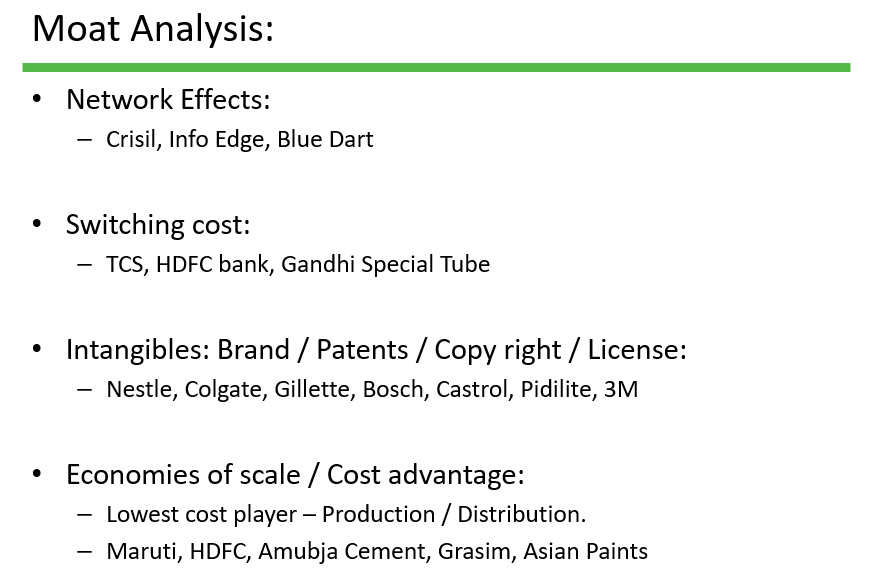
For me, it is important to invest in a company with moat, even if it is having a lower growth. Wide moat gives much more comfort to take higher portfolio position and a peaceful sleep as compared to no moat businesses.
SN: How do you think about valuations? What is your process of valuing stocks?
JS: We are bottom up stock pickers and have research universe of 125 companies in India. These companies meet our criteria of high quality businesses. We do have broad price bands (buy/ sell prices) for all companies in our research universe and occasionally review the risk to reward profile compared to price. Whenever stocks are available in our favorable zone, we do further deeper research and plan our investments.
SN: I read on your firm’s site that when you look at valuations, you don’t look at just absolute valuations, but valuations that are statistically low. Can you please explain that with an example?
JS: We look at multiple methods of valuations like historical, relative, DCF, 3TV (Three Tranches of Valuation; explained below), and sum-of-the-parts (SOTP). However, the most important metric for us is historical valuations.
We look at historical annual financial performance and valuations of companies over as many years as data is available. We also review yearly historical median valuations of companies at high and low for each year and over 10-15-20 years. We believe, in the long-term, the market is efficient in giving fair value to companies and in extreme situations it offers good buy or sell opportunities.
We look at historical valuations in relation to changes in business fundamentals. If there are no changes in fundamentals of business and the company is available at discount to fair value, we would be happy to buy. It is interesting to note that even very well-known and well researched companies like HDFC Bank, Asian Paints or Nestle have yearly volatility of 50% of more. In fact, most of the time, there are no changes in business fundamentals to justify such high movements, but it is due to emotional behavior of Mr. Market.
Anyways, let me talk a bit about the 3TV model we use.
Prof. Bruce Greenwald, in his book Value Investing: From Graham to Buffett and Beyond, explained this concept of 3TV (three tranches of valuations) wherein DCF value or fair value of a firm is divided into three different components –
- Book value, or reproduction cost of assets value for commodity business or no moat business;
- Franchise value for company with moat; and
- Growth value for company with moat and growth
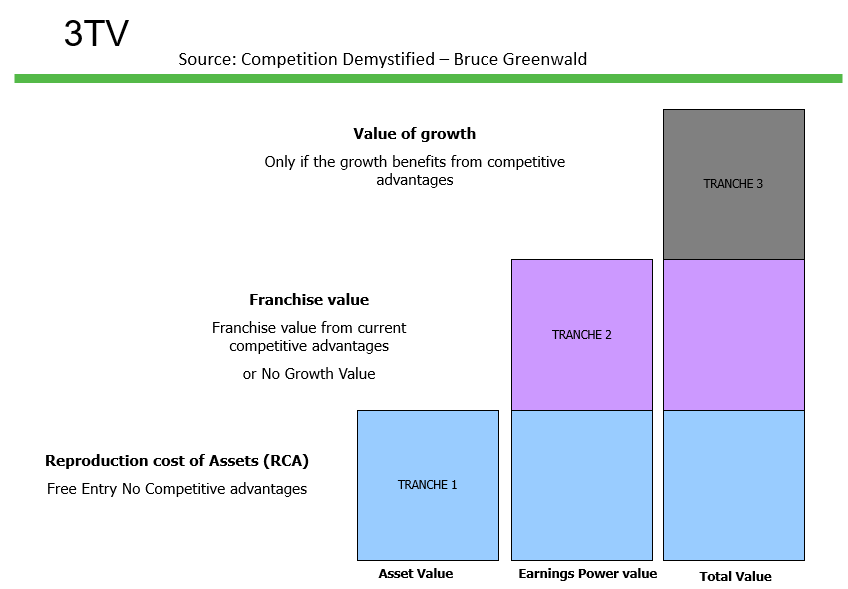
When we review fair value of a business based on these three different components, depending upon the quality of business, it is much easy to understand margin of safety.
SN: How do you differentiate between ‘paying up’ for quality and ‘overpaying’? When does a quality business become expensive and not worth buying?
JS: It is very difficult to decide between paying up and overpaying. For us, the process is important. For example, when we look that the long-term historical median P/E at low for HDFC bank is 16-18 (based on 15 years of past annual data), when one considers buying such a moat business with huge growth opportunity for decades or more, a large scale and size of operations due to low relative market share of 6-7 % in Indian banking, and the best culture of risk management, I think it is reasonable to pay 16-18 or even 20 P/E. In fact, with relative increase in CASA (current account saving account) balance, HDFC Bank is becoming stronger relative to PSU banks, which account for 70% of market share.
So, we do not pay very high valuations to companies on absolute basis. But we are ready to pay up for quality and we are not looking for turnaround or cigar butt kind of situations.
SN: How do you determine when to exit from a position? Are there some specific rules for selling you have?
JS: As discussed earlier, we have price bands as a part of our process, and so we have reasonable sell prices for companies when we buy their shares. We do review them on a quarterly basis and make the required adjustments based on changes in fundamentals of the companies.
If valuations move up to very high levels, we review our portfolio position to make progressive exit. I must accept, we have difficulty in timing our exits and most of time we are early to exit.
Now, it is relatively easy to make decision to exit when there are unfavourable changes in business fundamentals. But it is difficult to exit when valuations are high, as we have seen many times in past, whenever we have exited, price or valuations have moved much higher. We are still not sure how to act during such situations, but our process as of now is to reduce weights progressively as and when valuations are becoming high.
There are many companies like Maruti, Britannia, and Crisil where we have sold early. With some of these companies, if we are put in the same situation again, we may still do the same thing. However, in some others, with benefit of hindsight, we may reconsider selling. Possibly if we had built a portfolio from our exits, it would have perhaps outperformed our actual portfolio!
This is one very important situation where I need to continue to learn to hold on to a company and not exit at slight overvaluation.
SN: When you look back at your investment mistakes, were there any common elements of themes?
JS: As discussed earlier, one of the big mistakes I have repeated is that of selling too early based on pre-decided exit price when a stock reached overvaluation level.
We invested in Maruti during 2010 to 2012, when the stock price was down due to competition, royalty hike by Suzuki, violence at their plant and the issue of Diesel subsidy that resulted into higher price difference between petrol and diesel. The stock was around our approximate buying price of Rs 1,100 and was among the top three stocks in our portfolio. When the stock reached Rs 4,500 in 2014, as part of our process, we started selling and got out of it completely. I was very confident that the stock did not have much potential remaining, but the rest is history.
Anyways, another mistake I have made is that of not going deeper into a company’s research and taking higher position in a stock just when the investment thesis was confirmed.
As an example, I invested in Suprajit Engineering Ltd few years back, at an average price of Rs. 18, After taking a small position in the stock, I could not increase its weight in my portfolio at Rs 25 and then sold it early due to lack of deeper work later.
Luckily, such mistakes have been few and some of them have been rectified quickly. I still need to learn a lot and hopefully make affordable new mistakes.
SN: How can an investor improve the quality of his/her decision making?
JS: I think making the habit of decision process-oriented and data-based can help one to avoid many mistakes in investing. For example, sometimes during an upturn in an industry it is difficult to believe large companies like DLF will fall in value by 80-90%. But when we look at long term data, it seems easier to see the cyclical nature of real estate market at the global level.
SN: How do you think about risk? How do you employ that in your investing?
JS: Here are a few things we practice on the risk part of the equation –
- We try to avoid the balance sheet risk by avoiding investments in high debt companies.
- We try to avoid the valuations risk by sticking to process of investing at right valuation based on process and discipline.
- We try to avoid the business risk by investing in proven businesses with moats.
- Risk of management is one risk which is difficult to quantify and one needs to be careful while investing.
SN: What’s you two-minute advice to someone wanting to get into value investing? What are the pitfalls he/she must be aware of?
JS: I believe one needs to be very patient to realize true potential of power of compounding. I was lucky enough to experience the power of compounding in terms of money, knowledge and goodwill.
There are no short cuts, and one needs to read as much as possible and spend time with knowledgeable people who are willing to share their wisdom of investing.
SN: Which books/resources do you recommend to a budding investor for learning investing and multidisciplinary thinking?
JS: Here are some books and similar resources I like –
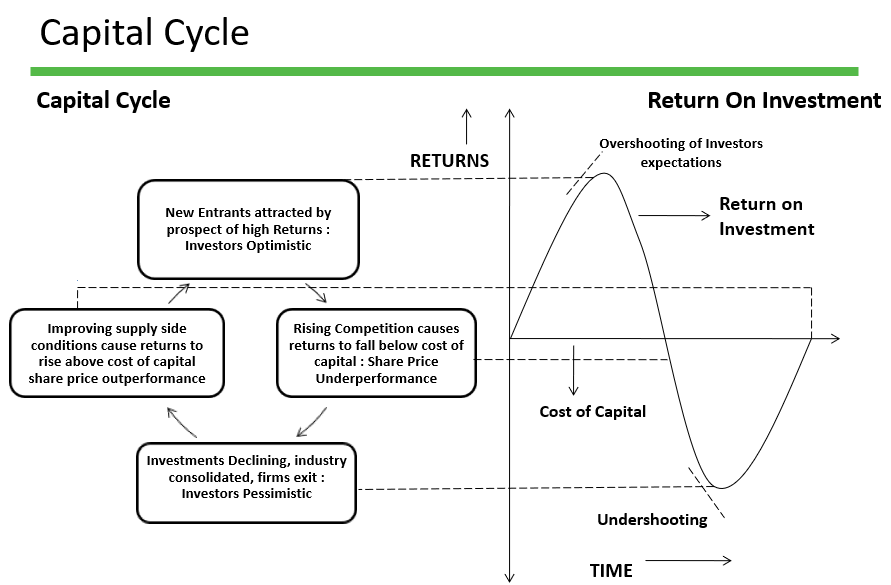
- Books written by the UK-based AMC Marathon Group – Capital Account and Capital Return, Capital account is out of print, but it is very well written book to understand capital cycles in businesses. I am adding one chart to give an idea about the concept in the book.
- Positioning: The Battle for Your Mind by Jack Trout and Al Ries (I will highly recommend all books written by these gentlemen)
- The Goal by Eliyahu M. Goldratt
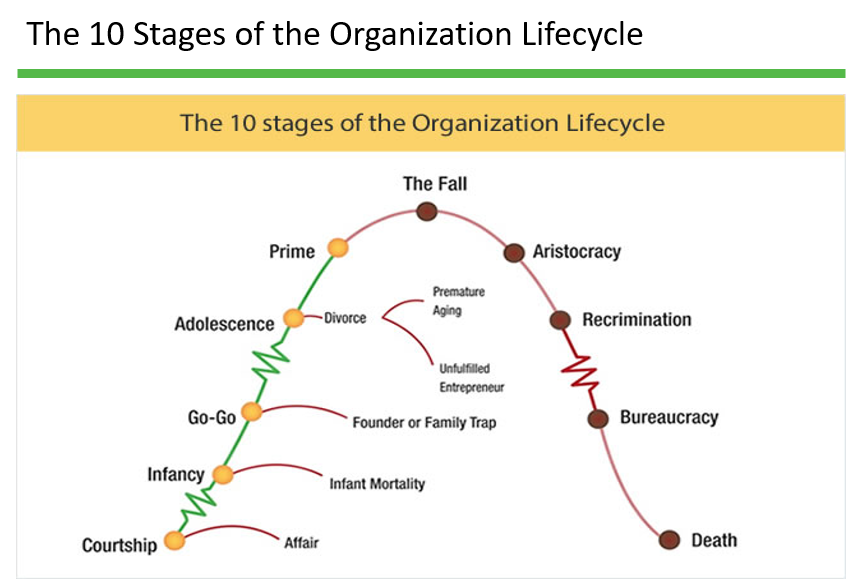
- Managing Corporate Life Cycle and Ideal Executive by Ichak Adizes (this book covers how different companies behave at different stages of evolution)
- Business Model Canvas by Alexander Osterwalder. This is must read book for analysts and investors to understand basic building blocks of business.
- Value Migration by Adrian J. Slywotzky
- Series of books written in Autobiography of India by K. Hari and D.K. Hema Hari
- All books in Amar Chitra Katha series
- Who Will Cry When You Die by Robin Sharma
- Value Investing: From Graham to Buffett and Beyond and Competition Demystified by Bruce Greenwald
- The Little Book that Builds Wealth and The Five Rules for Successful Stock Investing by Pat Dorsey
- Understanding Michael Porter by Joan Margretta
- Articles written by GMO and Howard Marks
SN: Which investor/investment thinker(s) so you hold in high esteem?
JS: I love to read and follow some legendary investors like Warren Buffett, Charlie Munger and Howard Marks.
Apart from reading, I think it is equally important to have like-minded people around you so that you are committed to the right path and are also able to learn a few lessons from people who are passing through similar situations in life. One such person from whom I have learned a lot about investments is Gokul Maheshwari from Allard Partners. We used to jointly work and have grown in terms of knowledge.
Then, I came to know about Ravi Purohit from SIMPL in one of the AGMs. Over time, we became good friends and shared investment ideas, met companies together, discussed and learned about interesting books. One of things I have learned from Ravi is about exiting stocks in a progressive manner.
SN: What other things do you do apart from investing?
JS: I am a cricket fan and spend some time daily playing the game with my friends. I am also the Secretary of my housing society, and this role has helped me learn a lot about how things work in India. We run a free Library at Banyan Tree office in Mumbai with 1,200+ books. I also love travelling.
SN: Well, that was great. Thank you, Jigar, for sharing your insights with me. I wish you the best.
JS: Thank you Vishal, it was pleasure sharing my learnings and experience with you. I hope it is useful to the readers..[/show_to] [hide_from accesslevel=’almanack-all’]
- Spotlight: Big ideas from Value Investing and why applying them in your investment decision making will be a great deal
- InvestorInsights: Interviews with experienced value investors, learners, and deep thinkers
- StockTalk: Thorough analysis of business models of companies (without any recommendations)
- Behaviouronomics: Deep analysis of human behaviour and how it impacts investment decision making
- BookWorm: Reviews of the best books on Value Investing and related subjects
- Free Course – Financial Statement Analysis for Smart People (otherwise priced at Rs 5,900)
- Archives: Instant access to our huge archive from the past three years