
In this special edition of InvestorInsights, we share the biggest ideas that we learned from various experienced value investors and money managers we interviewed during 2019
[show_to accesslevel=’almanack-all’]
Saurabh Mukherjea on Diversification Vs Concentration
 If we step back and ask why people diversify, the answer is that they diversify to reduce risk. Now, what is the risk that we are diversifying away from? The risk is that of unforeseen events and challenges to certain investments in our portfolio, and we are trying to mitigate against that by spreading the portfolio across more investments. And hence, if you allow yourself to diversify across 20, 30, 50 stocks, there is a very strong temptation to be intellectually lazy in your diligence on each of them. You are giving yourself the escape route. And hence I think there is a strong reason for investors to tell their fund managers that I want you to run a concentrated portfolio and I want you to be patient with your investments. This goes back to Warren Buffett’s ‘twenty holes in a punch card’ system. If you restrict your investments and you restrict the number of holes you are allowed to make in the punch card, you restrict the number of trades you are allowed to make, you force yourself to do extensive due diligence on stocks. And that is the best form of risk mitigation.
The best form of risk mitigation is your own deep diligence that this company is a powerhouse franchise and regardless of what happens, there is very high probability this franchise will endure.
So, Buffett’s “holes in the punch card” analogy we try to replicate here in building a concentrated portfolio of no more than 15 stocks and no more than 15% churn. By committing that to investors and practicing that, we are forcing ourselves to dig very deep with our diligence. And the two are linked. As soon as I allow myself and my colleagues to spread it out, one they practically have less time to diligence each company and two, they have less incentive to do that. And hence my fear for most investors out there who are invested with fund managers with bulky portfolios spread across several stocks is under the mantra of diversification they are being given less than ideal portfolios.
Abhinav Mansinghka on Assessing Corporate Governance
 The importance of management quality on the outcome cannot be overemphasized. Even a great business may destroy your wealth because a crooked promoter will figure out a way to deprive the minority shareholder of his share.
When judging management quality, I like to make a clear distinction between competence and ethics.
Ethics for me is non-negotiable. If there is historical evidence of a promoter being unfair to minority shareholders, then it is a strict no-go area for me especially when it comes to my core holdings. One cannot generalize, but excessive managerial compensation, serial capital misallocation, creating maze of subsidiaries etc. are red flags which need to be investigated.
It gets more difficult if there is insufficient evidence like in the case of many small and mid cap companies. In these positions, generally, small clues tend to show up over time. The risk is that you may have suffered losses in the interim as you wait to make up your mind. The key then is to limit risk through lower allocation where you are not confident.
The other aspect is judging competence. Here I tend to be a bit more flexible in my approach. Judging competence from a distance is never easy. We are easily prone to label industry tailwind benefactors as ‘intelligent fanatics’. Favorable media coverage and a suave well spoken management also contribute to the halo effect.
So in a nutshell, I am inflexible on ethics but willing to giving the benefit of doubt on competence and then play as it comes.
Ashish Kila on Position Sizing
 Earlier we used to follow the 2/5/10 framework which was inspired from legendary investor Mohnish Pabrai –
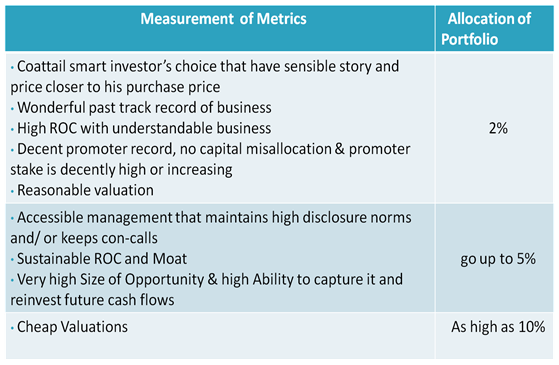
As discussed earlier, we now follow a more concentrated approach, based on ‘Ranking of Business Model’ framework –
- Starting with 5% and up to 10%, for the businesses that satisfy the essentials criteria but have very few desirable’s criteria.
- In businesses which have more number of desirables allocation, it could range from 10 to 20%.
Jiten Parmar on Business Cycles
 My approach to cyclical investing essentially makes me more diversified, as I use a basket approach. I would invest in multiple companies in a sector. This is all explained in my cyclical investing presentation on CNBC and on my blog.
I also want to emphasize that I am a value-oriented investor. Cyclical investing is nothing but value investing. It’s about buying an asset or business as distress valuation, after understanding the cycle and possibility of the cycle turning.
Cyclical investing is very counter-intuitive and highly contrarian. You are buying when companies are making losses or low profits, return ratios are bad, and so on. And selling when companies are making huge profits, return ratios drastically improving, etc. These turn out to be lonely trades. No one is looking at the sector. Once the cycle turns, it comes in focus, and research reports start pouring in. That’s the time to be alert.
Sunil Shah on Finding Ideas
 Stock market is an ever-evolving place. It’s less of science wherein a fixed formula can be applied to get a fixed answer, but more of an art. Hence, a checklist can help to minimize risk.
Over the years, I have learned that applying uncommon-common sense is the most important thing in the stock market. Over periods of time, the only thing the stock market rewards are companies that generate profits on a sustainable basis year after year. I have hence bifurcated companies on one of the following macro-economic themes, wherein companies’ profits are linked in one way or other to following themes –
- Demography / domestic consumption
- Government policy
- Exports / international environment
- Infrastructure
- Interest rate sensitives
I then have a view on the theme for the next 12- 24 months. I try to assess the theme for the near future and how it may perform in comparison to other themes. For example, in the current environment and given the way in which the banking and NBFC sectors are performing, it would be more prudent to keep away from the interest rate sensitive sectors. Likewise, demography / domestic consumption will be an on-going theme for the near future. Hence, the first step of my process is to get a directional call on the macro-economic environment correct.
I bifurcate the top 2,000 companies (by market cap) based on the five themes mentioned above. Post this, I apply filters on the theme I like –
- Filter 1 – Doing away with companies that are not able to generate a sustainable return on equity (ROE) in excess of the risk-free rate of return
- Filter 2 – Doing away with companies that have high debt/equity
- Filter 3 – Doing away with companies where a lot of capital is being stuck in working capital
- Filter 4 – Doing away with companies where growth in revenue and profits is sub-par over the last decade
- Filter 5 – Valuations
The next step is to assess the five non-quantifiable parameters –
- Management quality
- Moat of the business
- Competitive scenario
- Industry life-cycle
- Size of the opportunity of the business
Honestly, not every company can get a tick on all the above parameters, however, it is about being aware of what I am willing to let go and what risk I am willing to take for the price that I would pay to buy the stock.
Once I ascertain the risk and if and only if I am fine with the same, I build my investment thesis. Then, as the journey of an investment starts, I go about reinforcing and checking the investment assumptions and deviations from the same, if any, and keep on regularly monitoring if I am on the right course and then take corrective action if needed.
Abhishek Basumallick on Dealing with Noise
 Nobel laureate economist Herbert Simon articulated this beautifully, when he said, “…in an information-rich world, the wealth of information means a dearth of something else: a scarcity of whatever it is that information consumes. What information consumes is rather obvious: it consumes the attention of its recipients. Hence a wealth of information creates a poverty of attention and a need to allocate that attention efficiently among the overabundance of information sources that might consume it.”
I see this all around me and I am personally also not immune to it. Perhaps the biggest source of nuisance is the various WhatsApp groups. Most of the groups just forward various reports with little or no value addition by the members. Very few investors these days take time to just sit back and think about businesses they own or think of buying. They are running around just trying to collate more and more information. In the quest for more information, they don’t realize they actually compromise on understanding the business model and the strategy of the company, which is perhaps more important.
I am a great believer in Pareto’s principle. Information generally follows the well-known 80/20 rule: the first 80% of available information is collected in 20% of the time spent. The value of in-depth fundamental analysis is subject to diminishing marginal returns.
The first thing is to try to understand the business model and the metrics that drive the business. An important factor is to have one or many frameworks while investing. This helps in very quickly eliminating the unnecessary. Another is to know the key drivers of a business and then focus on the changes in those factors exclusively.
Chetan Phalke on Valuations
 We don’t really do any financial modeling or DCF or elaborate excel sheets. The earnings assumptions vary depending on the nature of the business. Whether the investment premise is based on capacity utilization, market share gains, import-substitution, entry into new geographies or new categories, etc.
For example, if it’s a tire company, then what’s the number of units it is selling across categories, how much it can sell in the future, and at what price point. Which are the channels through which they are looking to expand i.e., dealers, franchise stores, replacement markets, OEMs, etc. Based on these inputs, you have a broad sense of capital intensity for growth, from where the incremental growth should come from and how the margin profile/cash flows should move. That will give you an idea of peak profits when capacity utilization hits the roof.
Also, we do a cumulative cash flow analysis i.e., in 3-5 years, what can be cumulative cash flow from operations, incremental working capital and how much cash will be left for debt reduction, expansion or dividends. This gives a broad sense of how the balance sheet, ROCE and ROE profiles will look as we move forward.
While checking the capital allocation history, we take cumulative cash flows over the last 3 to 5 years i.e., from where the cash came in and how it was spent. Looking at this exercise in isolation may not be helpful. It is important to study what factors led to those cash flow movements. Whether it was the industry upcycle/downcycle, conscious change in business strategies, asset sale, etc.
It’s a pure common-sense approach based on qualitative factors. Even the promoters don’t know how the business will look like over the next 5-7 years. So, the point is to start with certain assumptions and re-assess whether it is fructifying or not.
Jaideep Merchant on Disruption
 Disruption is commonly understood as technological, however, regulatory disruption is more common.
A classic example was the NBFC business in the mid-nineties. With one stroke, the RBI bought in capital adequacy requirements for NBFCs that were accepting public deposits. Overnight, thousands of NBFCs closed shop and left depositors in a lurch. What survived was a handful. This was my first taste of what can happen when regulation is tightened.
Let’s look at the evolution of the Indian equity markets post-Harshad Mehta.
SEBI was formed, the monopoly of the BSE was broken, NSE introduced screen-based trading, Badla was banned, UTI 64 went under, settlement of trades in demat was implemented gradually for all stocks, regional stock exchanges collapsed, settlement of trades moved to T+2 basis, futures & options trading is now available in stocks, interest rates, and foreign exchange.
All these regulatory changes led to lower transactions costs for investors. Electronic trading and settlement systems that removed counterparty risk and brought in transparency. More importantly, it disrupted the business of a few lakh stockbrokers in India as the profits from the inefficiencies in the system disappeared.
In case the profitability of a business comes from a regulatory arbitrage of some sort, an investor must constantly evaluate the longevity of such an arbitrage. The business fundamentals are likely to change for the sector as regulation changes. Most regulatory changes reduce profit margins and capital return ratios to start with, after which the consolidation wave results in higher profits for the remaining companies.
Given the way regulatory framework in our country is tightening, it will be challenging for the economic rent-seekers to earn high profits in the new normal. Investors must incorporate this change in the environment in their investment strategy.
Gaurav Sud on Dealing with Uncertainty
 Returns in the markets are never linear. While they are positive in the long term, the journey is filled with all kind of gyrations, pitfalls and speculations.So, when you start your investment journey, you are quite optimistic about the prospects and your investing skills. If you are lucky enough to ride the wave, you get overly enthusiastic and divert more of your savings into investing and then get wrong footed when the bullish sentiment changes.
A key quote of Ben Graham that has helped me is this –
In the short run, the market is a voting machine but in the long run, it is a weighing machine.
So, depending on valuations in the market, one should be ready to take some money off the table.
My portfolio had a serious drawdown in the meltdown of 2008 and ever since then, I have been focused on how to handle the gyrations and accompanying psychological impact on our thought process. Here are a few insights I have gained and implemented over these years –
- Investing fulltime is not for everyone. There are a few aspects that need to be taken care of. There should be enough revenue stream to take care of your day to day living. Your capital should be large enough, that even lower than expected returns can take care of the opportunity cost of not having a job. Finally, you should be passionate about what you do. You should enjoy reading balance sheets, meeting managements and tracking industries. If you are in it only for making money, then sustaining yourself for long becomes difficult.
- When you start investing, first learn the asset allocation principles. Be very clear about how much of your net worth you want to put at risk in the stock market. Different people will have different thresholds and understanding how much drawdowns you can take on your net worth, is very important for long term success. People who are open to seeing a stock they invest in, correct 50% or more, and still be fine with it, should only focus on the small and midcap stocks. If people cannot accept this kind of volatility, they should focus on the large cap blue chips or invest in mutual funds.
- Learn to take money off the table when market valuations start moving up. It was clear in December 2017 – January 2018, that valuations had become frothy. Now there are many ways that one can say the market is expensive – one can look at the multiples the index is trading at, the valuations at which IPOs are coming in, or the big moves in the lower quality stocks. In my case, I track the P/E and P/BV of the Nifty index. When they move to the 70 percentile levels, I start moving to cash. So, by end-2017, I was on 40% cash, and that has been a big help for me in handling this sharp down move since January 2018
- Always invest thinking about the downside. Try to model the worst-case scenarios. Many times, we invest thinking about the upside if our hypothesis plays out but forget about the downside if it doesn’t. When you start thinking about the negatives, you will make more informed decision
- Finally, you should be aware about one big fact. Luck has a big role to play in your investing success. No matter how much effort you put in, no matter how much diligence you do, there is always the element of luck in the success of an idea. That is why investing is an art more than science.
- Spotlight: Big ideas from Value Investing and why applying them in your investment decision making will be a great deal
- InvestorInsights: Interviews with experienced value investors, learners, and deep thinkers
- StockTalk: Thorough analysis of business models of companies (without any recommendations)
- Behaviouronomics: Deep analysis of human behaviour and how it impacts investment decision making
- BookWorm: Reviews of the best books on Value Investing and related subjects
- Free Course – Financial Statement Analysis for Smart People (otherwise priced at Rs 5,900)
- Archives: Instant access to our huge archive from the past three years