
Ashish Kila is a Director at Perfect Group, a well-diversified conglomerate providing services in the sectors of financial supermarkets (NBFC), tax consultancy and audit services. He holds BFIA and Chartered Accountancy (All India Rank – 48) qualifications and has done his MBA from MDI Gurgaon. Prior to joining Perfect Group, Ashish worked in research roles at Morgan Stanley India, Religare Securities, and Goldman Sachs. During his stint with these leading investment banks, Ashish has done extensive research on listed Indian companies across various industries.
In this interview, Ashish shares his evolution as an investor, the key lessons learned, his investment process, and how he tries to minimize decision making mistakes.
[show_to accesslevel=’almanack-all’]Ashish’s Disclaimer: All the businesses that are mentioned here are for educational purpose only. We may or may not have vested interest in the businesses. We are not SEBI registered analyst.
Safal Niveshak (SN): Please share about your background and the key factors that have shaped your life as an investor? What inspired you in your early career towards investing?
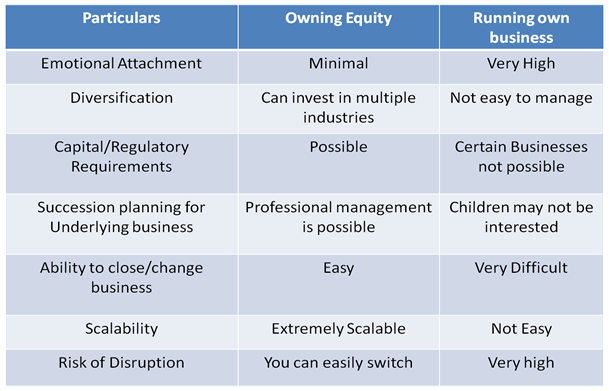
Ashish Kila (AK): My investing career wouldn’t have been possible without my father’s tutelage. I got inspiration from my father who was already practicing investing and running a business simultaneously. I realized early in life that serious wealth can be created if you can scale your time as an entrepreneur.
As Tim Ferris says in his seminal book The 4-Hour Work Week – “Be neither the boss nor the employee, but the owner. To own the trains, and have someone else ensure they run on time.”
On my journey of entrepreneurship, I found investing to be a time and force multiplier due to the following reasons –
SN: How have you evolved over the years as an investor? What part of your thought process has changed the most?
AK: Earlier, we used to run screeners for cheapness and try to understand if the business is sound before investing. Over the years we faced two issues –
- First, Reinvestment Risk, where a lot of such opportunities didn’t allow long-term holding as the price value gap converged and we had to sell and again look for new ideas.
- Second, we anchored our thesis on business quality and ended paying up (type 1 error) or anchored our thesis on cheapness and ended up buying low-quality businesses (type 2 error). In the tradeoff between type 1 error and type 2 error, we would much rather minimize type 2 error and absolutely try to avoid buying low-quality businesses.
To quote Charlie Munger here, “A great business at a fair price is superior to a fair business at a great price.”
Over a period of time, we worked on developing a framework looking at major wealth creators historically in the Indian market. We have sought to distill common characteristics of such businesses and make a framework to identify future wealth creators.
We call this proprietary framework the ‘Ranking of Business Models’ framework. This helps us first select a good business model and then allocate higher to great businesses. So, as per this framework –
Selection of a stock is based on –
Essential qualities/characteristics of Business Models in order of preference:
- Management – corporate governance
- Longevity – demand for products over a long period of time
- Scalability – huge size of an opportunity
- Favorable Industry Structure – limited competition
- Reasonable Valuations
Selection is basically an elimination test; all criteria need to be satisfied.
Allocation is based on, other Desirable Competitive Advantages:
- Annuity Revenues
- High switching cost/pricing power
- Tailwinds – E.g. Value Migration/ Supply Consolidation
- Optionalities – Free/Cheap lottery ticket
- Sidecar Investing – the ability of a company to acquire other companies in the same or different industry
- Ability to capture dominant market share
Allocation is a grading test, you may not satisfy all criteria, but the more grades you get, the higher the allocation.
SN: That looks like a great model! Anyways, how do you find your ideas? What are the necessary conditions that you would look at before you invest in a company and the additional conditions that will just go about reinforcing your confidence in the company?
AK: There are basically three sources “in order of preference” through which we build our investment universe:
- Cloning – We follow investment gurus that match our investment thought process; we find their investment picks and apply our own framework of “Ranking of Business Models” for selection. Some of the gurus we follow who invest in the Indian market are Mohnish Pabrai, Bharat Shah, Ramesh Damani, and Prof. Sanjay Bakshi. We also follow overseas investors like Pat Dorsey and Tom Russo to learn about the investments they have made and then we search for similar companies in India.
- Base Rate Investing – Involves finding companies/sectors globally which have created massive wealth and look for similar opportunities here in India. For example, one can find that FMCG and Financial Services have created a lot of wealth for investors.
- Other Cases – Companies not falling in the above two categories but still exhibiting characteristics of moats in terms of financials. E.g. Paint industry globally is not a very profitable segment like it’s in India as seen from the performance of companies like Asian Paints.
Regarding the second question of conditions to invest, we follow the ‘Ranking of Business Models’ framework discussed earlier which helps us to make better decisions about investments.
For the third question about reinforcing of confidence, basically, we keep tracking the business performance and sector developments to see if the story is playing as per the narrative we have thought of.
SN: The sheer amount of irrelevant information faced by investors is truly staggering today. Today we find ourselves captives of the information age. Anything you could possibly need to know seems to appear at the touch of keypad. However, rarely, if ever, do we stop and ask ourselves exactly what we need to know in order to make a good decision.
How can investors trapped by irrelevant information make independent investment decisions? What are the few factors investors can use to improve the quality of their decision making?
AK: I believe that we need to develop an art of saying “no.” Seneca in his memoir On The Shortness of Life wrote this – “How many have laid waste to your life when you weren’t aware of what you were losing, how much was wasted on pointless grief, foolish joy, greedy desire, and social amusements- how little of your own was left to you. You will realize you are dying before your time.”
Saying ‘no’ to almost everything will allow you to say ‘yes’ to the things that matter.
SN: Yes Ashish, saying no often is a great model of cutting out noise. Thanks for reiterating! Anyways, how do you go about developing your Circle of Competence and saying no to other things?
AK: We follow the process in which –
- We read a lot
- Think deeply
- Apply it in our practice
- Analyze the results
- Improvise/Adapt as per the mistakes
- Update our Mental Models
- Keep refining our Circle of Competence and
- Rinse & Repeat the same.
To filter noise from signal we do –
- For the companies we track
- Read articles on our investment universe by setting up Google Alerts, BSE Alerts, Social Media Alerts (Twitter and other platforms)
- Focus on fundamental things with long term impact, business strategy, industry dynamics, government regulations, etc. We look at information like volume growth, new product launches, size of the market opportunity and change in management.
- For E.g. for a QSR business like Jubilant Foods, we would like to track –
- Demographic changes in population – composition of the population
- An increasing trend of working women
- Per capita income growth and its associated effects on spending on the food industry
- An increasing habit of eating out or ordering in
- No. of times a person orders in/eats out vs. other countries
- Penetration of QSR outlets vs. other countries
- Competing outlets progress, performance and market share
- Impact of Food Aggregator Apps
- Ability to bring in more brands like Dunkin
- Ability to start homegrown brands like Hong’s Kitchen
- Ability to get into new markets like Bangladesh recently
- SSSG (Same Store Sales Growth) of outlets and new openings of outlets
- Innovation in Food Menu
- Value proposition – Affordability of brands for the middle class
- Taste acceptance of the brand
- For thought process and other industry insights –
- Follow industry stalwarts on Twitter and other social media platforms, where they share curated content
- Read various blogs from where we source the best information to update our thought process e.g. Farnam Street
- Read various curated publications like Ken, ET Prime
- Listen to quality podcasts like, by Shane Parrish – Knowledge Project, Patrick O’Shaughnessy – Investor Field Guide and Ted Seides – Capital Allocators.
- To avoid various biases and save time –
- Rather than watching prices regularly, we have setup price-based filters in Google sheets, on the achievement of which some renewed thought process is required to buy/hold/sell
- Prefer going through notes/ recordings then actually attending investor meets
- Prefer attending Con-calls (Research Bytes) or questioning the IR offline compared to management meetings
SN: A lot of long-time investors have said that they took concentrated bets during the initial phase of their investing life, and later they diversified. How has on concentration vs. diversification your journey been on this front? What are your thoughts?
AK: Regarding this matter, I would like to quote Buffett, who said – “I have two views on diversification. If you are a professional and have confidence, then I would advocate lots of concentration. For everyone else, if it’s not your game, participate in total diversification.”
We initially used to have around 25-30 stocks in our portfolio as we were learning and experimenting with different investing styles as well and refining our Circle of Competence.
Currently, however, the thought process is that every new business seeking entry in the portfolio will only be added if it provides some sort of diversification to the portfolio in terms of –
- Different segments within the same industry (within the overall exposure limit to the industry)
- E.g. Retail focused Bajaj Finance vs SME focused DCB Bank
- E.g. Oberoi Realty targets Mumbai market and Sobha targets Bangalore market
- Different business/industry drivers (what drives QSR-Quick Service Restaurants is different from what drives staffing companies)
- Different Mental Models (InfoEdge has Network Effects, Brand, Scale Advantages, Side Car Investing, etc)
This strategy automatically ensures that only a few names come in the portfolio.
For overall portfolio construction, I would highly recommend you to read through Prof. Bakshi’s insightful PPT on this topic. We really found the analogy insightful, of comparing portfolio to a plane and ensuring multiple engines so that the plane doesn’t crash. Also we liked the fact that a lot of times, certain industries are correlated – for e.g. NBFCs and banks or financial sector and real estate are correlated, and one should club them together to calculate overall exposure to that segment.
That being said and done, there is no one way to reach the Mt. Everest or make money. There are multiple examples of good investors who have made lot of money by being quite diversified as well.
SN: How do you think about valuations? Are there specific valuation models you prefer over other? If yes, which ones and why?
AK: First of all, we tend to look at valuations as the last step of our ‘Ranking of Business Model’ process, because a person who looks at it at the initial stage may filter optically expensive stocks as the business might be investing for the long run (capacity to suffer framework).
We follow the Reverse DCF Process, which is similar to that of the principle of Inversion to which Charlie Munger quotes – “All I want to know is where I am going to die, so I’ll never go there.”
This process helps us in getting to know the current implied growth rate of cash flows in the price, which helps us ascertain that whether the implied gain in market share of the company vs. sector looks feasible.
To quote an example of Eicher Motors, with close to 95% market share in India and 50% market share globally in its segment, the implied growth rate for the company at valuations last year seemed like a tough ask to achieve unless the market itself grew fast.
Another example for instance is of Gillette. The implied growth rate came out to be 51%. If the free cash flow (FCF) is to grow by 51%, then sales should grow by at least 25-30%. Assuming, even if sales grow by 25% then also it will surpass the market size itself.

For more details about the Gillette example and our thought process for Standard Valuation Matrix, you may visit our blog or can view my talk at an event in Pune, organized by CFA Society India and read the book Expectations Investing written by Alfred Rappaport and Michael Mauboussin.
SN: What are your thoughts on selling stocks? How does one get discipline into the selling process because there are more biases at work here than when one is buying? What selling rules do you follow?
AK: Our typical holding time horizon is in decades and would sell it under the following conditions –
- Change in thesis
- Change in management leading to change in management style
- Impairment of Moats
- Poor Capital Allocation
- Corporate governance issues (Management involved in unethical practices)
- Crazy levels of implied growth rate of cash flows much ahead of our expectation for the company’s growth prospects
You may read a detailed explanation in my 4C’s of investing presentation.
Hold Vs. Buy
What investors need to understand is that holding a stock is not a binary buy or sell decision. If we are holding a stock in portfolio, it doesn’t mean we are implying that one should be buying the stock. Once a stock has been bought, there is a considerable hold period before selling the stock.
Charlie Munger says, “Psychologically, I don’t mind holding a company I like and admire, and I trust and know that it will be stronger than now after many years. And if the valuation gets a little silly, I just ignore it. So, I own assets that I would never buy at their current prices, but I am quite comfortable holding them.”
To get more insights into this topic one can read the articles Charlie Munger on the Paradox in Hold vs. Buy Decisions by Prof Bakshi, The Art of Holding and The Conviction to Hold by Ian Cassel.
Rebalancing of Portfolio
Consider rebalancing of portfolio, when a particular business becomes a huge part of your portfolio in relation to other positions or some other opportunity appears which looks very attractive. Refer to Tom Russo’s podcast with Capital Allocators.
SN: When you look back at your investment mistakes, were there any common elements or themes? What investment process/philosophy you have changed/updated based on your past mistakes? Real-life examples would be helpful.
AK: Well, the mistake I regret the most is timing the markets. Earlier I used to base my investment decisions considering the Temperature of the Market (Howard Marks), taking out cash when the markets were frothy. I used to check for the overvaluation of Nifty. What I mean by that is when Nifty reached the multiple of 25x and above, I used to have around 20-25% of the portfolio in cash and wait for the market to correct before deploying.
My learning now is that, cash should be the function of not having any other opportunity and not due to the frothiness in the market. We are now willing to suffer temporary markdowns on our concentrated positions rather than lament on the upside missed by under allocation.
Another mistake which I’ve made earlier, is more to do with the allocation. Not “backing up the truck” on your favorite ideas is a mistake that I’ve made repeatedly in the past. In this aspect, I’ve learned a great deal from Ramesh Damani who keeps emphasizing this point in all his interviews.
SN: What are your thoughts on disruption and its impact on businesses and industries? How do you think about investment risk in a world that’s highly disruptive?
AK: Lot of businesses can get disrupted over a period of time, and so we prefer to focus at the rate of disruption than the disruption itself. We focus on companies where rate of change is not so swift.
Let’s look at three types of businesses –
- Businesses with high rate of change – You must avoid such businesses as you won’t get time to exit. For instance, let’s go back in time and look at the mobile industry, where new phones are launched every month. Motorola’s flip phones (e.g. Moto Razor) was a widely celebrated invention in the 2000s. But, due to the rapidly changing nature of the industry, Motorola couldn’t sustain itself.
- Businesses with moderate rate of change – You will get reasonable time to see how disruption is playing out. E.g. Cinemas are facing tough competition from Netflix, as it started making original content which gained traction among the audience. The added convenience of watching video on demand any time anywhere is a big plus for Netflix vs. cinema halls. No wonder, in the US, tickets sold per person have declined to their lowest point since the early 1970s.
- Businesses with lower rate of change – You will get a good amount of time to decide. Leading FMCG brands like Kraft Heinz which have legacies dating more than 100 years are increasingly under pressure from retailers pushing their own private labels, both offline like Costco and online like Amazon.
Or for example, PSU banks losing market share to private banks has been going on for decades now.
However, please remember sometimes such value migration trends are not permanent as the industry can reinvest itself against competition, like how Swiss watches positioned themselves as luxury timepieces against the onslaught of digital watches which were more accurate. However, now they are again getting threatened with the rise of wearables & smart watches.
SN: What are your thoughts on the issue of corporate governance in India? How does a minority investor assess governance that is such a tricky subject? Are there any thumb rules you follow to test governance levels?
AK: In our experience, we’ve observed that finding a good management in India is an exception rather than the norm. Every investor must check for corporate governance issues before investing and one needs to be extra careful during the bull market, as you only get to know who’s swimming naked when the tide goes out.
One thumb rule which we use is to have a look at how the market capitalization chart has evolved over the years, if the company has poor history of shareholders wealth creation, it could be possible signal of poor corporate governance.
Here are a few ways to identify potential red flags –
- Promoter Check
- Low Promoter holding and high percentage of pledging.
- Check for company and Director frauds on Watch Out Investors and by doing a Google Search with the keyword such as ‘fraud’ or ‘cheating.’
- One can also talk to the past employees and check employee reviews on Glassdoor.
- Auditor Check
- Scrutinize for the name of the auditor and their size compared to the company’s size.
- Track changes in auditor.
- High auditor remuneration.
- Financials Check
- Increasing receivables growth compared to sales growth over a period of 5-10 years.
- High percentage of receivables pending for more than six months compared to the total receivables.
- Aggressive depreciation rate vs. peers.
- Low operating cash flow to profits ratio over an economic cycle
- Elongating cash conversion cycle trend over a period of time.
- Related Party Transaction
- Loans given to the director.
- Loans given to group companies/subsidiaries – e.g. RNAM lending to group companies, Zee Group lending to Essel Group of companies.
- Corporate guarantees for subsidiaries.
- Sale/purchase of land from an entity owned by the promoter or someone close to him.
- Land taken on rent from promoter or entities close to him/her.
Benjamin Franklin said, “Keep your eyes wide open before marriage, half shut afterwards.” In this context, we understand that one should check for all the issues before investing in a company and after investing one must ignore small issues in the company. However, the real trick is to decide when there are shades of grey, and there’s a lack of complete information.
Few instances where shades of grey are reflected –
- Issues pertaining to divergence in the NPAs of the banking industry. E.g. – HDFC Bank which has been a huge wealth creator also reported some divergence issues, in this case the track record is good but yet the divergence is seen.
- Anti-profiteering issues faced by consumer companies on not passing the benefit of lowering down the GST rates.
- Investors generally avoid the companies where management remuneration is beyond a certain level. For instance – management of a leading ‘Off Highway Tyre’ company drawing a high salary historically.
Now, how do we deal with such situations? We look at whether despite such grey areas, has the management delivered exceptional shareholder wealth creation in the past. If yes, we are a bit comfortable and forgiving.
However on repeat of such instances, we apply Bayesian thinking. We always start from some prior belief about the problem at hand. We then acquire new evidence. If we are Bayesians, we neither accept in full this new piece of information, nor do we stick to our prior belief as if nothing had happened. Instead, we modify our initial views to a degree commensurate with the weight and reliability both of the evidence and of our prior belief. To learn more about Bayesian Thinking, one can refer to Prof. Sanjay Bakshi’s article on the subject.
It is important to realize that corporate governance is very transient in nature. It keeps on fluctuating. Thus, it is important for investors to keep updating their thesis regularly.
To learn more on the topic, one can refer to some of the sources such as –
- Role of Management presentation on our blog.
- Financial Shenanigans by Howards Schilit.
- Watch out Investors
- In Govern / IIAS
- Safal Niveshak’s course on Financial Statements Analysis
- Learning from past scandals like Enron and Satyam
- Case Studies of Manpasand Beverages and Kitex Garments on 2Point2 Capital’s blog
- Presentation By Vardha Rajan at IIC
SN: Nassim Taleb talks about the concept of Antifragility, which describes things that not only bounce back quickly, but come back stronger when they meet adversity. Antifragility is beyond resilience or robustness. So, while the resilient resists shocks and stays the same, the antifragile gets better. Now, when I combine Taleb’s concept of antifragility with Buffett’s concept of economic moats, and embed that in the current business landscape, I see a lot of businesses that look resilient but may turn out fragile when the tide turns bad for them. I’m sure, given your experience and thought process, you may have studied businesses from this angle. What are your thoughts on the same? How does one go about identifying businesses that could be antifragile, and moats that may be sustainable?
AK: While studying business failures, we found it insightful to look at cases where dominant brands lost most of their market share quickly to competition. For e.g., Everyuth dominated the face-wash market, but due to the lower entry barriers of the industry and lack of stickiness of customer with their product, their market share was eroded with the entry of new players.
Such fragility prompted us to work hard on understanding whether such weak links exist in our portfolio. Prof. Bakshi, in his recent presentation at IIC, talked about this topic in detail. He lucidly explained various forms of fragility and how to deal with it.
As investors we tend to test the longevity of business in our ‘Ranking of Business Models’ framework using the above tests of fragility in the presentation. One mental model which can really help the investors in this regard is the Lindy Effect, which implies that the longer a company has been around, the higher is the probability that it will stay around for even longer.
In a nutshell, we always think fragility in terms of “what few factors can potentially mar this business.” Now, in such cases, sometimes the probability of such events happening may be remote, but one needs to think in terms of outcome not in terms of probability. The portfolio should be able to survive the tail event.
As Warren Buffett said on the LTCM fiasco to students of Florida University –
“But to make money they didn’t have and didn’t need, they risked what they did have and did need. That is foolish. That is just plain foolish. It doesn’t make any difference what your IQ is. If you risk something that is important to you for something that is unimportant to you it just does not make any sense. I don’t care whether the odds are 100 to 1 that you succeed or 1000 to 1 that you succeed. If you hand me a gun with a million chambers in it, and there’s one bullet in a chamber and you said, “Put it up to your temple. How much do want to be paid to pull it once,” I’m not going to pull it. You can name any sum you want, but it doesn’t do anything for me on the upside and I think the downside is fairly clear. So I’m not interested in that kind of a game. Yet people do it financially without thinking about it very much.”
Here are some resources for further reading on these topics –
- Prof. Bakshi’s PPT on thinking in terms of outcomes and not probabilities
- Antifragile: Things That Fain from Disorder by Nassim Taleb
- Article by Contrarian Edge – Part 1 and Part 2
SN: How do you think about the concept of margin of safety, and how do you employ it in your investing?
AK: We build margin of safety for our approach in two ways. First is selection of extremely high-quality businesses, using our ‘Ranking of Business Models’ approach discussed earlier. Second, using Reverse DCF approach to ensure while we pay for quality, we don’t overpay for it. Please refer to the Eicher Motors and Gillette example given earlier.
SN: You have done extensive work on how to identify businesses that have the capacity to suffer. Can you please elaborate on the subject here? What is your process to find such businesses and then continue to test them on this metric?
AK: Capacity to suffer is the concept introduced by French Investor Jean Marie Eveillard when he was asked to describe the characteristics of a good analyst. His response was “capacity to suffer.” Thomas Russo picked it up and popularized it and even applied this phrase to businesses.
Capacity to Suffer basically refers to the
- Ability of the management to have the capacity to reinvest in the business, and
- Investing with a long-term objective irrespective of the impact on short term earnings and the sentiments of the investors.
The role of management and promoters is very important in such businesses. Promoters should be patient enough to suffer losses in present and the management should have belief in their products and the future projects. Family controlled businesses are more careful with the way they deploy capital. Family ownership gives a management team the “capacity to suffer.”
We come to know about such companies once we start studying them. We look for following traits –
- Family owned management or professional management with very long-term view.
- Investing disproportionately for future gains (Phillip Morris spending US$3 billion for making IQOS, Google investing in MoonShot).
- Management not worried about short term analyst views. For instance – In an article by MOI Global on Heineken, it was criticized by the analyst community when it refused to acquire a company in Brazil for a price that management believed was too much. However, just four years later, Heineken acquired the same company from its competitor at 1/4th of asking price as the competitor struggled to run the business efficiently, again the same analyst community warned the company to stay away from the same asset.
Few Indian examples include –
1. DCB Bank, a leading MSME Lender –
- It launched its plans to double its branch count within 12 months in 2015 in order to achieve sustainable long-term growth.
- Reaction from the street was swift and most of the brokerages downgraded the stock to sell, as this plan would’ve impacted the ROE and ROA negatively in short term.
- Despite the plan making business sense in the long run, markets did not like the pain even if it was temporary.
- Fast-forward to today, DCB Bank is well on its way to achieve several of the milestones it laid down in its business plan in 2015.
- The people who had the right knowledge and conviction stuck to the business and the others exited out of fear and uncertainty.
2. InfoEdge, an internet company operating brands such as Naukri.com, 99acres.com –
- It has been continuously backing several of its loss making ventures like 99acres.com
- It is making VC investments (Today Info Edge is reaping the benefits of its past investments as both Zomato and policybazaar.com have become unicorns)
However, we will not apply this framework for capacity to suffer in all cases of reinvestment. For example, in the case of Reliance investing in Jio, we are not sure of technological changes happening every few years (4g/5g/ so on) and that the benefit of such investments would accrue in long run or not.
Anyways, you may refer to our blog and associated video for detailed understanding and read on the same topic in an interview of Thomas Russo.
SN: What are your thoughts on position sizing? How do you do it?
AK: Earlier we used to follow the 2/5/10 framework which was inspired from legendary investor Mohnish Pabrai –
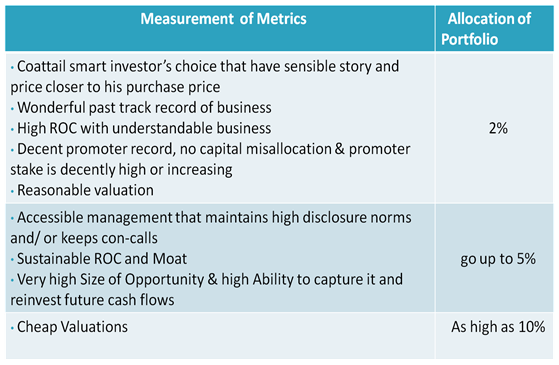
As discussed earlier, we now follow a more concentrated approach, based on ‘Ranking of Business Model’ framework –
- Starting with 5% and up to 10%, for the businesses that satisfy the essentials criteria but have very few desirable’s criteria.
- In businesses which have more number of desirables allocation, it could range from 10 to 20%.
SN: What’s your advice to someone wanting to get into value investing? What are the pitfalls he/she must be aware of?
AK: Charlie Munger says, “In our way of thinking, all intelligent investment is value investment.”
So, my advice would be to learn from the investors who have committed the mistakes. Learning vicariously is important, learning from one’s own experience costs a lot of time and money. I would advise anyone wanting to get into value investing to make sure he has the following three elements –
- Time – One must have at least few hours a week to keep track of news items regarding their company and sector and keep a track of results and study for new ideas.
- Interest – One should enjoy reading on new businesses. One who wants to be a value investor need to be in love with the profession and curious enough to learn the dynamics of businesses.
- Temperament – Stocks are volatile and one should have the stomach to see fall in the portfolio value in the short run.
Regarding pitfalls, as Buffett says, “Investing is simple but not easy.”
Big money is in buying and holding great businesses but owning such businesses will produce gut-wrenching roller coaster rides which the investor has to bear. You can’t avoid those rides by jumping out and trying to get back in and attempts to do so are likely to be unsuccessful. So, the best strategy is to stay put and bear it. Also, an investor must tie with the right management by taking a good check for the corporate governance issues discussed earlier; otherwise he can lose his shirt.
To read more on roller coaster investing, please refer to material from Prof. Bakshi and Ian Cassel.
SN: Which are some the books on investing, behaviour, and multidisciplinary thinking that have inspired you the most over the years? If you were to give away all your books but one, which one would it be and why?
AK: I have books that I would always keep with me as a treasure trove of wisdom, but the one book that I would keep with me will be The Little Book that Builds Wealth by Pat Dorsey. It closely resonates with our investment philosophy. This book is an engaging and fascinating read on moats. Pat Dorsey beautifully captures why some companies are so successful with the help of moats. The case studies are presented in such a way that one can actually relate with the advantages in a better way.
SN: Who are some of the people – inside or outside the value investing circles – who have inspired you the most over the years, and why?
AK: I am blessed to have many role models in life, to mention a few I am inspired from, the first being my father; he has always been my inspiration from the beginning. It’s because of him that I am able to understand businesses. He helped me to align both my interest in investing and business. Initially, I was on the way to become a full time investor, but learnings from my father made me understand the importance of balance between the two. Like Buffett says, “I am a better investor because I am a businessman and a better businessman because I am an investor.”
Secondly, I can’t emphasize enough the teaching/inspiration/guidance given by Prof. Sanjay Bakshi. We are all indebted to him for all the efforts he makes to reach out to investor community and share his knowledge. One can learn from him via his Twitter, blog, YouTube videos, or by attending his course at MDI.
SN: A hypothetical question: Let’s say that you knew you were going to lose all your memory the next morning? Briefly, what would you write in a letter to yourself, so that you could begin relearning everything starting the next day?
AK: Here I would like to quote Richard Feynman who said if you want to learn concepts deeply you must either write it down or explain it to someone who is unfamiliar with the subject. Referring to the context, we already have a process in place where we write down our own thought process and give presentations about it.
Repetition is key when we talk about writing, doing it regularly will generate a subconscious pattern that will allow you to understand any information perfectly well.
There is an instance I can recall from the iconic film Harry Potter, wherein Dumbledore describes how he used to bring clarity in his thought process. He said, “I use the Pensieve. One simply siphons the excess thoughts from one’s mind, pours them into basin, and examines at one’s leisure. It becomes easier to spot patterns and links, you understand, when they are in this form.”
So to answer the question, I would write a memoir wherein I would highlight my experiences and learnings through my journey as an entrepreneur, social worker and as an investor, along with that I would share links to key articles, blogs, etc. that influenced my thinking and enabled me to structure my thought process in a better way to read the next day and reflect on.
SN: What other things do you do apart from investing? If you were not an investor, what other work(s) would have been occupied with?
AK: Apart from managing family office funds, I am involved in business operations of Perfect Group.
One of the major objectives of our family is to give back to the society and contribute towards social causes. And to accomplish the same, our Group is actively involved with various social projects, to name a few –
- Under Bhaorao Deoras Sewa Nyas we are managing two projects –
- First project is feeding 2,000 people everyday free of cost, since 2017 at AIIMS Hospital, Safdarjung Hospital and Ram Manohar Lohia Hospital.
- Second project is managing a 300 bed facility at AIIMS Power Grid Vishram Sadan (AIIMS Trauma Centre Complex) for patients and their attendants.
- Under the aegis of Marwari Yuva Manch, South Delhi, we are actively involved in managing a hostel for outstation students for last 2 decades.
To answer the second part, if I was not an investor, I would still have been running some business as I am really passionate about entrepreneurship.
SN: Wonderful! Thanks Ashish for sharing your insights!
AK: Thanks Vishal.[/show_to] [hide_from accesslevel=’almanack-all’]
- Spotlight: Big ideas from Value Investing and why applying them in your investment decision making will be a great deal
- InvestorInsights: Interviews with experienced value investors, learners, and deep thinkers
- StockTalk: Thorough analysis of business models of companies (without any recommendations)
- Behaviouronomics: Deep analysis of human behaviour and how it impacts investment decision making
- BookWorm: Reviews of the best books on Value Investing and related subjects
- Free Course – Financial Statement Analysis for Smart People (otherwise priced at Rs 5,900)
- Archives: Instant access to our huge archive from the past three years