 The speaker had a charisma. He was smooth, articulate and delivered a very entertaining speech. The audience were spell bound while he was speaking. A perfect ten on ten.
Here’s the rub. When the audience were surveyed about how much they remembered from our star speaker’s speech, most of them couldn’t recall much. All they remembered that the guy was good.
What a waste of time and effort for both speaker and audience, unless it was a stand-up comedy show where the audience just wanted pure entertainment and then forget everything the next day.
In today’s knowledge economy, what’s more important than ideas? It’s an ability to execute those ideas. But there is another critical piece of puzzle, especially when you are working with a team, which is how sticky your idea is in other’s minds.
“Sticky” is a metaphor to emphasize that your ideas are understood and remembered, and have a lasting impact. A sticky idea changes your audience’s opinions and behaviour. Your ability to add value or bring any meaningful change is determined by your ability to make your ideas stick.
<!–more–>[show_to accesslevel=’almanack-all’]
It would help if you first think about the urban legend which has been floating around on the internet, first in emails now on WhatsApp, about how somebody got infected with HIV by a needle protruding out from a seat in a movie theatre in Chennai. And there are many such stories which keep coming back to you as a forwarded message from a friend.
My favourite was when someone figured out a way to open his car lock by asking his wife to point the remote locking key to her phone. Believe me, no matter how stupid it sounded, I couldn’t resist trying it once, only to realize that it indeed was a nonsense.
In spite of being false, for some strange reason, these urban legends and conspiracy theories are naturally sticky. They are stubbornly persistent in our memories.
In fact, perhaps the oldest class of naturally sticky ideas is a proverb – a nugget of wisdom that often endures over centuries and across cultures. “A bird in hand is better than two in the bush” has been found in texts dating back to thousands of years. Many similar proverbs have survived through ages and are still in use to convey ideas very effectively and succinctly. Proverbs are something which stick through millennia.
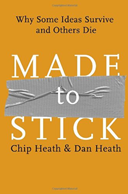
Some ideas are inherently interesting and some aren’t. Are ideas born interesting? In their book, Made to Stick, Chip and Dan Heath have tried to answer this question.
In an attempt to explore the anatomy of the stickiness factor, Heath brothers have distilled out six principles which make an idea stick.
1. Simplicity
2. Unexpectedness
3. Concreteness
4. Credibility
5. Emotions
6. Stories
These six principles will help you in tailoring ideas in a way that makes them more creative and more effective with your audience. They act like a checklist that you need to run through against your idea.
But knowing about these principles doesn’t necessarily make our job, how to make an idea stick, easy. It requires us to first identify the biggest hurdle which kills the stickiness of an idea.
For me the most interesting insight from the book wasn’t about these six principles. It was about…
The Curse of Knowledge
Heath brothers write …
We claim that using these principles is easy…so why aren’t we deluged with brilliantly designed sticky ideas? Why is our life filled with more process memos than proverbs?
Sadly, there is a villain in our story. The villain is a natural psychological tendency that consistently confounds our ability to create ideas using these principles. It’s called the Curse of Knowledge.
Curse of Knowledge is – once we know something, we find it hard to imagine what it was like not to know it. We had written about Curse of Knowledge in Behaviouronomics section of August VIA issue.
The Listeners and Tappers Experiment described in the book was an eye opener and a fascinating way of illustrating the curse of knowledge.
The curse of knowledge is a cognitive bias according to which better-informed people find it extremely difficult to think about problems from the perspective of lesser-informed people. In other words, the more knowledgeable you became about a subject, the more unnatural it became for you to communicate that idea in a simple and clear way. In short, your knowledge itself became a barrier to its own propagation.
Once you understand the paradox of curse of knowledge, learning about the six principles will make a lot more sense. Let’s look at some of these six principles.
Simplicity
It’s hard to make ideas stick in a noisy, unpredictable, chaotic environment. If we’re to succeed, the first step is this: Be simple. Not simple in terms of “dumbing down” or sound bites.” You don’t have to speak in monosyllables to be simple. What we mean by “simple is finding the core of the idea.
Finding the core doesn’t just mean removing the superfluous and tangential elements. It means weeding out even those parts which are important but not the most important. Chip and Dan “walk the walk”. They write…
In fact, we’ll follow our own advice and strip this book down to its core. Here it is: There are two steps in making your ideas sticky – Step 1 is to find the core and Step 2 is to translate the core using the SUCCESs checklist [acronym for the six principles]
Southwest Airlines example in the book is a fascinating story of how the simplicity of an idea can turn the decision making process fast and efficient for every employee of a large organization.
Historically, running an airlines business has been a losing proposition. The odds are stacked against you and a very small percentage of airline companies have make any money in the business. But Southwest Airlines has been consistently profitable for more than thirty years. How so? The authors write –
…perhaps the single greatest factor in the company’s success is its dogged focus on reducing costs. Every airline would like to reduce costs, but Southwest has been doing it for decades. For this effort to succeed, the company must coordinate thousands of employees, ranging from marketers to baggage handlers.
Herb Kelleher’s [the longest-serving CEO of Southwest] communication to his organization is “We are THE low-fare airline.” It’s a simple idea which has proved extremely useful for guiding the actions and day to day decision making process for Southwest’s employees for more than thirty years.
Should you serve free peanuts to the passengers? To answer that, go back to the basic ethos – does it help Southwest in its quest to remain “THE low-fare airline.” A well-thought-out simple idea can be amazingly powerful in shaping behaviour.
So what kills the simplicity of an idea? It’s called burying the lead. It’s a jargon from journalism. You bury the lead when the you let the most important element of the story slip too far down in the story structure.
Don’t start with something interesting but irrelevant in hopes of entertaining the audience. Instead, work to make the core message itself more interesting.
So how do you make your idea simple? Make it compact first. Human attention and working memory has a limited bandwidth.
“We know that sentences are better than paragraphs. Two bullet points are better than five. Easy words are better than hard words…The more we reduce the amount of information in an idea, the stickier it will be.
Proverbs are the holy grail of simplicity. They substitute something easy to think about for something difficult. The proverb “A bird in hand is worth two in the bush” gives us a tangible, easily processed statement that we can use for guidance in complex, emotionally fraught situations. Coming up with a short compact phrase is easy. Anybody can do it. On the other hand, coming up with a profound compact phrase is incredibly difficult…[But] finding the core and expressing it in the form of a compact idea can be enduring powerful.”
Stories
Millions of year of evolution has wired the human mind in such a way that it finds it easier to remember a message in form of a story. Before the invention of written scripts, storytelling was the only way to propagate the important knowledge between generations.
Stories are effective teaching tools. They show how context can mislead people to make the wrong decisions. Stories illustrate causal relationships that people had not recognized before and highlight unexpected, resourceful ways in which people have solved problems.
When a message is packaged in form of a story, it makes people act. The audience listening to a story isn’t passive. As the story unfolds, the human brain simulates it, fills the finer details, completes the missing pieces with its own assumptions. It’s an engaging experience.
When we read books, we have the sensation of being drawn into the author’s world. When friends tell us stories, we instinctively empathize. When we watch movies, we identify with the protagonists…right kind of story is, effectively, a simulation…This is the role that stories play—putting knowledge into a framework that is more lifelike, more true to our day-to-day existence.
The hard part about using a story is creating it. But you don’t have reinvent the wheel.
The Chicken Soup series of books are a publishing phenomenon. They have sold more than four million copies worldwide. What’s special about those books? They are collection of inspirational stories. Authors didn’t write those stories, but they merely collected those stories which uplift, motivate and energize.
Therefore, to exploit the principle of stories, you don’t need to be the original author. The goal is to learn the ‘Art of Spotting’ the right story that has the potential. There are three types of plots where stories can be categorized.
First is the Challenge Plot where the protagonist overcomes a formidable challenge and succeeds. Typical examples are – rags to riches stories, underdog stories etc. Challenge plot underscores the importance of perseverance and courage.
The Connection Plot is about our relationships with other people. They make us want to help others, be more tolerant of others, work with other, love others.
The third is the Creativity Plot. Stories of these types make us want to do something different, to be creative, to experiment with new approaches.
Stories have the amazing dual power to simulate and to inspire. And most of the time we don’t even have to use much creativity to harness these powers—we just need to be ready to spot the good ones that life generates every day.
Unsticking an Idea
So how do you unstick an idea? In fact, why would you want to unstick an idea?
If there is a sticky rumour spreading all over about you or your company, you surely want to unstick or erase that false idea from people’s minds.
Unfortunately, you can’t. Sticky ideas stick. However, what you can do is fight the sticky idea with a stickier one. As the authors write –
For decades, McDonald’s fought rumors that it used earthworms as filler in its burgers. At first, the company tried to unstick the idea. In 1978, McDonald’s officials had denounced the rumors as “completely unfounded and unsubstantiated.” Guess which idea was stickier: “earthworms in your meat patties” or “unfounded and unsubstantiated”?
By 1992, Ray Kroc, McDonald’s most famous CEO, had come up with a better approach. He said, “We couldn’t afford to grind worms into meat. Hamburger costs a dollar and a half a pound, and night crawlers cost six dollars!” That’s nice; Kroc is fighting sticky with sticky. He might even have gone a step further and made a joke about it: “If someone ever tries to sell you a WormBurger, you should worry about them secretly filling it with beef.”
Conclusion
In Made to Stick, Chip and Dan Heath have established what it is that determines whether particular ideas or stories stick in our minds or not. What makes the book an entertaining read is that it’s packed full of fascinating case histories and thought-provoking anecdotes.
As I have been saying in all my previous BookWorm posts – the goal is not to spoon feed you with the summary of the books. The authors of these amazing books have spent thousands of hours researching and brainstorming over the ideas. Reading a book review, containing couple of hundred words, can never be a replacement for the book itself.
If the book review doesn’t sound interesting to you, perhaps it’s my inability to communicate the awesomeness of the book.
The books that we select for BookWorm aren’t chosen randomly. These are the books that have appeared in the must-read list of many business leaders, investors, thinkers and authors.
Chances are that my untrained eyes have missed many other wonderful insights in the book which you will be able to spot easily. So not reading the book would be a mistake.
The goal here is to prime you with few insights from the text so that you get a copy for yourself and read it, re-read it, highlight and mark the text and make your own notes.
Go, transform your ideas and make them stick.
[/show_to] [hide_from accesslevel=’almanack-all’]- Spotlight: Big ideas from Value Investing and why applying them in your investment decision making will be a great deal
- InvestorInsights: Interviews with experienced value investors, learners, and deep thinkers
- StockTalk: Thorough analysis of business models of companies (without any recommendations)
- Behaviouronomics: Deep analysis of human behaviour and how it impacts investment decision making
- BookWorm: Reviews of the best books on Value Investing and related subjects
- Free Course – Financial Statement Analysis for Smart People (otherwise priced at Rs 5,900)
- Archives: Instant access to our huge archive from the past three years